Dear faithful readers, each month I share anecdotes, observations, remembrances, or adventures that try to live up to the title of my column. While I’ve only scratched the surface of the possibilities, this month I have an extra special inspiration to share.
During my now 45 years of performing as a professional pianist, vocalist, and entertainer, about the only thing that excites me as much as encountering young new talent dedicated to the music of the 1890s-1930s that I hold so dear is keeping in contact with—and continually learning from—the people who were engaged in their ragtime-trad jazz-swing activities (whether as players, writers, attendees, or all three) long before I even saw the light of day. As I age, these folks are becoming harder to find. I’ve several dozen to choose from, but two recent encounters are particularly timely so I’ll save the others for future entries.
This Guy Needs No Introduction

Tex Wyndham has been a long-time friend and a terrific champion of what began to be referred to in the 1990s as OKOM (Our Kind Of Music). Never making a living as a full-time musician, he chose instead to research and learn as much as he could about Ragtime and Traditional (or, if you prefer, Classic, Early, Dixieland) Jazz, playing both on the piano and latter on the cornet while maintaining a career at DuPont. His most lasting legacies include “Texas Shout,” his series of articles for The American Rag (that are available in the online version of its successor, our one and only Syncopated Times), his festival band “The Rent Party Revellers” (as well as the recordings that band made), with sidemen comprised entirely of leaders of other bands, and his long-running musical-history course on the subjects of Ragtime, Tin Pan Alley, Jazz, and the Blues for Road Scholar offered several times a year on Jekyll Island, Georgia—it’s his course that Anne and I inherited upon his retiring after 23 years. [RS#8009 for anyone interested!!]
I had the pleasure of sitting in the piano chair for a couple of festivals with RPR in the 1990s, having the opportunity to play with, among others, the awesome reed-pairing of Ray Heitger and Noel Kaletsky. Tex filled in for me many times in Mystic, CT, on Friday and Saturday evenings at the Seamen’s Inn as part of the trio “Don’t Shoot” when I was on tour: a fact that shows how much he loves to play, as Mystic, CT, is four-and-a-half hours one way from Wilmington, DE, and that’s only if the world’s largest parking lot—I-95—is by some miracle unclogged. Our friendship goes back over thirty years.
So I always delight when he emails me about either of my monthly columns. He’s just as quick with praise as he is with critique, and with stories as he is with corrections, and I love whatever he shares. Everything with Tex is always so thoughtful and well-thought-out.

His most recent missive to me concerned my column about the hazards of playing tunes with unusual chord changes (TST, June 2026). This is what he shared:
Your current article reminded me of an incident which you might find amusing.
Decades ago, I was booked to play cornet with and lead a pickup Dixieland combo in a parade. When I reached the venue and started to assemble the sidemen, it turned out that the tubaist was under the impression that we would be a reading band. The only Dixieland tunes he could play without the music were “When The Saints Go Marching In” and “Bill Bailey, Won’t You Please Come Home?”.
We could have gotten through the parade on two tunes because we’d be walking along—no one on the sidelines would hear us for more than a tune or two. However, I thought it would be boring for the musicians to play two tunes over and over. Also, I wanted to save “Saints” for the last tune in case we wound up at a reviewing stand.
So, as we started off, I began going down the list of “Bill Bailey” tunes—“Washington & Lee Swing,” “Over The Waves,” “Bourbon Street Parade,” “The Dummy Song,” etc., etc. We only played pop tunes—no excerpts from jazz standards. Moreover, we were limited to tunes that had exactly the “Bill Bailey” chord pattern—no little quirks (most often they come at bar 25).

Still, we managed to get through the entire parade without repeating a tune, swinging into “Saints” as we made the last turn. The trombonist playing that day eventually became the trombonist in my Red Lion Jazz Band. He still delights in telling this story to any new sideman who comes along.
Keep those stories and observations coming, Tex, and as you always sign off on a phone call, letter, or email, “Keep Swinging!”
The Man Who Revealed Scott Joplin to the World
Ed Berlin writes occasionally for TST. He’s not a performer, although his musical background greatly informs his writing on ragtime. It was from him that I first learned that ragtime songs with verses and a chorus were often much more popular during 1896-1917 than were multi-strained instrumental compositions, in part because the relative ease with which performers could learn them (in contrast with difficult piano pieces) helped spread them faster. It was he who wrote King of Ragtime: Scott Joplin and his Era, the definitive biography of Ragtime composer Scott Joplin, published by Oxford University Press in 1994. It was also he who then kept tirelessly researching, uncovering so many new facts about Joplin that Oxford published a second edition in 2016, the year Ed turned 80!

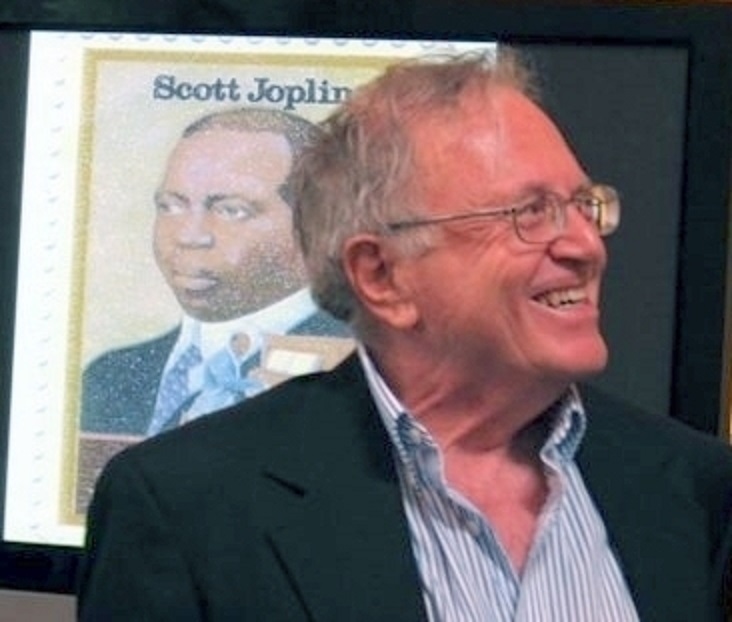
(courtesy www.edwardaberlin.com)
Writer, lecturer, researcher, and historian, Ed Berlin is a living legend. I’m also proud to call him a friend. Whenever he was at a ragtime festival where Anne and I were performing or I was giving a concert in the East Coast Tri-State area (NJ, NY, CT), he and his wife Andree would make an attempt to attend. For years Ed sponsored a concert at Scott Joplin’s gravesite in St. Michael’s Cemetery in Queens, NY. One of my biggest regrets is that I never played at that annual event; although Ed repeatedly tried to engage me to perform, sadly I was always booked somewhere else.
On June 26, Ed celebrated his 90th birthday. His family reached out to those of his close friends and associates too far away to be directly involved in the festivities, requesting a greeting, story, or photo to share at his party. Anne and I thought we might try to do better than that. So I wrote lyrics honoring Ed to the first two sections of Joplin’s immortal rag “The Entertainer” and Anne and I sang them on a video to send him. Here they are:
Anne [to the A strain]: Now, they say it’s your birthday, Ed

And we will hope it won’t go to your head,
That so many people love you,
Just for all that you are and what you do!
Well you told us about old Scott
Jeff: [spoken interjection] A LOT!
Anne: In a great bio that read like a plot
Both: You’ve shared so much with us
And, Ed, your age is a plus
So now we wish you five dozen years more!
Anne [to the B strain]: You always shared your thoughts
And [indicating me] often he was caught
Jeff: With dates and people, please, names that I got wrong
Anne: You were so gracious when
Correcting him and then
You’d smile and listen to us rag a song
Oh Ed, you cannot know
Your friendship goes to show
Jeff: That once a while everything just comes out right
Both: We hope to see you, under the sun or the moon
So Happy Birthday, Ed, and Good Night!
I usually wouldn’t have shared a personal greeting like this, except Anne and I received this lovely response from Ed a couple days after his party:
Jeff & Anne,
Many, many thanks for your incredible birthday greeting; I hope you’ll publish that great lyric.
While I was grateful for his appreciation and enthusiasm, really it would only work for someone named Ed who’d written a book about someone else named Scott, and that rather narrowed down the prospects. So I decided to print it here. Ed, now I can say it’s been published!!
♫ ♫ ♫ ♫ ♫
Through my career, I’ve been blessed to have encounters, and often subsequent friendships, with legendary figures of the music I love. Sadly, when I was thirteen I missed by a matter of seconds shaking Eubie Blake’s hand at a post-concert meet-and-greet, but the list of past greats I knew well and drew inspiration from is formidable: Max Morath, Trebor Tichenor, Dave Jasen, Mike Montgomery, Johnny Maddox, Bob Wilber, Bucky Pizzarelli, and Bill Allred are but a few. Still with us are Terry Waldo (a mere 81 years of age), Ed Polcer (he’s 89 and still playing weekly…and NOT weakly) and Dick Hyman (at this writing 99 years old!). As are, I am so happy to say, Ed Berlin (again, 90 years old as of June 26) and Tex Wyndham (who turned 89 on June 30). My greatest wish is that if I am granted such a long, illustrious life I will be able to pass the same friendship and wisdom to younger musicians the people listed above (and so many more) shared with me.
I’ll conclude with another great sign-off, though slightly different from Tex’s favored one. I ended my first column under this title (TST, July 2021) with the closing another legend I was honored to call friend and mentor used, and as I enter my fifth year writing this column it seems a good time to share it again. As the great pianist Ralph Sutton always reminded us: “Keep Breathing!”

Jeff Barnhart is an internationally renowned pianist, vocalist, arranger, bandleader, recording artist, ASCAP composer, educator and entertainer. Visit him online atwww.jeffbarnhart.com. Email: Mysticrag@aol.com