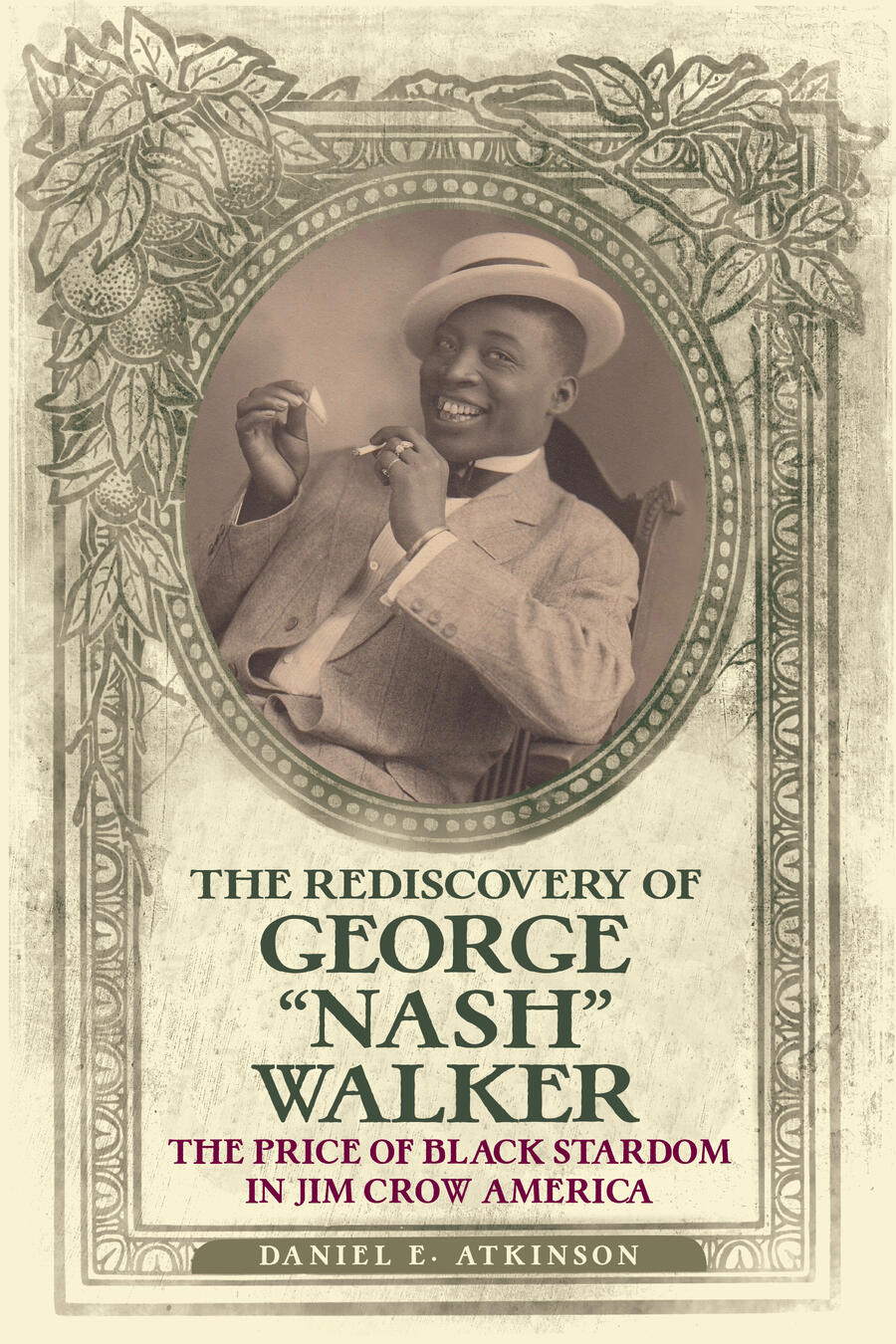
 Between about 1890-1910 there was a lively, successful Black theatrical-vaudeville-minstrelsy scene, centered in New York, but active throughout the country. Author Daniel E. Atkinson tells that story through the life and career of George Walker, a name which if it’s known, is likely because of his close association with Bert Williams, whose fame ultimately eclipsed that of Walker.
Walker and Williams were among a talented cohort which included Billy Kersand, Jesse Shipp, Robert Cole, James Weldon Johnson, Ernest Hogan, Black Patti, Will Marion Cook, Paul Dunbar, Ada Overton, Cecil Mack, and a large supporting cast of Black composers, musicians, dancers, and music publishers. Atkinson makes a strong case that Walker’s talent, persistence and business acumen was a key element in the success of this cohort and was largely responsible for Walker and Williams rising to the top of the show business heap. Onstage, Walker and Williams were equals, but there’s no question that Walker was the man who took charge of the duo’s career.

The oppressiveness of the Jim Crow situation is never far from the center of Walker’s story. Audiences in every city were segregated, with Blacks relegated to inferior seating. Producers did not believe (or want to believe) in the financial viability of shows like Octaroons, Clorindy, or Origin of the Cakewalk, In Dahomey, and others, relegating them to smaller venues and thereby ensuring they would not be as successful as white acts. Romance has always been one of the key elements of successful musical theatre, but no Black show of that era ever had a romance, as it was simply assumed that it would not be acceptable to audiences.
The tightrope that Walker understood he had to walk was between taking into consideration these strictures while trying to forward an agenda of Black talent and competence. He had ambitions for himself and for his race and pushed against the constraints of Jim Crow as much as possible which. Author Atkinson says that as long Walker and Williams could generate money, the whites in power wouldn’t mind the “indiscretion of their ambition.”
Neither man worked in blackface until Williams, who was Bahamian, was told in Detroit that vaudeville audiences wouldn’t accept him without it. Williams “blacked up” and they reversed roles. Walker became the straight man and Williams the comic figure and they began to have tremendous success. Williams said that “It was not until I was able to see myself as another person that my sense of humor developed.” He wore blackface for the rest of his career.

One of the keys to the success of Walker and Williams was their proficiency at the Cakewalk, a dance which illustrates the “double consciousness” referred to often by the author. That is, the roots of the dance were subversive; a way of enslaved, or manumitted people to satirize white culture. When viewed by whites, however, it was seen as a novelty or “eccentric” dance and was taken up by all classes of whites, including the elite. In fact, Walker’s wife Aida Overton, a noted practitioner, was hired to privately teach the dance to white women who were members of the elite “Four Hundred.” William K. Vanderbilt himself was known to perform the Cakewalk at society functions, something that Walker tried to leverage for publicity by publicly challenging Vanderbilt to a Cakewalk contest. Vanderbilt took a pass. As an aside, Walker says the music for a cakewalk “must have the right swing,” which the author says may be the first use of this word in a musical context in print.
The author tells a rich history, but there are elements of the story which seem incomplete or contradictory. For example, we are told at various points that Williams and Walker are the highest paid Black act—sometimes thousands of dollars a week—and then told they are broke or stranded outside of New York. This is possible, of course, but in describing their rise to fame, the author never gives us a clear sense of the relationship between the large amounts of money they earn and what they spend on clothing, housing, gambling, and other recreations. Atkinson describes Walker’s elaborate funeral having a “funeral train that was one of the longest ever seen in Lawrence” and yet he also says that Walker died “…abandoned, flat broke, and completely dependent on others” and that his grave remained unmarked for 10 years.
It’s somewhat jarring that there’s no mention of a decline in Walker’s health until his “condition” is mentioned during a 1908 photo session. By that point, someone has to steady his left leg and he is “slumped in his chair with a vacant look on his face.” (Syphilis hit the Black theatre community hard, with Walker, Ernest Hogan, and possibly Bob Cole and Walker’s wife Aida Overton succumbing to the disease). Yet, while Walker’s health has seriously deteriorated, the author says he made weekly visits from his home in Lawrence Kansas to Manhattan to “generate income through the Williams and Walker brand.”
The key subtext through the book is Walker’s motivation of trying to forward his race through his career. In the broader scope of the 1910s, we see that little attention was paid to Black artists by the recording industry. Atkinson says that there was a boycott of Black talent in the 1912-1913 vaudeville circuit and cites a story told by Eubie Blake: “According to Blake, it was retaliation for Jack Johnson’s marriage to a white woman…” Another large Black theatrical production like In Dahomey or Clorindy wasn’t undertaken again until Blake and Sissle’s Shuffle Along in 1921.
Atkinson ascribes much of the blame for this drought to Bert Williams’ decision to sign with the Ziegfeld Follies in 1910. First of all, Atkinson is very harsh in his judgment about Williams’ role in the dissolution of the act, saying “If Bert was not actively responsible for the destruction of the company, he was far worse, a coward who seemingly did nothing to stop it.” Soon after, the author also says “Management (unclear to whom he is referring) ensured that the company was in a shambles.”

Secondly, Atkinson believes that Williams’ decision to sign on as the sole black performer in the Ziegfeld Follies in 1910 was an abandonment of his race, saying: “As the beta test for assimilation, disguised as integration, Bert’s acquiescence ensured the destruction of a hard-won and established Black institution to enrich a white one, thus signaling the end of an unprecedented era of achievement.” In other words, Atkinson believes the assimilation represented by Bert Williams came at the cost of an autonomous Black theatrical infrastructure.
No matter how you feel about Atkinson’s judgments and aside from the caveats I’ve mentioned, I respect the work the author has done here. Anyone trying to delineate 19th century to early 20th century Black history in American has major challenges to overcome and Atkinson uses a large number of primary and secondary sources to get the job done. In addition to the main body of text, Atkinson has compiled a complete list of Walker and Williams performances, including their fellow cast members. There are also postscripts describing the later careers of the major players and institutions, including the Frogs, an Afro-American fraternal organization of thespians, businessmen, and musicians which Walker helped create.
The Rediscovery of George “Nash” Walker
The Price of Black Stardom in Jim Crow America
by Daniel E. Atkinson
State University of New York; sunypress.edu
434 pages, September 2025
Hardcover: 9798855803167, $145
Paperback: ISBN 9798855803181, $29.95

Steve Provizer is a brass player, arranger and writer. He has written about jazz for a number of print and online publications and has blogged for a number of years at: brilliantcornersabostonjazzblog.blogspot.com. He is also a proud member of the Screen Actors Guild.