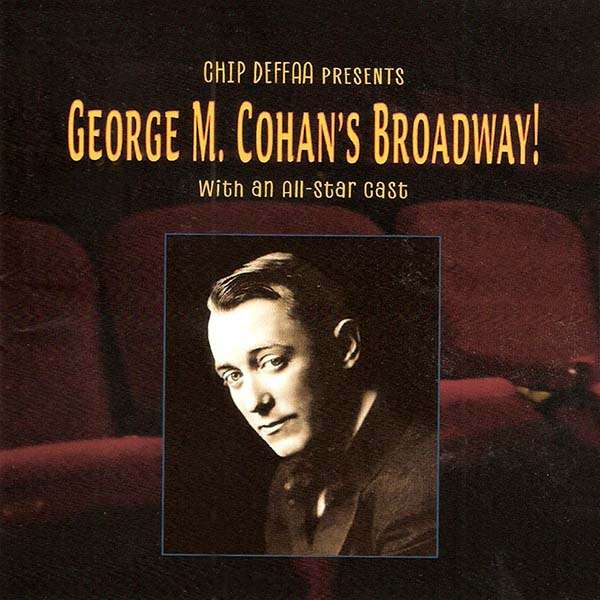
 Theatrical polymath Chip Deffaa has been studying and promoting the works of George M. Cohan for over six decades, beginning when Chip was just a child and saw the movie Yankee Doodle Dandy. Cohan lived from 1878 to 1942 and worked for most of those years, first in a family act with his parents and sister, and then on his own, writing and producing and acting in shows that not only defined the sound of Broadway but helped to wrench the center of musical theater from Europe to New York.
As Deffaa notes, “He wrote some 50 Broadway plays, of all sorts—comedies, dramas, musicals. He produced or co-produced some 80 Broadway shows. At his peak, he and his longtime partner Sam Harris owned or controlled seven theaters. People called Cohan ‘the man who owns Broadway.’ And he delighted in that title.”

It’s only fitting, then, that much-credited Broadway performer Lee Roy Reams should open Deffaa’s new recorded tribute to Cohan with “Give My Regards to Broadway.” We know the song; we don’t mind hearing it again. But this isn’t that kind of tribute, so there’s no “Yankee Doodle Dandy” or “Grand Old Rag” or “Over There.” This tribute is about the Cohan songs we don’t know, and there’s probably no better qualified an enthusiast than Deffaa.
As he reminds you in one of the spoken introductions that dot the program, Deffaa wrote the much-performed solo show George M. Cohan Tonight, and he wrote it for the versatile Jon Peterson, whom you’ll hear near the start of this disc singing “All Aboard for Broadway,” and if you need more evidence for Peterson’s Broadway cred, he adds some tap dancing. Which is a nice touch. Without the visual element of a good tap routine, you’re more easily able to appreciate that it shows the skill of a good drummer.
Deffaa offers spoken introductions to many of the songs and performers on this disc, and had the rare ability to leave us tracks that don’t pall after a listening or two. I’ve been through this recording a few times and still enjoy hearing what he had to say.

Starting us off is a sequence of Broadway-related songs. “The Broadway Girl,” has never before been recorded, and in this case the music is credited to Noble McDonald. But the lyrics are pure Cohan, even though they were written when he was about 15, in 1894. And they’re emblematic of lyrics of that era. We start with a verse in 2/4 that features the lines:
Just cast your optics on me, I’m a girl of great renown,
A girl who’s always up and never down,
A girl who wins the swellest gents in town.
And then we’re into 6/8 for the refrain:

For I’m a Broadway Girl, you’ll always find me happy,
A Broadway Girl, I always have a chappie.
Never get home in the morning till nine,

Beer? No! Nothing but wine.
The hit of the city is dear little Kitty.
And it’s deftly sung by Dea Julien, who counts the Broadway production of The Kite Runner among her credits. “You Can Have Broadway” is sung by the young performer Alec Deland, and then we hear from an even younger singer, Bella DiBuono, a teenager making her recording debut with the melancholy and moralizing “I Wanted to Come to Broadway.” It’s a trick song, suggesting that the singer has had enough of the Great White Way, until we learn that she plans to return to her “home in Kankikee / (and) bring all my family back to Broadway with me.”

Keith Anderson, a singer who delights in vintage songs, offers “The Man Who Owns Broadway.” Music director Richard Danley plays piano, as he does throughout this recording, and Gavin Rice adds a characteristic banjo accompaniment. We also have a baritone sax obbligato played by Carol Sudhalter, who also performs on a few other tracks; it’s a startling sound, somewhat overpowering, and while I appreciate the ingenuity of adding this instrument, I would debate it necessity.
Deffaa’s scholarship has taken him deep enough into Cohan’s papers to reveal rarely seen and never-before-recorded material such as the complete lyrics to the coyly autobiographical “The Musical Comedy Man,” sung by Deffaa himself. His isn’t a trained musical-theater voice, which is fine with me; I’d rather hear someone who understands the lyrics and knows how to put across a number, and when Deffaa sings “There he goes on his dancing toes / With that famous American stride / Full of musical comedy pride,” you easily believe it.
He and Peterson duet on “The American Ragtime,” and Dea Julien returns with the first complete recording of “Hello Broadway,” which is enough of a flag-waver that those long notes on the second syllable of “Hello” cen get tedious.
We enjoy a welcome contrast in sound as an ensemble comprising Michael Townsend Wright, Dea Julien, Jonathan Gellert, Jesse Gellert, and Deffaa move us a bit north, to New Rochelle, for “Forty-five Minutes from Broadway,” the title song from a Cohan show. I suspect the current inhabitants of that burg would fail to recognize themselves such lyrics as
You tell them old jokes and they laugh till they sicken
There’s giggles and grins here to let;
I told them that one about “Why does a chicken?”
The Rubens are all laughing yet.
Busy nightclub singer Seth Sikes introduces the three-song Irish section of this collection and sings “Nellie Kelly, I Love You,” and then we’re into what Deffaa terms a few of Cohan’s “Class” songs. You know the first one, I’m sure: “Mary’s a Grand Old Name,” sung by Jack Corbin (“I hate to meet a Mary who calls herself Marie.”)
Five more numbers follow, and, along with singers we’ve already met are Josephine Sanges, Jeffrey Sewell, and Santa Claire Hirsch, the last-named joining Anderson on “Where Were You?,” the first-act closer of Cohan’s show “Billie,” from 1928. The song has a flavor of Jerome Kern from his “Rolled into One” years, and Danley even sneaks in quote from “Nola.”
We hear some of Cohan’s earliest work as Deffaa introduces “some of the youngest members of my theatrical family.” This includes a Swedish performer named Misha Bautista, who enthusiastically recites the songwriter’s very first song. The “melody has been lost to the ages,” but the lyrics invented by the precocious four-year-old begin, “Damn it to hell! Damn it to hell!” and continue in exactly the same way.
“The Dancing Master” was written by Cohan’s father, Jerry, and is sung by Jonathan Gellert and Jesse Gellert, complete with tap effects. The “Cohan Curtain Speech” is known to all who have heard Cagney recite it in “Yankee Doodle Dandy;” here, Bautista gives it his all.
A potpourri of songs completes the album. “You Won’t Do Any Business If You Haven’t Got a Band,” is the up-tempo warning given by Jon Peterson, Michael Townsend Wright, and Jed Peterson, while Deffaa and Noah Frieman put the over-rhymed astronomical feature to rest in the amusing “Musical Moon,” including such classic line-enders as “funny moon,” “honeymoon,” and “always gets the money moon.”
Some of the highlights of this sequence include “When Lindy Comes Home,” sung by Mathias, “Let’s You and I Just Say Goodbye,” featuring Nicolas King (a veteran of “Beauty and the Beast” on Broadway, among other shows), and another short so-long number, “T’isn’t Easy to Say Goodbye, Broadway,” effectively handled by Deffaa. (I like the tremolos that Danley adds to the second refrain.)
Deffaa explains that, of the many numbers he had to leave out of the revue George M. Cohan Tonight, he most regretted omitting “I’m a One-Girl Man.” So here is Peterson singing it at last, backed by a vocal ensemble. “Honest and true / there could never be two / I’m a one-girl man,” he boasts, following it with a tap sequence. And how can you not enjoy the awkward confession, “One girl, that’s my racket / one heart needs my jacket.”
Cohan continued writing and performing almost until he died. The penultimate song here is Cohan’s ultimate, “Life Is Like a Musical Comedy,” a bright 2/4 with Deffaa and Mathias in duet.
How did Cagney get that plum role as Cohan in Yankee Doodle Dandy? Seth Sikes explains as he finishes this disc with a reprise of “Give My Regards to Broadway.”
Forty-six tracks crowd this recording, although many of them are short intros and song snippets—but it’s nevertheless a feast. Deffaa is generous about featuring young, little-tried but well-taught singers, and my hope is that these singers will ease away from those lessons and get inside of the lyrics, which are the driving force behind this type of song. An informal feel informs this CD as a whole, but I feel that it’s one rehearsal shy of being a great recording. Nevertheless, Cohan’s work deserves this kind of attention, and I’m glad Deffaa is on hand to provide it.
George M. Cohan’s Broadway is available for listening or download via Spotify and YouTube. To inquire about CD copies, email Garnet Mountain Records at footloose518@aol.com.
George M. Cohan’s Broadway
Various Artists
Produced by Chip Deffaa
Garnet Mountain Records
B.A. Nilsson is a freelance writer and actor who lives in rural New York. His interest in vintage jazz long predates his marriage to a Paul Whiteman relative, and greatly helped in winning her affections.