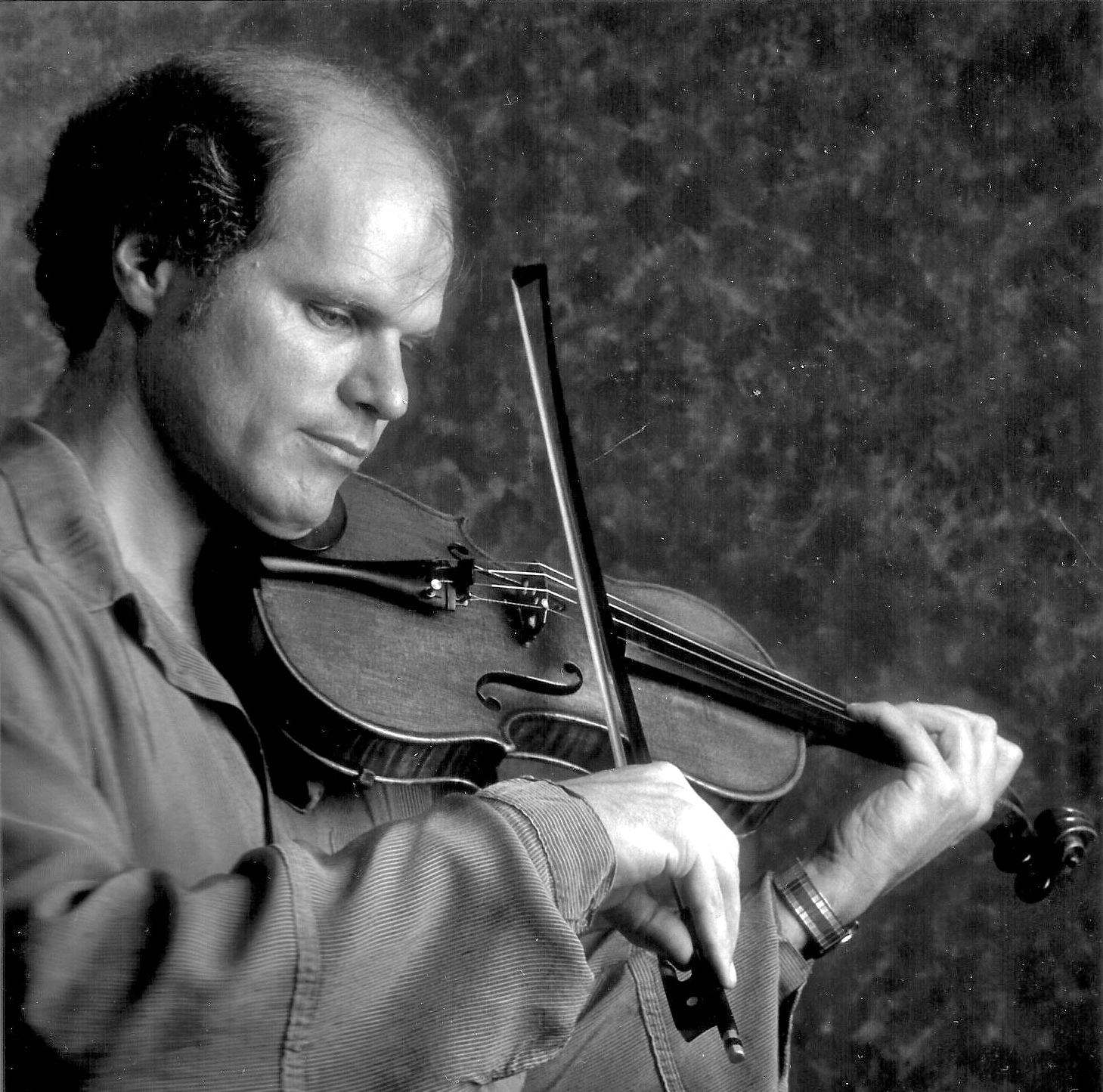
I first met David Reffkin in 1991 at the Scott Joplin Ragtime Festival in Sedalia, Missouri, after he gave a presentation about different personalities he had interviewed on San Francisco radio station KUSF-FM over the years. During the lecture, David would play brief excerpts from recorded interviews. This and subsequent participation in the festival was my introduction to David: a meticulous researcher, concert violinist, recording engineer, teacher, conductor, orchestrator, intrepid interviewer, musical contractor, and possessor of a delightfully deadpan sense of humor.
Davidson: I know that you graduated from the New England Conservatory of Music (NEC) in Boston (majoring in both performance and education), but were you from Boston originally? And were you bitten by the “ragtime bug” before you went to NEC?

Reffkin: I’m one of the few students originally from Warwick, Rhode Island, the birthplace of NEC’s founder, Eben Tourjée. I was aware of ragtime music in high school, but not passionate about it until working on the NECRE “Red Back Book” album, on which I was a recording technician.
Davidson: I know you worked with Gunther Schuller quite a bit because of your connection to the NEC. Can you describe those experiences?
Reffkin: As a young student, his reputation was intimidating, although I had played in the MENC All-Eastern Conference Orchestra in high school, which he conducted. So I was already familiar with him. At school I played in the NEC Symphony Orchestra (which he conducted), in smaller groups coached by him, and worked for him as an audio technician on various projects. So I got to know him on several levels simultaneously. He could be demanding, occasionally impatient, but he always worked on behalf of the composers and their music. We understood his enormous gifts of musicianship and respect for music history. [N.B. David wrote a more in-depth essay to be found at: www.guntherschullersociety.org/copy-of-rediscovery-of-ragtime ]

Davidson: How did you become a recording engineer?
Reffkin: Audio and the science of sound have always been strong interests. In my first month at NEC it happened that they needed a student worker in the Audio Department. It effectively became a full-time job on top of my studies, recording recitals, concerts, and albums, running PA systems, and helping visiting luminaries with their electronic setups (e.g. Robert Moog, Karlheinz Stockhausen).
Davidson: How did you wind up in San Francisco?
Reffkin: After graduation, I taught public school orchestra programs in other parts of the country. After five years, I moved to San Francisco because it had a great reputation for accommodating musicians with odd ideas like directing a ragtime orchestra.
Davidson: And did your becoming a recording engineer lead directly to working in radio?

Reffkin: Not really. I had an idea to do a ragtime program, though familiarity with the equipment helped my credibility. It did lead to my being hired at the station as a technician for maintenance and repair, and in other capacities. The program was “The Ragtime Machine,” a one-hour show which ran weekly without interruption for 30 years. The station was sold at that point.
Davidson: So how did the American Ragtime Ensemble come about? And further, your recording of Judith Lang Zaimont’s works? I think the performing and arranging on that album is excellent [www.classicstoday.com/review/review-14034/ ].
Reffkin: I formed The American Ragtime Ensemble the day after NEC graduation, which was two days after the NECRE’s first public performance following the release of the “Red Back Book” album. I met Judith through a mutual friend, and she asked me to orchestrate and record a couple of her pieces for the album.

Davidson: How did you go about choosing your interview subjects? Or did they sometimes choose you? Who were your most memorable interviewees?
Reffkin: Many of my guest interviews were recorded at the Joplin festival in Sedalia. Most of the others were people passing through San Francisco. Choosing the most memorable is difficult and perhaps unfair to single out. I was fortunate to speak with people who were already quite old, as they had a closer connection to the ragtime era. Given that circumstance, at this point about 35 percent of all my interview guests are now deceased.
Davidson: At one point you recorded a series of interviews with various physicists as well as ragtimers. How did this happen? And is there a major difference between interviewing those in the two disciplines?

Reffkin:I had three radio shows: ragtime, salon (which was musically very open-ended), and a program called “Static Limit.” That was an interview program on the subjects of astrophysics and particle physics, which are deeply interesting to me. My guests were, frankly, among the world’s leading researchers and theorists in those fields, including Nobel Prize winners (and eventual winners). Many physicists have had serious musical experience, including composing. One interesting similarity between physics and music, as pointed out to me by Andreas Albrecht (one of the originators of the inflationary theory of the universe), is that both areas are concerned with making abstract ideas, at least momentarily, concrete.
Davidson: How did the transcriptions of your interviews and other articles you wrote for The Mississippi Rag come about?
Reffkin: The publisher, Leslie Carole Johnson, and I met shortly after the creation of The Mississippi Rag. She asked me to submit stories about ragtime and ragtimers, because most of their contributors were covering jazz. It was a natural progression to transcribe my more substantive radio interviews for publication. I also wrote reviews and commentary. I was eventually promoted to Contributing Editor. Leslie would occasionally thank me for “keeping the ‘rag’ in The Mississippi Rag.”
Davidson: What happened to all those recordings and transcriptions of interviews? Where did they go? What happened to The Mississippi Rag?
Reffkin: “The Ragtime Machine” programs are housed in the Archive of Recorded Sound at Stanford University. They are intended to be available for listening there. The Mississippi Rag archive, as I understand it, is still in storage.
Davidson: What would you say has been your “bread and butter” in the music world?
Reffkin: I am a violinist. Aside from orchestras, chamber music, and soloing, my interests and work have spread to just about any music that can be played on a violin. Part of my work is in contracting—matching players to clients and vice-versa. Another interesting area is orchestration, which involves turning a piano score, for example, into a set of instrumental parts for an ensemble of any size. This I do by hand, not computer, and sometimes by listening to a piano recording when there is no printed part.
Davidson: How did you become connected to the Scott Joplin Ragtime Festival? What led up to this? I know that as a result of your efforts, you were awarded the Scott Joplin International Ragtime Foundation Award in 2006.
Reffkin: I signed up to enter the string contest at the first festival in 1974. Arriving days early, organizer Larry Melton invited me to stay at his home. I was soon recruited onto the work crew. Over the years, in addition to performing, conducting the All-Star Orchestra, and presenting seminar talks, I volunteered for various tasks, became a sort of musician-advisor, and was eventually named Festival Historian. It’s turned out that I’m the only musician who has attended every year.
Davidson: Can you tell me a little about your connection to Donita Fowler, Scott Joplin’s niece?
Reffkin: Having learned that Donita lived near San Francisco, I invited her (and her own niece) to one of my ensemble concerts, and onto “The Ragtime Machine.” I continued to visit her until her death. Until I brought her a few items, her only ragtime possessions had been the Scott Joplin Collected Piano Works and the copy of his Pulitzer Prize.
Davidson: And can you please tell me a little about your connection to Scott Joplin’s “Red Back Book”?
Reffkin: This is a phenomenal tale of bizarre good luck. I invite readers to check out the full story in the Oddities section of my website [davidreffkin.com]. A music store manager received a donated collection with “Rags” in the title. Knowing my interest, she let me have them (free!). Turned out to be nine of the 11 orchestral part-books of Standard High-Class Rags, aka “The Red Backed Book.” Having recorded the NECRE album of that name, eventually performing with that group in later years, and giving talks and writing papers on the subject, I by then had become known as one of the few musicians in the country who had taken a deep interest in this particular collection. I also knew it was an exceedingly rare publication, with a very limited original printing, and only one or two known complete sets extant. It’s beyond astonishing that I would by chance be in that store just as this collection was about to be discarded. Thanks to the goodwill of renowned collector Tony Hagerty, who just happened to have the two missing parts I needed, I was able to reunite all the parts as a complete set.
Davidson: Thank you for taking the time to talk to me. Before we go, I’d like to ask of you the most probing question of my journalistic career …what’s the capital of North Dakota?
Reffkin: If you’d said Rhode Island I could have told you.
Visit David Reffkin online at www.davidreffkin.com.
Matthew de Lacey Davidson is a pianist and composer currently resident in Nova Scotia, Canada. His first CD,Space Shuffle and Other Futuristic Rags(Stomp Off Records), contained the first commercial recordings of the rags of Robin Frost. Hisnew Rivermont 2-CDset,The Graceful Ghost:Contemporary Piano Rags 1960-2021,is available atrivermontrecords.com.A 3-CD set of Matthew’s compositions,Stolen Music: Acoustic and Electronic Works,isavailable through The Sousa Archives and Center for American Music University of Illinois (Champaign/Urbana),sousa@illinois.edu.