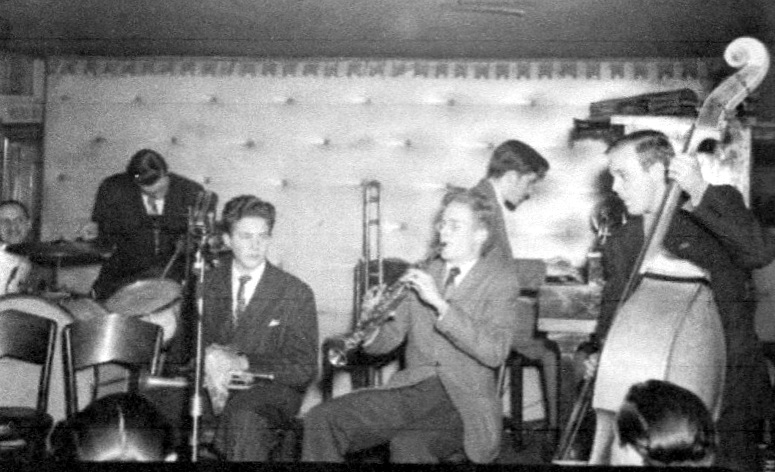
It is very likely that first Commodore 78 this writer ever owned was by Bob Wilber, “Willie The Weeper” and “Mabel’s Dream” on Commodore 583. This recording of February 22, 1947, by the Wildcats from Scarsdale (with Johnny Glasel, trumpet, Dick Wellstood, piano, Charlie Traeger, bass, Dennis Strong, drums) led to a lifetime of admiration for a master of the clarinet and the saxophones. Thanks to his many trips to Europe, I heard him in person many times and these are some of the highlights, plus a few other facts and figures.
♫ ♫ ♫
Queried about a “Really the Blues” concert in New York’s Town Hall on November 9, 1946, Bob Wilber told Bert Whyatt, “The Wildcats [with Ed Hubble, trombone, and Eddie Phyfe on drums] were hired for the concert …. to impersonate the Original Dixieland Jazz Band to open …. I remember it well because the night before we were hired to play a private party at the home of Marion Davies, the Hollywood actress, perhaps more famous for being the mistress of William Randolph Hearst.
“About 4 a.m. who wanders in but Django Reinhardt, with his manager carrying the guitar. He was appearing at Café Society Uptown prior to going on tour with Duke. After standing near the bandstand listening to a few numbers the manager comes up to me and informs me that Django would like to sit in. ‘What would Mr. Reinhardt like to play?’ I query. The manager returns to Django for a whispered conference (in French of course) then informs me that ‘Monsieur Reinhardt’ will play ‘Tea For Two.’ Django unpacks his guitar, sits down and turning to Dick Wellstood, utters two words, ‘Play oompah.’ So off we go! When we finish Django packs his guitar and without a word wanders off into the night with his manager. I’ll never know whether he enjoyed the experience or not!”
♫ ♫ ♫
Bob Wilber’s first visit to the UK was with the Eddie Condon band in early 1957 – Wild Bill Davison, cornet, Cutty Cutshall, trombone, Wilber, clarinet, Gene Schroeder, piano, Eddie Condon, guitar, Leonard Gaskin, bass, and George Wettling, drums.
The band arrived at Heathrow on January 15th, 1957. It then played fourteen cities in England and Scotland, including two dates in London. A midnight show at the Royal Festival Hall on February 4th concluded the tour. The support band was Humphrey Lyttelton’s, except for two occasions. In Newcastle it was Chris Barber’s and in Bradford The Saints Jazz Band. My attendance was at London’s Stoll Theatre on January 27th and I was suitably impressed.

Bruce Turner from the Lyttelton band played clarinet with the Condon group at the concert in Leicester. Bob Wilber overslept!
♫ ♫ ♫
A founder member of the World’s Greatest Jazz Band in 1969, Wilber left after a successful five years to co-lead Soprano Summit with Kenny Davern. For reasons of economy, it was decided that the rhythm section would be guitar, bass and drums, with the bassist and drummer recruited locally. Bucky Pizzarelli being unavailable, the leaders made the wise decision to contact guitarist/vocalist Marty Grosz, who was then working for the US Postal Service.
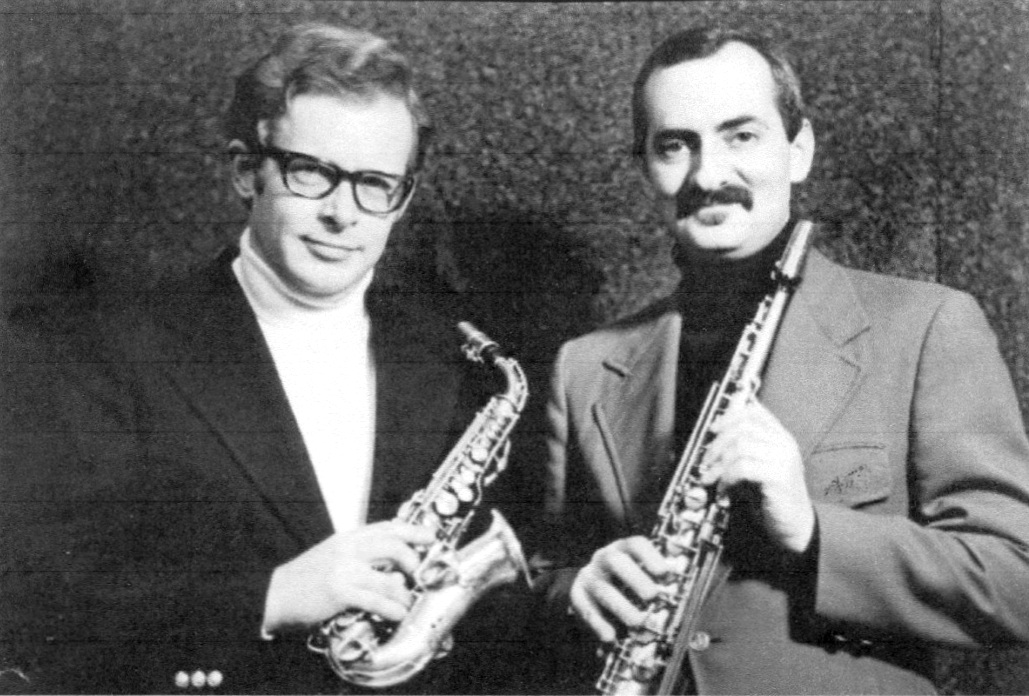
Marty Grosz recalled his reply to Wilber’s telephone call which asked if he wanted to join the proposed Soprano Summit. “Look out the window. That’s me coming up the path.” Another version has him saying, “My bags are packed.”
♫ ♫ ♫
At La Grande Parade Du Jazz in Nice in July 1975, Wilber, Davern and Grosz featured with Soprano Summit, contributing some of the highlights of that festival. In addition, Wilber was featured in Tributes to Sidney Bechet, Johnny Hodges and Louis Armstrong—as well as adding some needed class to the playing of “Shim-Me-Sha-Wabble” and “Make Me A Pallet On The Floor,” when guesting with the rough and ready New Iberia Stompers, led by trombonist Mike Casimir.
At the 1977 Festival Soprano Summit, without Marty Grosz, again appeared, though only twice, with the leaders also guesting in a variety of settings, Wilber being seen with the New York Repertory Orchestra, a Clarinet Marmalade set (Wilber, Davern, Barney Bigard and Eddie Daniels, plus Tony Coe on one number) and with singers Gatemouth Brown and Carrie Smith.

♫ ♫ ♫
At the Red Lion at Hatfield on November 3, 1975, a Ken Lindsay promotion headlined Bob Wilber with the Alex Welsh band, but with Digby Fairweather subbing for Alex on cornet. An enjoyable first set had one number by the band (Roy Williams, trombone, John Barnes, clarinet, alto, baritone, Brian Lemon, piano, Pete Skivington, bass-guitar; Roger Nobes, drums, vibes) and a Williams feature, followed by five songs by Bob Wilber, two with the band and three with the rhythm section.
But after the interval everyone stepped up a gear. The band played Louisiana and, with Wilber on soprano, “I Let A Song Go Out of My Heart.” Then came “Nagasaki” and “Between The Devil and the Deep Blue Sea,” emulating the Benny Goodman Quintet, Nobes on vibes, followed by Wilber clarinet, Barnes, alto, and the rhythm section at the Apex Club, with Sweet Lorraine” and “Running Wild.” Two numbers on clarinet with the full band, “Just A Closer Walk With Thee” and “I Found A New Baby” concluded the session. My notes end with the following: “Two choruses by the ensemble without rhythm backing almost brought the house down. Wilber ended the evening by saying he’d never enjoyed a session more or worked so hard. Allowing for a certain poetic licence, he could have been somewhere near the truth.”
♫ ♫ ♫
The Mississippi Rag for November 1976 carried a news item that Marty Grosz had helped to write the title music for a Sean Connery film, The Next Man. The other musicians named included Bob Wilber, Kenny Davern, and Dick Hyman. When the film was released, the credits showed Michael Kamen as the composer, with Frederic Hand as featured guitarist. However, one of the opening scenes, over which the credits are shown, is of a London street dancer who plays an LP on his portable player which features a band, with bass sax and banjo prominent. This band number lasts barely a minute.

Marty Grosz recalls that his involvement with The Next Man was “the result of a friendship with Bob Lovett, who edited the film. Bob wanted me to listen to the soundtrack. I …. thought the music was rather dull and wasn’t contributing to the plot or the action. What I heard was the “glooey” twang of a highly amplified guitar. Bob, himself a former professional clarinettist, had the idea of using a combo (sort of trad). Whereupon he hired … if memory serves … Bob Wilber, soprano sax, Warren Vache, trumpet, Kenny Davern, bass sax, Eric Kress, violin, Jack Gale, trombone, Dick Hyman, piano, I have forgotten who the drummer was, and myself, acoustic guitar.”
Presumably most of the jazz recorded for the soundtrack was left on the cutting room floor. The movie itself is a very strange one and was a complete critical and financial failure.
♫ ♫ ♫
1976 was a busy year for Wilber and me. There was a “Song of the Tenor” concert on March 18 at the Shaw Theatre in London, with Bud Freeman, Bruce Turner, reeds, and pianist Keith Ingham, plus three Soprano Summit sessions. These had British guitarist Dave Cliff subbing for Marty Grosz. May 3 and October 25 were at The Red Lion in Hatfield, and October 31 was at the Roebuck Hotel just outside London.

♫ ♫ ♫
In the late 1970s Wilber recorded a number of times with the Swedish vibes player, Lars Erstrand. One gig they played together was at the Pizza Express in Soho on February 14, 1980, with Keith Nichols, piano, Dave Green, bass, Alan Jackson, drums, and Pug Horton, vocals.
That same year Ken Lodge was organising monthly sessions at the North East London Polytechnic Hall in Dagenham, Essex, under the banner “Jazz at the Poly”.
On Friday, November 14, 1980, Wilber and Erstrand were featured, this time with Brian Lemon, piano, Len Skeat, bass, Stan Bourke, drums, Pug Horton, vocals, plus guests John McLevy, trumpet, and Tommy Whittle, tenor.
These sessions confirmed how well Wilber and Erstrand worked together.
♫ ♫ ♫
Thanks to a Michael Steinman interview, we have some information about Nick Niles, who held senior positions as a publisher with various sporting magazines and with Changing Times, a personal finance and consumer stories publication. He played piano and had a fondness for jazz, particularly for Ralph Sutton. Many parties for clients were held during the 1980s, five or so featuring Canadian Brass, a classical brass quintet, and others with jazz groups. Between 1981 and 1986 at least nine such staff parties were held in various cities across the country, in New York, Boston, Chicago, Bloomfield Hill, MI., Darien, Conn. and Los Angeles. Private cassettes compiled from nine parties are known, distributed as souvenirs. The two Boston affairs feature Bob Wilber and Ralph Sutton, with Jack Lesburg, bass, and Buzzy Drootin, drums. Wilber is heard on five others, all band numbers, featuring such stalwarts as Yank Lawson, Joe Wilder, Vic Dickenson, Dan Barrett and Buddy Tate.
Another mini-series in which Wilber participated was the Strides of March, at the Hilton Hotel in New Jersey.
♫ ♫ ♫
Wilber formed Bechet Legacy in late 1980, with Glenn Zottola, trumpet, Bob Wilber, clarinet, soprano; Mark Shane, piano, Phil Flanagan, bass, Chuck Riggs or Butch Miles, drums, and either Mike Peters or Chris Flory on guitar and banjo.
Two dates in November 1981, the 23rd in Oldham and a “Jazz at the Poly” gig on the 27th had Peters and Miles, with Len Skeat subbing on bass. A year later, on December 3, 1982, another “Jazz at the Poly,” with the personnel the same and still playing top grade jazz.

Among a number of LPs issued, there are three on Wilber’s own label, Bodeswell. A visual record of the band is Bob Wilber: A Tribute to Sidney Bechet or Bob Wilber: Jazz at the Smithsonian, filmed at the Smithsonian Institution’s Baird Auditorium on November 29, 1981. This DVD, lasting 57 minutes, was released on Shanachie 6324, in their Jazz Masters series.
♫ ♫ ♫
In 1984 Francois Ford Coppola was filming his Prohibition Era movie, The Cotton Club, starring Richard Gere and including his nephew, a young Nicholas Cage, plus an appearance by Thelma Carpenter. Coppola was not the first director, just one of the many changes in senior roles during the making of this troubled movie. It cost well over budget at $47.9 million and earned $25.9 million.
Ralph Burns, composer of Early Autumn, had been hired to recreate the sound of the 1930s Duke Ellington Orchestra, but it was felt that his scores lacked authenticity. Bob Wilber was invited to take his place, also organising the big band for the soundtrack. The original music for the film was written by John Barry and the New York Jazz Repertory Company received a mention in the film’s credits.
This gangster-cum-musical was yet another in the long list of failed “jazz” films. Its highlight is watching six minutes of interminable credits rolling at the end of the movie, while enjoying Wilber’s recreation of early Ellington, uninterrupted by tap dancing or bursts of machine gun fire. Not surprisingly, Wilber won a Grammy for Best Jazz Instrumental Performance, Big Band, in 1986 for his soundtrack album. Dan Barrett was in the soundtrack orchestra and recounted his memories of the recording sessions in The Syncopated Times for June and July 2020.
(In his articles, Dan Barrett refers to the racist comments made by Stanley Crouch about the choice of Bob Wilber, a matter Wilber himself confronted in a letter to The Village Voice. To quote, “In a … diatribe entitled ‘The Rotton Club’ Crouch demanded to know why some ‘white boy’ was hired to recreate our music.” (A most unfortunate and quite bizarre statement from a supposed “jazz authority.”)
♫ ♫ ♫
Ellington ’85 and Ellington ’88, both held in May at the Birch Hall hotel in Oldham, Lancashire, had Bob Wilber as musical director, as well as the tribute band Harlem. Guests in 1985 included ex-Ellington musicians, Willie Cook, Jimmy Hamilton, June Norton, Alice Babs, Herb Jeffries, the Duke’s PR Pat Willard and, to name a few, researchers Jack Towers, Charles Delaunay, Jerry Valburn, Erik Wiedemann.
In 1988 Alice Babs, June Norton, and Herb Jeffries returned, with ex-Ellingtonians Bill Berry, Buster Cooper, Jimmy Woode, and Sam Woodyard, plus Lillian Boutte. The researchers were boosted by Loren Schoenberg, Max Jones, Brian Priestley and Steve Voce. A preview of the world premiere performance of The Queen’s Suite, composed in 1958 by the Duke for Queen Elizabeth II, and played by Bob Wilber and the Ellington ’88 Orchestra, was the highlight of the Sunday concert of May 29th.
These were three-day weekends of first-class music and presentations of the highest standard.
♫ ♫ ♫
“The Famous Benny Goodman 1938 Carnegie Hall Concert recreated by an All Star Big Band directed by Bob Wilber” was another of Wilber’s projects. Using top British musicians, a concert was held in London at the Royal Festival Hall, on October 8, 1989. Guests were Shorty Rogers, trumpet, Al Grey, Roy Williams, trombones, Spike Robinson, tenor, Art Hodes, piano, and Charlie Byrd, guitar. This was just one of several similar concerts which Wilber led.
This proved to be a disappointing exercise. Somehow the spirit of the 1938 concert was missing and the jam session personnel seemed out of place. Perhaps my view was later biased by the pit band’s spirited performance of “Sing, Sing, Sing” in the show Fosse the Musical. That was in April 2000. Then, in September 2007, Pete Long’s Good Men “plays Benny Goodman’s famous Carnegie Hall set” at the Ruislip Manor Sports and Social Club. The “Jam Session” was omitted, otherwise it was an excellent recreation. (Long played clarinet. He also led well-regarded tribute orchestras to Count Basie and Duke Ellington.)
♫ ♫ ♫
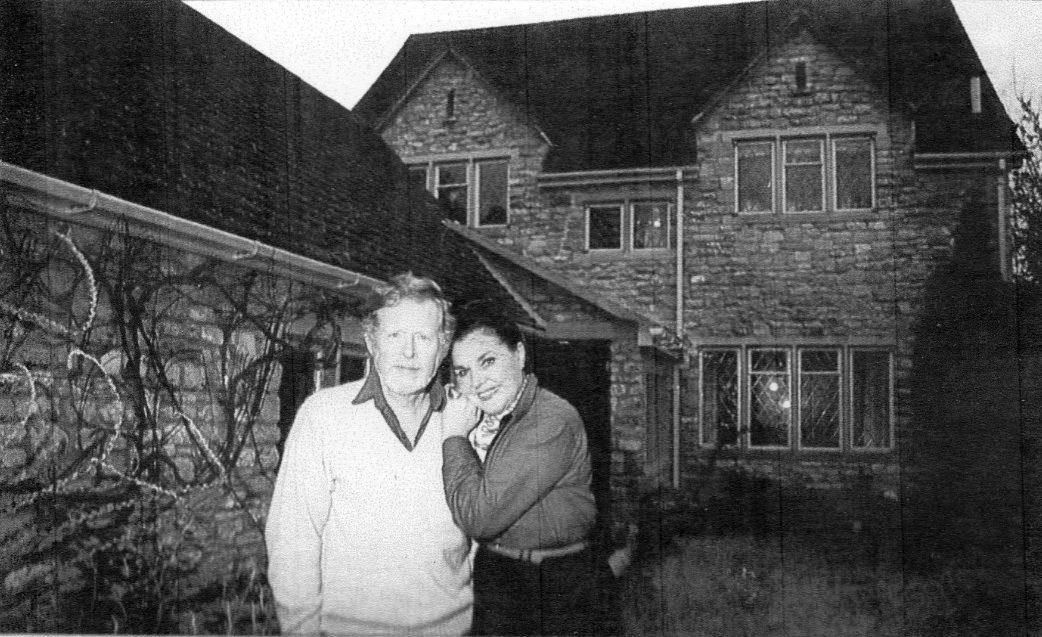
In 1989 Maison, a glossy 104-page publication for Black Horse estate agents, contained an article entitled “Home From Home”: “Jazz musician Bob Wilbur [sic] explains to Samatha Lee why the Cotswolds have become his permanent home.” (Wilber’s name was mis-spelt throughout the article.)
The Cotswolds is a region of Southern England, close to the Welsh border, noted for its attractive small towns and villages with cottages built of the local yellow limestone. The Wilbers had relocated to a house (“M’Dina”) in Chipping Camden, Gloucestershire, though spending January to April each year in their house in Scottsdale, AZ.
Miss Lee’s article contains a description of M’Dina (“a sumptuous town house on three floors”) and a summary of Wilber’s career, including a mention of the Royal Festival Hall concert on January 23 that year, featuring the world public premiere of The Queen’s Suite. There is also a reference to a six page profile in a “recent” issue of The New Yorker.
♫ ♫ ♫
Another movie soundtrack for which Wilber was responsible was made in Italy in 1990. This was Bix touted as “An Interpretation of a Legend.” Wilber was featured on the soundtrack, as was Tom Pletcher on cornet. The music can heard on RCA issues and the film watched on RCA-Columbia Pict, Rhapsody 9022, and Cine Switch 30219.
In his letter to The Village Voice, Wilber writes, “I have also been called upon the recreate early jazz for the following films, The Untouchables, Brighton Beach Memoirs, and Tucker (The Man and his Dream).”
♫ ♫ ♫
Another opportunity to hear Wilber was at the Jazz Journal Christmas Party, hosted by editor Eddie Cook at a club in Soho, December 10, 1993. The jam session included Bob Wilber, soprano, Eddie Cook, tenor, Hugh Rainey, cornet, unidentified clarinet and rhythm section. Needless to say, a good time was had by all.
♫ ♫ ♫
One Sunday, probably early in 1994, I noticed that the BBC was showing Young Indiana Jones and the Mystery of the Blues. Intrigued, I watched. The plot revolved around Indiana Jones and his room-mate, Elliott Ness, investigating the murder of gangster Jim Colosimo, with journalist Ernest Hemingway assisting. Jones works as a waiter in Colosimo’s nightclub, where he is friendly with the band and Sidney Bechet teaches him to play jazz on the curved soprano. Bix Beiderbecke sits in with the band at one point.
Other characters portrayed in this episode were Dion O’Bannion, Johnny Torrio, Al Capone, Ben Hecht, Louis Armstrong, and the Dodds brothers! The music is good and in response to my query, Bob Wilber replied, “Of course it’s me on Mystery of the Blues—who else? It’s Kenny Baker on trpt. and cornet (Bix).”
This episode can be viewed on Amazon and is in a Young Indiana Jones DVD boxed set, Volume 3.
♫ ♫ ♫
“Jazz: A Tale of Age, Rage and Hash Brownies” was an article by Richard B. Woodward which appeared in The Village Voice for August 1994, detailing problems at Lincoln Center for the fourteen months prior to publication—racism (both ways), favoritism, and feuds. The equivalent of four packed pages in a small-font, it told something of the history of the Lincoln Center Jazz Orchestra, starting with Gunther Schuller and his repertory concerts at the New England Conservatory concerts in Boston in 1971. The contributions of Wynton Marsalis, David Berger, Stanley Crouch, Gary Giddins, Rob Gibson, and others are considered and politics involved are discussed and, at the time of the article, the animosity between the board and the jazz press was clear.
Bob Wilber was annoyed that his contribution to repertory jazz was not mentioned and wrote to The Village Voice on November 24, 1994, setting out his part in the movement. He pointed out that his Wildcats were playing the music of the Creole Jazz Band, the Hot Five, and the Red Hot Peppers in 1946. (As, of course, were so many other bands in that period, mainly semi-professionally.)
His involvement with the New York Jazz Repertory Company and the Smithsonian Repertory Ensemble, when they were founded in 1947, went unremarked. (At least Dick Hyman receives a brief mention for his major contribution in those early years.)
It has yet to be confirmed that Wilber’s letter was published in The Village Voice.
♫ ♫ ♫
On April 25th and 26th, 1999, Hal Smith was the drummer with Soprano Reunion at the Atlanta Jazz Party. The Reunion, a more free-wheeling successor to Soprano Summit, replaced Marty Grosz with a varying rhythm section. At Atlanta it was Mark Shane, piano, Bucky Pizzarelli, guitar, Frank Tate, bass, Hal Smith, drums. A CD from the party was issued on Jazzology JCD-385.
Hal was surprised that “Bob and Kenny argued how to interpret almost every phrase during the rehearsal prior to the performance at the Atlanta Jazz Party.” When Davern started complaining that the rhythm section was rushing, Wilber responded, “Would you rather have Zutty Singleton on drums? Then everything would slow down.”
♫ ♫ ♫
On September 30, 2014, at the Irish Centre in Basingstoke, a session organised by Dave Bennett, paired Wilber with Sammy Rimington’s International Band—Phillipe De Smet, trombone, Rimington, alto, clarinet, Emile van Pelt, piano, Paul Sealey, banjo, guitar, Trefor Williams, bass, Norman Emberson, drums. At 86 Wilber was frail and unsteady on his feet, but once he started to play that was forgotten. He still performed at a high level and full of energy.
♫ ♫ ♫
And to conclude with a few variations, this memoir covers 57 years of seeing and hearing Mr. Wilber and 67 years of listening. He was interviewed by Gordon Cruikshank on Radio Scotland in August 1987, with a tape perhaps in an archive somewhere. Not mentioned are sessions with the World’s Greatest Jazz Band; and a fine session with pianist Dave McKenna, April 18, 1978; an appearance leading an all-star big band at the Brecon Jazz Festival in August 1991; the First Swinging Jazz Party, Blackpool, in April 2000; and numerous Soprano Summit dates.
After the 2014 session I commented, “He remains one of the finest musicians to emerge from the jazz revival of the 1940s.” Derek Webster wrote, “His work is notable for its tastefulness and integrity.” Michael Steinman said: “What strikes me is his assertiveness: when he and Benny Carter were the two horns, Bob soloed first, at length, and ran over Carter.”
♫ ♫ ♫
When Pug Horton paid tribute to her husband in a presentation, “Bob Wilber and Me,” at the IAJRC-UK weekend in 2018, Bob was unable to attend, but he sent a message: “So sorry not to be with you today but I know that my beautiful Pug will entertain you royally as she has done with me since we’ve been together. Keep swinging, Bob.”
♫ ♫ ♫
Robert Sage Wilber, was born in New York City on born March 15, 1928 and died in Chipping Camden on August 4, 2019.
Recommended Reading:
The New Grove Dictionary of Jazz, 1988, lists a number of magazines with articles about Bob Wilber, published between 1966 and 1987.
Eddie Cook, interview (two parts), Jazz Journal, September and October, 1993.
Gerard Bielderman, Bob Wilber Discography (Swinging Americans, No. 32), 2012
Derek Coller, The Six: A Band Before its Time, IAJRC Journal, Summer 2016
Just Jazz, Happy Birthday Bob!!, Just Jazz, March 2018
Samantha Lee, Home from Home, Maison, 1989
Conde Nast, The New Yorker, September 1, 1989 (not seen)
David Poulter, Bob Wilber at 90, Clarinet and Saxophone, Spring 2018
Pete Simkins, Bob Wilber at 90, Jazz Journal, April 2018
Music Was Not Enough, by Bob Wilber, assisted by Derek Webster. (The MacMillan Press Ltd., 1987)
I am grateful to Marty Grosz, Hal Smith and Michael Steinman for their helpful contributions to this memoir.
This article is based upon a presentation made at the IAJRC-UK weekend, on September 28, 2019.
Derek Coller, born in Devon, UK, in 1926, became a big band enthusiast as a teenager. His interest in jazz led to him becoming an author and jazz magazine editor. His recent biographies of Johnny Guarnieri and Big Joe Turner have been reviewed in The Syncopated Times.