The sound of muted trumpets and trombones has been woven into the fabric of jazz almost from the beginning. They are a tool that can be used to expand the expressive possibilities of the music-not to mention allowing you to practice at home without your neighbors calling the cops.
Mutes have been around for a very long time. Stoppers for natural trumpets (basically, long metal tubes) were found in the tomb of King Tut dating to around 1300 BC. They may have been used to alter the sound, but were more likely used to protect the instrument from moisture or damage during transportation (gig bags were a long way off).
In 1607, the Italian composer Monteverdi used mutes for the first time in a written musical score, in the Toccata preceding his opera “l’Orfeo.” These first mutes were wooden, turned on a lathe and looked something like chalices.
The first mute to be given a United States patent, on December 5, 1865, was the invention of John F. Stratton. The Stratton invention was a “practice mute.” It was described as “A conical plug with a central pipe extending through both ends of the plug and a certain distance beyond the same.” In the last 150 years, 123 patents have been issued for some very sophisticated, acoustically complex mutes. My own contribution was a mute I made while traveling with my pocket trumpet in Barcelona, Spain. In order to not disturb the general peace during siesta time, I dumpster dived and I came up with some styrofoam, cut and taped it together into what could qualify as a straight mute. Patent still pending.
I would guess that the straight mute is the earliest and still most widely used type of mute used in jazz. Other common types for trumpet and trombone, with many variations in construction material, are the cup, plunger, harmon or wah-wah, derby and whispa, bucket or velvetone. Electronic systems also exist that go in the bell and allow players to hear themselves through headphones. You can use these systems to output the sound through various effects and amplify it-not the usual goal of “mutes.”

Brass playing has traditionally been about power. The shofar, a ram’s horn, was used to bring down the walls of Jericho. Trumpets and sackbuts (early trombones) were used to play fanfares announcing the arrival of kings and queens. Back around the turn of the 20th century, you weren’t likely to find mutes being used in Military bands, circus bands, the bands of Sousa or Goldman or James Reese Europe’s outfits. The accent was on power and if you wanted less sound, you’d simply score the music for fewer instruments.
Minstrelsy, Medicine Shows, Tent Shows and vaudeville were another story. Skits, comedy acts, monologues, song-and-dance routines, musical duets, jazz bands, and eventually even scenes in silent films all called for a variety of music and sound effects. If a jazz or proto-jazz band was on the bill, they were a separate act, and a pit band provided what was needed for the other acts. Note, however, that musicians often had a foot in several camps, playing in vaudeville and Tent Shows and then becoming jazz musicians. If a cornet or trombone player heard the trumpet being used to imitate a horse or laughter, it’s not a stretch to think they wouldn’t consider using it as a musical device in a jazz context.
In fact, vaudeville work was an important source of income for professional jazz musicians in the early 1900s. Clarinetist Wilbur Sweatman, whose 1916 recording “Down Home Rag” was arguably the first jazz recording had deep roots in circus and vaudeville. New Orleans guitarist Danny Barker said: “In the late teens and early twenties,…all the big circuses would come through New Orleans. And if they needed a musician, they know they could pick one up in New Orleans. All the minstrel shows, like the Rabbit Foot Minstrels, and Silas Green and the Georgia Minstrels, used New Orleans musicians year in and out.”
Of course, the first recordings widely called jazz were by the Original Dixieland Jazz Band in 1917. No mutes on those, although plenty of noises that were “off the horn.”
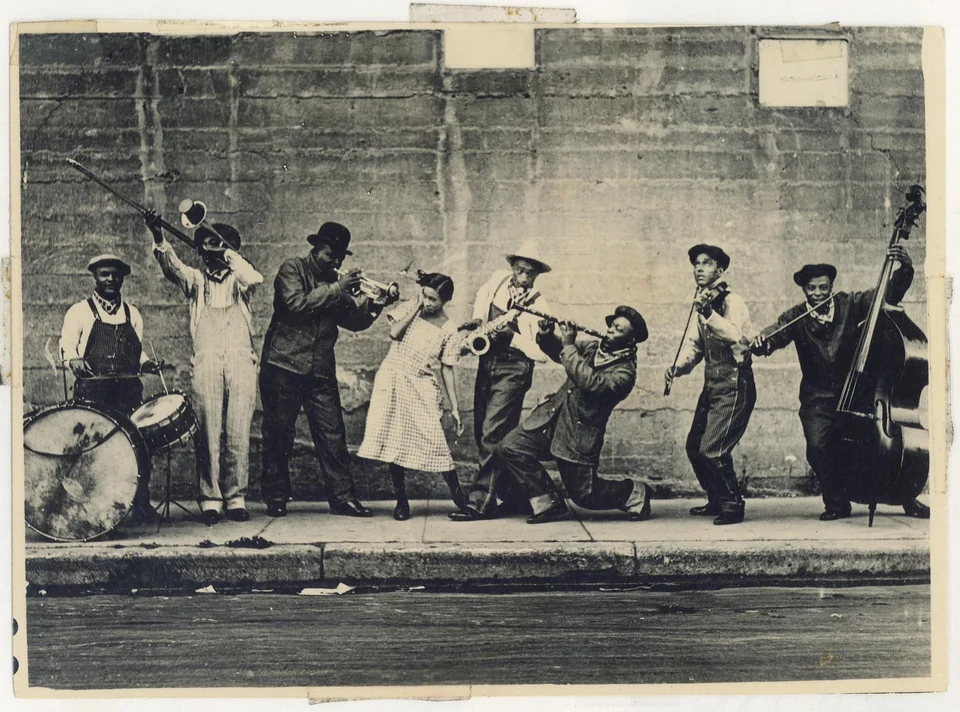
Probably the early jazz musician most famous for his work with mutes was King Oliver. There is a photo of King Oliver’s Creole Jazz Band in San Francisco in 1921 where he is holding a mute. However, the first recordings that I could find with muted trumpet were by Johnny Dunn in 1922. Dunn has a reputation as a leading trumpeter in New York City, but he deserves more credit as an innovator using mutes-what was also called ‘freak trumpet.’ Examples include “Hawaiian Blues” by Johnny Dunn’s Original Jazz Hounds, and, “Sweet Lovin’ Mama Blues, Please Come Back To Me”.

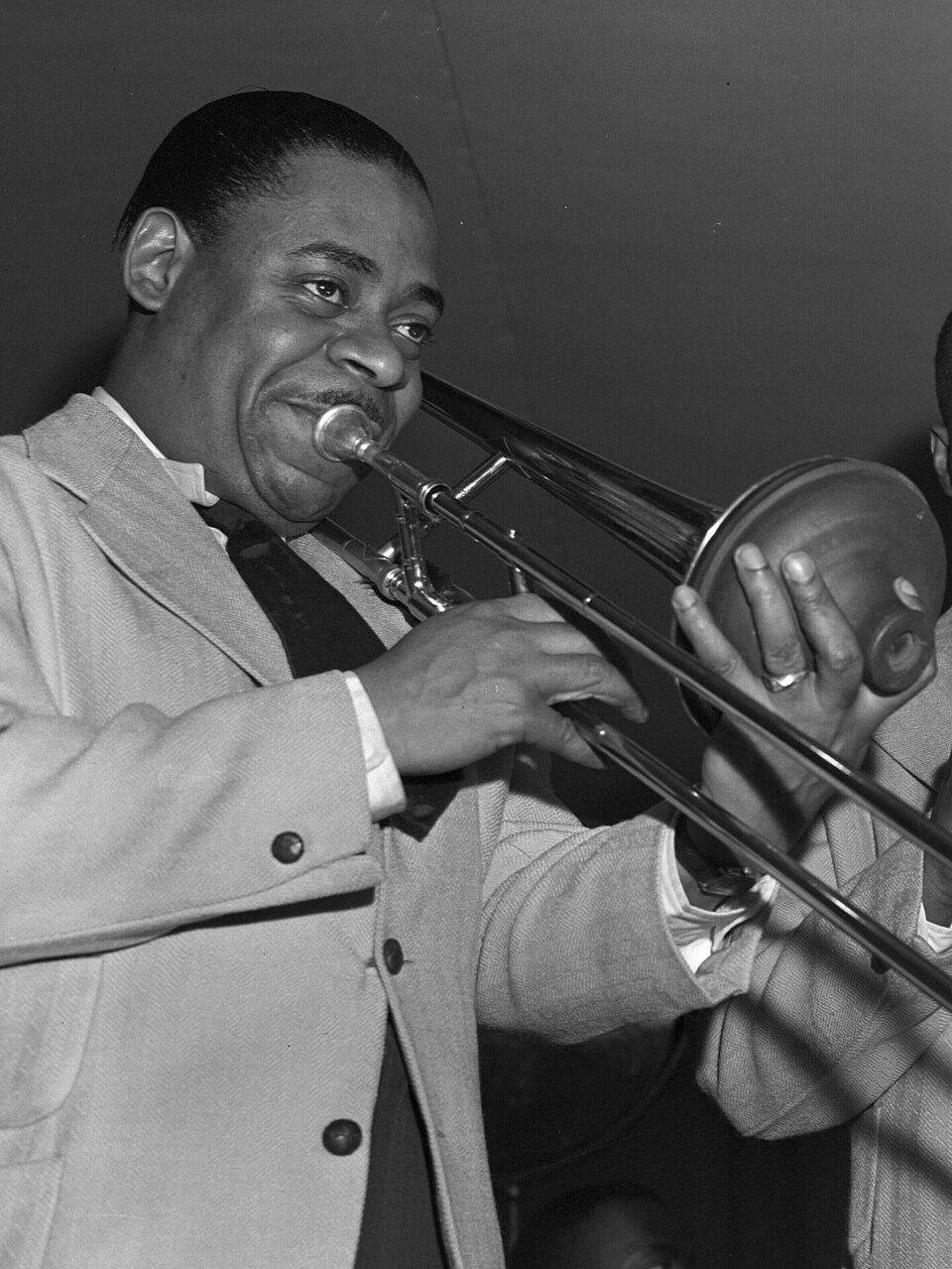
Dunn was an influence on two of the most noted early mute practitioners, trombonist “Tricky” Sam Nanton and trumpeter Bubber Miley. The 17-year-old Nanton heard trumpeter Johnny Dunn using a plunger in New York and said he thought it would work well on trombone. Bubber Miley replaced Johnny Dunn in Mamie Smith’s Jazz Hounds in 1920. Nanton and Miley became Duke Ellington stalwarts and helped to define his “jungle music” sound of the late 1920’s-early 30’s.
Tommy Ladnier of New Orleans plays a ferocious plunger solo with Ollie Powers Harmony Syncopaters on “Play That Thing” (1923).
I could only find a couple of muted solos by the great trombonist Miff Mole on The Tennessee Tooters’ “How Come You Do Me Like You Do,” which sounds like a straight mute, and, “Some Sweet Day”.

The other early virtuoso on mutes was King Oliver, who pioneered the use of mutes (On the west coast, Oliver and his band engaged with the vaudeville tradition, performing in plantation outfits). Oliver liked a small metal mute made by the C.G. Conn Instrument Company, but would use a rubber plunger, derby hat, bottles, cups or anything close to hand. Louis Armstrong describes routines between Oliver and bassist Bill Johnson where Oliver imitates a white child then a black child on his horn which broke up the audience. Possibly his most famous solo is on his own composition “Dippermouth Blues.” Louis Armstrong takes the first, open solo, then Oliver. His 1926 recording “Wa Wa Wa” actually mostly features the straight Conn mute and he doesn’t break out the plunger until the end.
One of his Oliver’s protégés, Louis Panico wrote a book entitled The Novelty Cornetist, which is illustrated with photos showing some of the mute techniques he learned from Oliver.
Trombonist J,C, Higgenbotham, who recorded with Oliver, was a mute adept. Listen to his solo on “Speakeasy Blues”. Then here, on “Biff’ly Blues,” with Red Allen.

As I noted, there was an important lineage of plunger mute practitioners associated with Duke Ellington: Bubber Miley, who joined Ellington right at the beginning, in 1923, then Cootie Williams, then Ray Nance. On the trombone side, “Tricky” Sam Nanton held the plunger chair. Their expressive sounds were the main ingredient in the band’s early “jungle” sound, that evolved during the band’s late 1920s engagement at Harlem’s Cotton Club.
Nanton himself said that at first he sounded terrible and played out of tune. In an interview, he said: “Trombonists have to violate all the principles of trombone playing to use the plunger properly. Therefore, it is not advisable to use the plunger and try to be a good trombone player unless the musician is going to use that style exclusively…After doing this over a period of years, that’s all you’re good for.” Nanton’ used a straight mute with a plunger, hummed notes to produce multiphonics and flutter tongued.
There are many recordings that feature Miley and Nanton. At the beginning of this film, you can see Miley and Ellington working out “Black and Tan Fantasy”. Here’s Nanton on “Lightnin’”.
After Miley’s departure in 1929, Nanton taught Cootie Williams, Miley’s successor, some of the growl and plunger techniques that Miley had used. Williams became a plunger virtuoso in his own right. He developed, in addition to other tricks in his bag, a “ya-ya” effect with a plunger, in combination with a Magosy & Buscher nonpareil straight mute. He kept the details of his technique a secret, even from his band mates, until his death. “Concerto For Cootie” may be the most famous example of his work.
Bix Beiderbecke is often cited for his “bell-like” tone on the trumpet, but he used a mute occasionally. Here on “Blue River” he is using what sounds like a straight mute. And here he is on “Louisiana” with a short derby hat solo.
There was a school of players who used the Harmon mute in what we think of now as a ricky-ticky way-stem left in, hand moving over the end to get the wah-wah effect. Henry Busse a well-traveled trumpet player with Paul Whiteman and others, was a well-known practitioner.
Here’s Busse in his first of several recordings of “Hot Lips“.
Trombonist Jack Teagarden had such advanced technique that he could mold the sound with slurs and trills and seldom used mutes. But he had one singular mute that he devised where he removed the bell of his trombone and put a regular drinking glass on the tubing. You can see it here, on “Jack Armstrong Blues”.
Lawrence Brown was the non-plunger Ellington trombonist, but he got a beautiful tone with a cup mute, as here on “Flamingo”.
Red Allen only very occasionally used mutes and said himself “I want to BLOW my horn”. (Thanks to Brian S. Goggin for the reference) Here on “Patrol Wagon Blues” Allen plays an opening solo with a solotone/cleartone mute. On “Barrellhouse” with Mills Blue Rhythm Band he uses a cup mute.
There’s some debate about the mute preferred by Dickie Wells, most noted for his stint with Count Basie. Some say he called it a “pepper pot,” but there was a commercially available mute called a “pepperbox.” There are photos of Wells playing a straight mute that he used an ice pick or an awl to perforate. You can see him play it during the band session in the 1957 film “The Sound of Jazz” at 21:10.
Tommy Dorsey played a fair number of ballads and often used a cup mute. In 1938, he used it, with his customary vibrato, to get a more “exotic” quality in “Song of India” (don’t forget to listen to the great Bunny Berigan here, not muted but a great solo)-https://www.youtube.com/watch?v=5hDWIg4FGJs.
Bunny Berigan uses a straight mute/plunger combination in this version of “Caravan”. He gets a very buzzy tone on “My Walking Stick”.
Harry James, known for his brilliant tone was not much of a mute user, but you can see him here with a harmon mute with the stem pulled out, playing in back of Helen Forrest.
James also was said to have a mute made by Tony Scodwell, a trumpet mouthpiece maker called the “Scod-WELL mute/flask. It was supposedly a combination mute and flask for shots of his vodka. His custom-made trumpet case could accommodate a fifth of said booze.
Roy Eldridge began using mutes a lot during the 1950s, at least recording with them, but did use them occasionally before then. He plays a beautiful cup mute solo with Teddy Hill’s Orchestra here on “When Love Knocks at Your Heart”. And here he plays a straight mute solo on “When I Grow Too Old To Dream” with Putney Dandridge’s outfit.
Bands worked mutes into group routines for extra flash. You can see the Glen Miller band using a variety of mutes in this Hollywood film- Sun Valley Serenade (1941).
The mute was ubiquitous by the 1950’s. Some of my favorite work is by Charlie Shavers, whose cup mute playing was stellar starting in the 1930’s. Here he is on “Musicomania” on cup mute with John Kirby. In the fifties, he meshes perfectly with Billie Holiday on “Easy To Love”.
The Talkative Horns of Rex Stewart and Dickie Wells showcases them in a series of 1959 mute ‘conversations.” Here’s “Side By Side”.
At the beginning of his career, Miles Davis followed Dizzy Gillespie into Charlie Parker’s group and he often chose to play with a cup mute, possibly to avoid open horn comparisons with the dazzling Diz. You can hear him in this seminal recording, “Embraceable You” with Bird. Miles became an increasingly important influence on many musicians through his music, wardrobe and persona. He took the stem out of the harmon mute and played right up on the mic. This is the sound we most closely associate with Miles. We can hear his singular tone on this famous recording of “Round Midnight” made ten years later.
Not much changed in mute use until electronics entered the jazz world. I suppose that early jazz listeners might have found the sound of mutes as odd as some today find electronics. After all, back then it was called “freak” or “eccentric” playing.
Miles had begun incorporating electronic instruments-keyboard, bass and guitar-in about 1967. Finally, in late 1970, he began putting his horn through a box with a pedal, often through a harmon mute and running the wah-wah down. From 1971 on, he rolled with electronics as you can see here on “turnaroundphrase”.
Trumpeter Don Ellis pioneered in electronics and sometimes used a mute in the process. Notice his 4-valved “microtonal” trumpet. The tunes on this live recording are listed as “Reach,” “Night City,” “The Blues,” and “Pussy Wiggle Stomp”.
Some players have adopted electronics, but good old fashioned analog mutes can provide a wide sonic palette for soloists and arrangers and have become a part of the everyday artillery of jazz trumpet and trombone players. Hi-hats off to those who pioneered their use.
In fact, lets close this article by circling back to a great early practitioner, Bubber Miley and this first recording of Duke Ellington’s “East St. Louis Toodle-O”.
Steve Provizer is a brass player, arranger and writer. He has written about jazz for a number of print and online publications and has blogged for a number of years at: brilliantcornersabostonjazzblog.blogspot.com. He is also a proud member of the Screen Actors Guild.