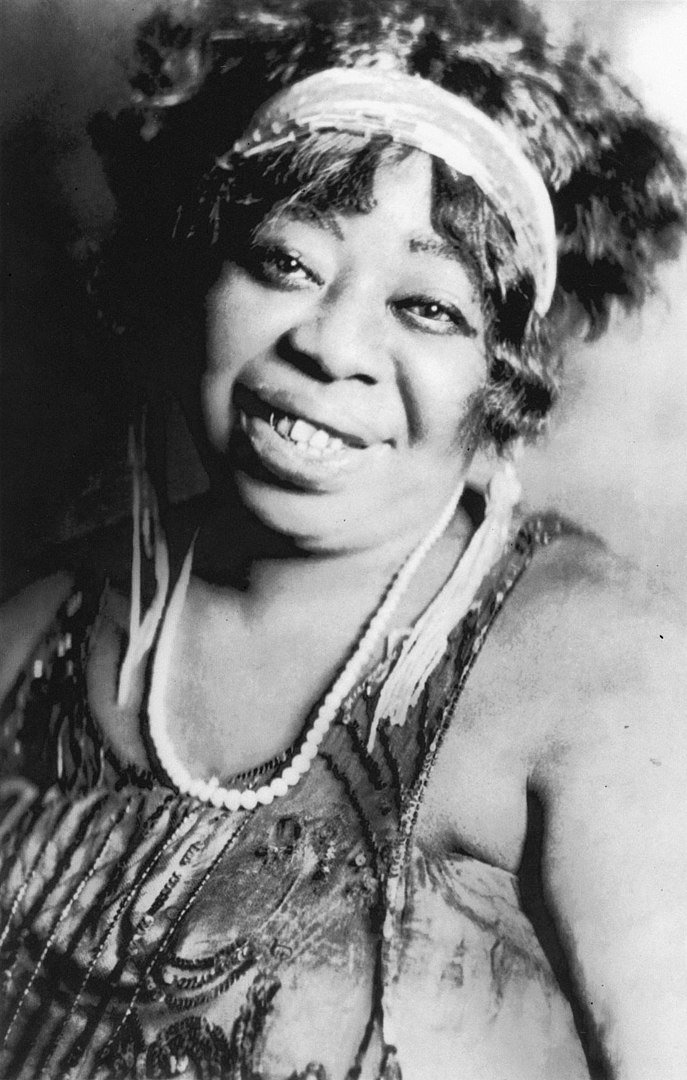
Of all of the classic blues singers of the 1920s who were able to record, Ma Rainey’s history went back the furthest. In an interview in the 1930s, she said that she first heard the blues in 1902 and soon afterwards was including blues in her repertoire. Billed as the “Mother of the Blues,” Rainey was not the first singer to record blues (Marion Harris was recording bluesy material in 1916), or the first African-American vocalist (Mamie Smith had a giant hit with 1920’s “Crazy Blues”). Even the younger Bessie Smith preceded her into the recording studio by ten months.
Rainey at 37, or possibly 41, was considered a bit old to be making her recording debut, but the power of her singing and her popularity among African-Americans finally resulted in her making her first records in Dec. 1923. During the next five years, she created a strong body of work but there was a catch. Rainey recorded exclusively for Paramount and that label was notorious for its inferior sonic quality and distracting surface noise. Because of that, Ma Rainey’s recordings were always much more difficult to listen to than those of Bessie Smith and Mamie Smith, resulting in her contributions to the music being a bit underrated and to an extent overlooked.

But now, with the release of the rather remarkable five-CD set The Complete Paramount Recordings 1923-28 (Black Swan BSCD-44, available from www.jazzology.com) with its cleaned-up and crystal clear sound, one can finally really hear Ma Rainey sing, a century later.
Gertrude Melissa Nix Pridgett was born on Apr. 26, 1886 in Columbus, Georgia; at least that is what she later claimed although it is possible that she was born in Sept. 1882 in Alabama. Her family included some minstrel show performers and quite early she learned all about the ups and downs of show business. She started out appearing in the amateur show “A Bunch Of Blackberries” around 1899 and in several minstrel shows. Rainey first heard the blues sung by a street performer three years later. She later said that, after learning the song and singing it herself onstage, she was asked what type of music it was. She claimed that she created the term “blues” to describe it.
In 1904 she married song and dance man William “Pa” Rainey. At first, they formed the Alabama Fun Makers Company although by 1906 they had joined Pat Chappelle’s Rabbit’s Foot Company as blackface comedians, actors, and singers of popular songs. In 1909 they joined Benbow’s Chocolate Drops. A young Bessie Smith was listening closely to Ma by 1910 when they briefly worked together and Smith (who was born in 1892) was influenced and inspired by her at that early stage. They became friends rather than competitors.

In 1915, the Raineys joined Alexander Tolliver’s Smart Set touring company where they were billed as “Rainey and Rainey – Assassinators Of The Blues.” By then Ma Rainey was 29 and the headliner of the tent show but Pa Rainey was in declining health; he passed away on June 29, 1919. Ma continued on, working with several other tent shows as a star and for a time headed Madam Rainey’s Southern Beauty Show. She also worked with the Wortham Big Carnival, traveling with the troupe not only in the South but visiting Mexico.
By 1923, there was a strong market for blues recordings, a craze that started with Mamie Smith’s “Crazy Blues” in 1920. Quite a few African-American female vocalists from black vaudeville and Southern troupes were brought into the studios and given an opportunity to record two or four bluesy songs. Many were not heard from again but some, including Ida Cox, Ethel Waters, Alberta Hunter and Bessie Smith, sold enough records to have prolific recording careers. J. Mayo Williams, the manager of the Paramount label’s Chicago branch, arranged for Ma Rainey (one of the oldest discoveries of the period) to travel to Chicago and begin making records. While Rainey had a fairly diverse repertoire in her vaudeville and tent show performances, most of her recordings were blues or blues-oriented. She recorded 92 songs during a five year period (Dec. 1923-Dec. 1928), all for Paramount.
The five-CD box set The Complete Paramount Recordings 1923-1928 (which could have been titled quite accurately The Complete Recordings) is a marvel. From the first notes of the opening selection, “Bad Luck Blues,” one can clearly hear not only Ma Rainey’s voice (in some ways for the first time) but some great cornet playing by Tommy Ladnier. Based on this session alone, Ladnier ranks among the greats of the time, sounding more advanced than King Oliver.
The 92 songs that Ma Rainey recorded (including the two-part “Blues The World Forgot”) are joined by 21 alternate takes and 4 previously unreleased test pressings. Among the sidemen who are heard on various selections (virtually all are first-rate) are Lovie Austin and her Blues Serenaders (with Ladnier and clarinetist Jimmy O’Bryant), the Pruitt Twins (a banjo-guitar duo), guitarist Louis Lasky, players from the Fletcher Henderson Orchestra (listed as being Rainey’s Georgia Jazz Band and sometimes including trombonist Charlie Green, clarinetist Buster Bailey, cornetist Joe Smith and, on one session, Coleman Hawkins on bass saxophone), pianists Jimmy Blythe (her only accompanist on “Mountain Jack Blues” and “Don’t Fish In My Sea”), Claude Hopkins, and Georgia Tom Dorsey, Doc Cheatham (on soprano sax!), trombonist Albert Wynn, clarinetist Johnny Dodds, guitarists Blind Blake and Tampa Red, violinist Leroy Pickett, singer-banjoist Papa Charlie Jackson, and the long-forgotten but excellent C-melody saxophonist George “Hooks” Tilford. This partial list does not include Louis Armstrong who in Oct. 1924 recorded three songs (plus two alternates) with Rainey including the original versions of “See See Rider.”
Doug Benson is responsible for the set’s very impressive sound quality. He searched for and acquired the best possible source material and then magically made all of the performances (including the alternates and the test pressings) sound extremely listenable. A comparison of these selections to the earlier versions reissued on a long-ago double-Lp set by Milestone and the CDs in the Document series show just how much he has succeeded at preserving Ma Rainey’s legacy. Doug Benson deserves to win an award for this accomplishment.

A mention should also be made about the massive 108-page booklet that comes with the LP-sized box. David Sager’s very lengthy liner notes are definitive in covering Ma Rainey’s life and summarizing each song and session, the lyrics for all of her recordings are included, the discography is easy to use, and Benson discusses the work that went into this challenging project. In addition, the photos of Rainey (probably every one that exists), her musicians and contemporaries, contemporary advertisements, sheet music and memorabilia are wonderful.
As for Ma Rainey’s singing, she is quite consistent no matter what the accompaniment. She is strong and confident, her voice is sometimes rural but always appealing and, while one can hear a bit of what Bessie Smith gained from her, Rainey always comes across as her own woman, assertive and occasionally tender. Among the highlights are “Bad Luck Blues,” “Bo-Weevil Blues,” “See See Rider Blues,” “Titanic Man Blues,” “Trust No Man,” “Ma Rainey’s Black Bottom,” and “Blame It On The Blues” but every performance is well worth hearing.
Due to her Paramount recordings and the publicity that they generated, Ma Rainey was at the height of her fame during the 1920s when she was not only called “The Mother Of The Blues,” but “The Songbird of the South,” “The Gold-Neck Woman of the Blues,” and even “The Paramount Wildcat.” An astute businesswoman, in 1924 she toured with her group (the Wildcats Jazz Band) which included pianist Georgia Tom Dorsey (her musical director) and trombonist Albert Wynn, performing in Chicago, Pittsburgh, New York, and throughout the East Coast, the Midwest and the South.

She stayed quite busy with her group, which was renamed the Georgia Jazz Band, during 1925-26. But times were changing, the blues craze was ending, and vaudeville and tent shows were gradually declining in popularity. While she had a hectic schedule in 1928 and recorded 20 selections that year for Paramount, the label dropped her at the end of the year, feeling that her records were not selling well enough. For unknown reasons, she did not attempt to get signed by another label and the Ma Rainey Story, at least on records, ended after recording “Big Feeling Blues” in a duet with Papa Charlie Jackson in Dec. 1928.
Ma Rainey continued to work, mostly at carnivals and fairs in Texas and the Southwest. She held onto her loyal black audience even as she gradually slipped into obscurity during the Depression years. After the death of her sister, she retired in 1935 and moved back to Columbus, Georgia to take care of her grieving mother who passed away a few months later. Rainey bought and ran three theaters (the Liberty, the Lyric, and the Airdrome) with her savings, was active in her church, and maintained a low profile during her last few years, no longer performing.
In 1939, John Hammond went down South to search for Ma Rainey, hoping to persuade her to end her retirement and sing at his upcoming From Spirituals To Swing concert at Carnegie Hall scheduled for Dec. 24. He was unsuccessful in locating her and instead used Ida Cox who had also appeared at his previous year’s concert which led to her having a comeback and a few recording sessions.

Ma Rainey passed away from a heart attack two days before Hammond’s concert, on Dec. 22, 1939 at the age of 53. While she was never completely forgotten in the jazz and blues world, 87 years after her death one can finally hear why Ma Rainey was such a popular figure in the 1920s and an influential force in the history of the blues.

Since 1975 Scott Yanow has been a regular reviewer of albums in many jazz styles. He has written for many jazz and arts magazines, including JazzTimes, Jazziz, Down Beat, Cadence, CODA, and the Los Angeles Jazz Scene, and was the jazz editor for Record Review. He has written an in-depth biography on Dizzy Gillespie for AllMusic.com. He has authored 11 books on jazz, over 900 liner notes for CDs and over 20,000 reviews of jazz recordings. Yanow was a contributor to and co-editor of the third edition of the All Music Guide to Jazz. He continues to write for Downbeat, Jazziz, the Los Angeles Jazz Scene, the Jazz Rag, the New York City Jazz Record and other publications.