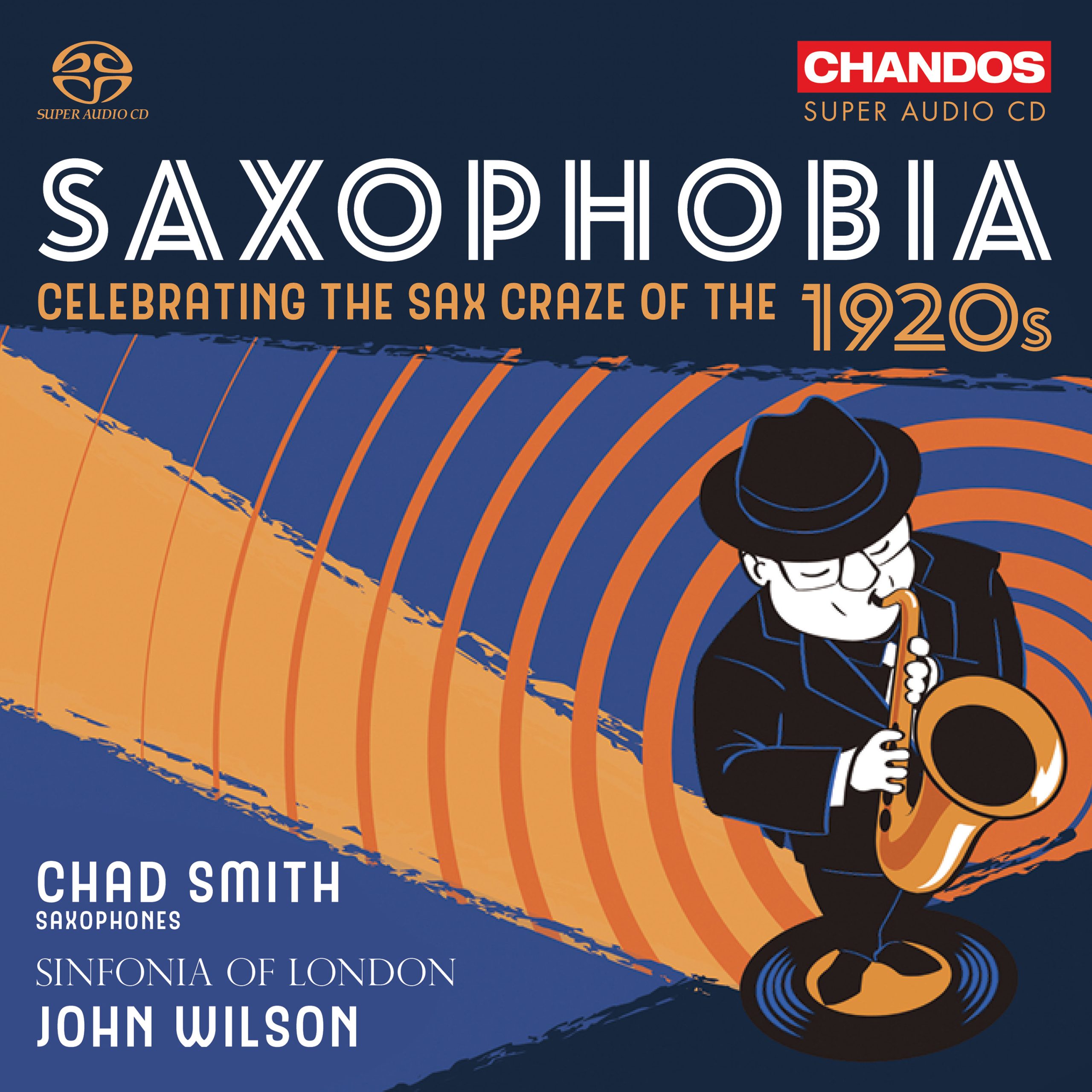
 Chad Smith describes his new album as “a love letter to that moment in time, when the saxophone did not belong to any single world; not quite classical, not quite jazz, it borrowed freely from several kinds of music, it shimmered brightly, and spoke with a voice entirely its own. These pieces are virtuosic, yes—but above all, they are joyful.”
Saxophobia is a tribute Rudy Wiedoeft (1893-1940), the leading saxophone virtuoso of the 1920s—the man, when you get right down to it, who put that instrument on the map. With his incredible technique and songwriting facility, he spread the gospel of that hitherto neglected horn and helped make it the fixture of the jazz world that it remains today.

The eighteen selections on this album are skillfully programmed to offer a variety of speeds and styles, and Smith has the chops to recreate the Wiedoeft technique. This I know because Rudy was much-recorded, and I long ago immersed myself in his legacy through reissues. This new CD comes closest to capturing that sound.
But it’s by no means a slavish re-creation. Twelve of the selections feature the Sinfonia of London conducted by John Wilson, himself no slouch when it comes to a variety of musical styles.
Wiedoeft began on clarinet, grew disillusioned with his career chances, then, almost on a whim, switched to sax and became hooked on it, achieving a mind-blowing ability on all of the members of the saxophone family. And his dazzling virtuosity all was done with single-tongue technique.

Smith writes, “He made the saxophone so popular that cities across the United States instated sax curfews in residential districts from 9 pm to 6 am owing to incessant noise complaints.” I’d like to think that these new recordings will inspire a new generation of young people to take up the instrument.
Especially when you hear the title track, “Saxophobia” written by Wiedoeft in 1918
while he was confined to barracks during World War I because of the flu pandemic. And during the ensuing 18 months, he recorded it for seven different studios. It’s a frantic showpiece featuring C melody sax (with great woodblock accents) in a ’20s-style orchestration by Lanny Meyers.
Then you can further frolic with up-tempo numbers like “Sax-o-Trix,” written as a fast 4/4, its melody a flurry of triplets on each beat for one measure followed by dotted figures to ease the rush and add syncopation. Typically for this type of number there’s a contrasting B section of a more lyric nature. The orchestral backing features unexpectedly delightful string support.
I was introduced to Wiedoeft’s “Sax-o-Phun” by Rudy’s own recording with George Olsen and His Music; it’s a laughing tune that became so well known as a cartoons stinger that it has infected our DNA. The orchestral setting given here by Meyers complements the soloist’s pyrotechnics beautifully. Its “Good Evening, Friends” finish eases nicely into the crowing rooster opening of “Rubenola” which, as its title suggests, pays tribute to country bumpkins. It turns out that “Reuben” has been a disparaging term for a hayseed since the beginning of the 19th century, shortened to “Rube” by the end of that century—and immortalized in the 1871 song “Reuben and Rachel.” Blur your eyes a bit and you’ll see Percy Kilbride emerging from the barn

Here the accompaniment is violin and piano in Smith’s own transcription, in a tune that quotes some well-known square dance and fiddle tunes as the sax decorates them with merry counter-melodies; then the tempo snaps into a Presto before Smith lays an egg—musically literally, as the sax imitates a hen’s squawks when her egg is emerging. And that’s Dalton Ridenhour on piano.
Also in the up-tempo realm are “Gloria,” by Justin Ring and Frederick Hager, a performance on C melody sax with banjo and piano; “Saxarella,” another Lanny Meyers arrangement for orchestra (catch that syncopated bridge); and “Saxema,” one of a legacy of pieces Wiedoeft wrote and then recorded with a then-unknown Oscar Levant.
Brahms and Liszt were fascinated by Hungarian musical stylings, and Rudy gave them a jazz voice. All the expected elements are in his “Danse Hongroise”: minor key, syncopations, abrupt tempo changes, accelerando passages, and, above all, wonderful melodies. The harp deftly sneaks in as co-star from time to time.

“Canary Cottage-One Step,” from 1916, is the earliest work on the disc, and could well be what many would consider ’20s music, but TST readers will know that it’s the sound of the ’10s, a prestissimo 2/4 with a garrulous sax dancing with a violin over trombone smears before heading into a stop time sequence that lets loose an even more frantic sax. The number itself is a medley of Earl Carroll tunes transcribed by fellow sax virtuoso Dan Levinson, presented here with a cracking ensemble of violin, banjo, trombone, drums, and piano; among the players are Justin Quinn, banjo; Andy Wood, trombone; and Matt Skelton drums.
A ’20s band wouldn’t survive without having waltzes on the menu, and Wiedoeft was generous with his three-quarter-time compositions. “Valse Llewellyn” is an early work from Wiedoeft that became one of his signature tunes; “Valse Vanite,” from 1923; and “Valse Mazanetta” is a danceable number with harp to the fore as the orchestra leads us in, then presenting a sax that sounds almost wistful—until it throws in some lightning licks. Especially ear-catching are the sequences doubled by xylophone.
Doug Caldwell, an authority on 1920s music, is the author of the liner notes on this album. At the Library of Congress he unearthed a very early Wiedoeft melody titled “Cloudy Days.” It’s a limpid waltz, a gentle treatise on how a sax can imaginatively decorate such a number.

Two of the songs pair sax and harp; harpist Lynette Wardle regularly performs with saxophonist Smith, and here provides a compelling companionship in “Dans L’Orient” and “Valse Sonia,” the latter of which opens portentously before easing into a wistful melody that soon welcomes the spice of Wiedoeft’s (and Smith’s) Tatum-like runs. I’d like to think that his beautiful low-register sound comes from summoning the spirit of the late Al Gallodoro, whose alto sax Smith acquired and uses for this track.
Two vocal selections feature Mikaela Bennett (with discreet sax obbligato) on Victor Herbert’s “Kiss Me Again” and Irving Berlin’s “You Forgot to Remember.” Both with orchestra, both with a 16-bar sax solo between the vocal refrain and the half-refrain reprise. And both are achingly sentimental.
From where, you may ask, did Chad Smith emerge? A live performance of what I’m guessing to be a very young Smith is a bonus track (it’s otherwise not explained) of “Saxophobia” with piano.
Wiedoeft’s life didn’t end well. Along with a run of bad luck and a fiery marriage, he developed an alcohol habit that eventually dominated and then ended his life. But he was remembered by many with great fondness, including a saxophone student named Hubert who was so proud to call Wiedoeft a friend, and changed his own name in tribute, becoming Rudy Vallée.
Saxophobia: Celebrating the Sax Craze of the 1920s
Chad Smith, Saxophones
The Sinfonia of London
John Wilson, conductor
Chandos (www.chandos.net)
B.A. Nilsson is a freelance writer and actor who lives in rural New York. His interest in vintage jazz long predates his marriage to a Paul Whiteman relative, and greatly helped in winning her affections.