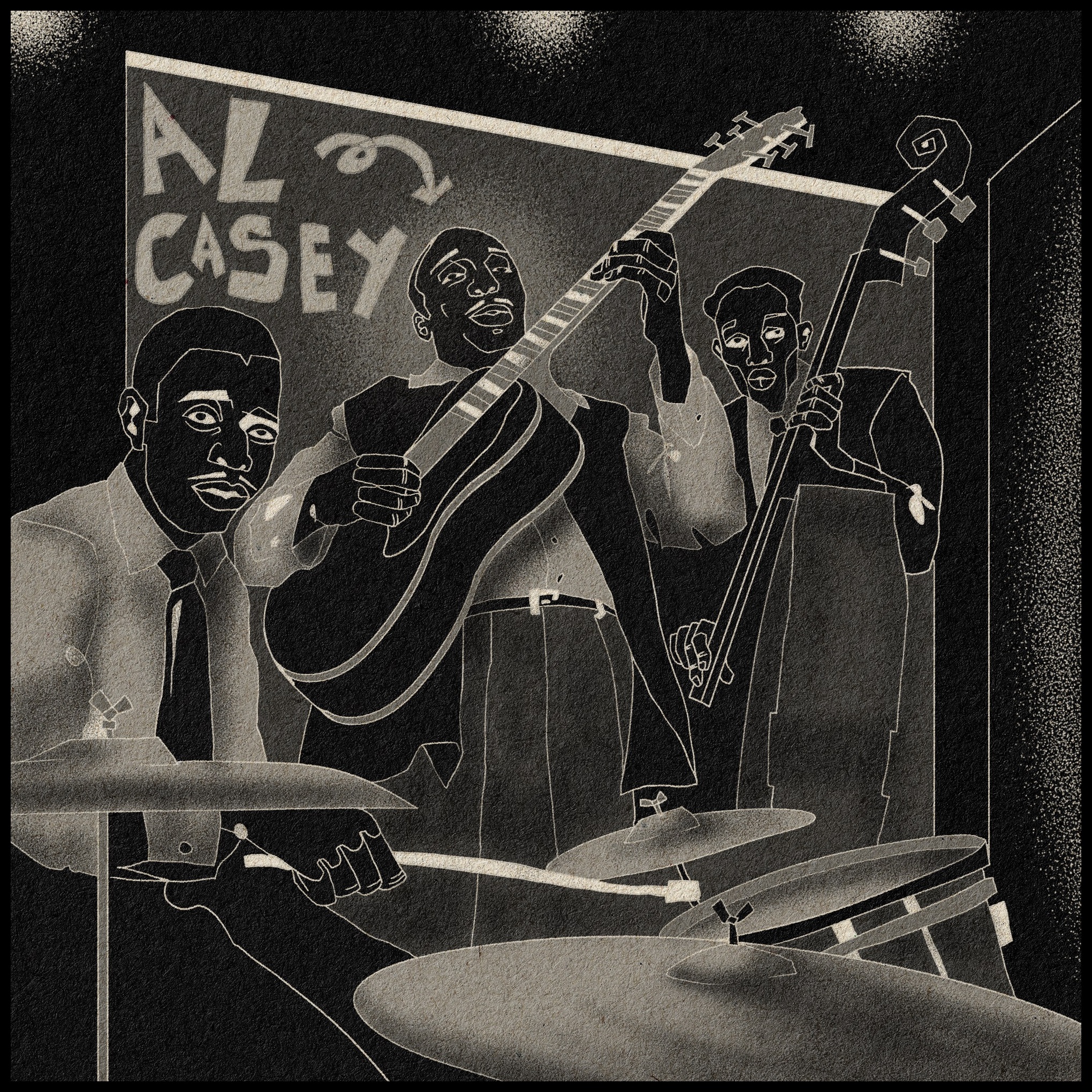
Albert Aloysius Casey was born September 15, 1915, in Louisville, Kentucky. He attended DeWitt Clinton High School in New York City and studied guitar.
He was a child prodigy who first played violin. He began playing guitar in 1930 and met Fats Waller in 1933. The next year, 1934, the 18-year-old Casey recorded with Waller on his first “Rhythm” date for Victor. “But I was just a kid, and scared to death.” Casey made many recordings with the band; Waller was a “second father” to him.
Due to the popularity of so many Waller records, Casey’s playing had a big impact on other players at the time, showing how the guitar worked in a small combo during the Swing Era. Al admitted being very affected by Charlie Christian, and changed his technique drastically in response to Christian. In a 1940 piece on Al by Leonard Feather we learn that he used a “medium pick,” that he placed a B string in the 1st-string position, for more power, and used that string the most. “He mixes single string solos with subtle chordal effects…[and] has a beautiful way to ad lib indefinitely.” After Waller’s death in 1943, he led his own trio with Will Shire, piano, and bassist Al Mathews. For two consecutive years in the 1940s, he was voted best guitarist in Esquire magazine.
In an interview with Mike Lipskin, Casey said, “I worked on the street after [Waller] died, and heard these bop changes—I’m still trying to learn them!”
During his career, Casey worked with Louis Armstrong, Chu Berry, Coleman Hawkins, Lionel Hampton, Billie Holiday, Billy Kyle, Frankie Newton, Clarence Profit, Art Tatum, and Teddy Wilson.

From 1957, he was a member of a rhythm and blues band led by King Curtis. Four years later he dropped out of music, though he returned in the 1970s to record with Helen Humes and Jay McShann. Another absence followed until 1981, when he returned to music to play with the Harlem Blues and Jazz Band.
Al Casey died of cancer on September 11, 2005, just shy of his 90th birthday. – adapted from Wikipedia and Mike Lipskin’s 2002 interview with Al Casey.