Jeff Barnhart: Dear fans of hot jazz music! Hal and I are delighted to share our third and final delve into the sounds of Clancy Hayes, drummer, banjoist, guitarist, pianist and above all, vocalist! For those who read Part II, we apologize that the accompanying sound links were incorrect on the online version of this publication. This error has now been rectified, so please do go back to listen to the tracks that weren’t correct. You’ll be well rewarded! For now, I’m thrilled to finally get to the recording session that first introduced me to Mr. Hayes!
The Original Salty Dogs approached Clancy about recording an album with them in August 1964 when he was appearing at the Plugged Nickel in Chicago. He readily agreed, and the entire production was recorded in a single session on August 31, 1964. Cornetist Lew Green recalls going to pick up Clancy at his hotel room around 11:30 that morning, and that Clancy had already had a few belts. Green was worried that Clancy would be in no shape for the recording that afternoon, but once he was sat on his stool and handed his banjo, he performed everything without a hitch.
In fact, the six alternate takes included in the CD reissue of 1964’s LP Oh, By Jingo! (Delmark DL-210 [mono]; DS-210 [stereo]) from 1997 (Delmark DE – 210) show no evidence of Clancy having been the reason for a retake! Twelve fantastic, polished, HOT performances in a single session says a great deal about everyone’s professionalism, but especially about the late, great pianist Jim Dapogny, who played 2nd cornet and valve trombone in addition to, as drummer Wayne Jones gives credit in his liner notes, writing the arrangements and acting as musical director.
Hal, I’ve said enough in general about this recording, but I’d love you to start us off with your observations concerning what I think is an album that exhibited Clancy Hayes’ vocal talents better than any other single session before or after.
Hal Smith: Jeff, Oh, By Jingo! (Full Playlist) is definitely a great showcase for Clancy Hayes’ singing! His vocals sound as relaxed and confident as ever—even though the whole album was recorded in one session. Clancy’s vocals make the well-worn “Tin Roof Blues” and “Beale Street Blues” absolutely shine. And he took on a couple of numbers I associate with other vocalists (“Wise Guys”/Turk Murphy and “Rose Of Washington Square”/Thad Vandon) and made them his own! And his declamatory opening to “Michigan Water Blues” ranks right up there with Jelly Roll Morton’s vocal. (No surprise, since Morton was one of Clancy’s heroes). I love the way he sang “I’m Comin’ Virginia” with the Salty Dogs briefly departing from the revival style to provide Bix-inspired accompaniment.

It is interesting to compare Clancy’s vocals on “Oh By Jingo!” and “My Little Bimbo” with those on the Lu Watters recordings of 1950. With the Salty Dogs, he sings in lower keys Eb and C, as opposed to F and Db with Wattersbut with the same warm vocal timbre. Also, on live recordings from Hambone Kelly’s, Clancy sang “Cakewalking Babies” in the usual key of Bb. He is in Ab with the Dogs; another example of his voice becoming even mellower with age!
This record was a real eye-and-ear opener for me. Though Clancy Hayes is the featured artist, I was blown away by hearing the Salty Dogs for the first time! The lightness of the rhythm section and the freewheeling front line playing “revival” material was a real revelation. I became friends with all the Dogs over the years and as you know, Wayne Jones was an invaluable mentor. The combination of outstanding material, a hot band and Clancy’s inspired vocals make this a must-have album for traditional jazz fans.
By the way, 60 years after hearing this album for the first time, I am still knocked out by all the great things that Jim Snyder played. For my money, his contributions to “Oh By Jingo!” are right up there with Clancy’s!
JB: AGREED! Luckily, for those who don’t have this hard-to-find album (or CD), YouTube once again comes to the rescue, by way of Chris Reid’s channel! You concentrated on Clancy’s repertoire and vocals on this recording, so I’ll just mention some highlights from the Dogs. Their ensembles in-between his vocals are all exciting, beautifully integrated, and lovingly played. “Rose of Washington Square” features some sweet muted cornet backing Clancy’s singing. The outstanding voicing for the horns on “I’m Comin’ Virginia” is courtesy of gifted arranger Jim Dapogny. On this tune, Clancy almost brings me to tears. His voice breaks a few times with emotion. I adore John Cooper’s saloon-tremolo intro on “Wise Guy” (a tune that, along with “Virginia,” had never been recorded by Clancy until this session, according to biographer Chris Reid).n Clancy’s “improvised” lyrics on the first section of “Beale St. Blues” are expertly backed by trombonist Jim Snyder.
I can’t recall hotter versions anywhere of the three instrumentals the band and Clancy chose for the album. This was my introduction to all three. “Oriental Strut,” “King Chanticleer,” and “New Orleans Stomp” floored me and are still the benchmarks by which I evaluate all other revival renditions. And Clancy’s driving banjo strumming was a big part of the success of these sides!

Regarding Clancy’s voice getting lower as he aged, he had the professionalism and self-awareness to lower the keys of his vocals. Many aging singers could take a tip from him!
Hal, I know you’ve something equally wonderful to share next, so please take us along!
HS: Let’s move forward a couple years to 1966 and an album that was recorded live at Earthquake McGoon’s in San Francisco. Clancy sang and played banjo on the intermissions and the Turk Murphy Jazz Band would join in on the final number as a transition to the band set. ABC-Paramount recorded several nights’ worth of material for the LP, which was available for only a short time. Turk said that Clancy chose the takes where he sounded the best, even if the band’s performance was not as good as on other takes. Turk threatened to sue the record company if the LP was allowed to stay on the market, so ABC removed it. It is now one of the most difficult traditional jazz LPs to find!

Fortunately, our friend Chris Reid made several tracks from the LP available on his “Clancy Hayes Jazz” YouTube channel. Take a listen to “My Little Bimbo” and “Ace In The Hole” where you can hear Clancy by himself and then singing with the full band as they return to the stage.
JB: Hal, I LOVE these sides! It’s marvelous to hear Clancy starting these songs alone, and hearing the Murphy aggregation “feathering” in. Sorry Turk felt the way he did. I know he was a perfectionist, but this is wonderful music, even with the very “loose” feeling. Midway through “Ace in the Hole,” someone in the audience whistles for joy like it was a rock concert! Jack Crook sounds great on his bass sax interpolations! It’s also fun to compare the version of “My Little Bimbo” that’s on the 1964 Oh, By Jingo! album with the one you introduced here.
I’ll add just three more tracks to your choices. I love hearing Clancy on “Tomorrow” accompanied only by bassist Squire Girsback, as well as experiencing his humor and involvement with the audience on a medley of “Pretty Baby,” “If I Could Be With You,” “Jada,” “Oh, You Beautiful Doll,” and “Mother to Me” (accompanied again only by Girsback) and his soulful singing on “Tishomingo Blues,” with simply perfect backup from the entire Murphy band!

Where do we go now, Hal?
HS: I wish you could have heard Clancy at McGoon’s in person! I will never forget hearing him sing “Willie The Weeper” at the perfect tempo with the Murphy band in full cry joining him on the chorus. I wouldn’t trade that memory for anything!
If we back up one year, there are two albums on ABC-Paramount which contain some fantastic performances by Clancy. The first one was titled Big Yank Is Here by Yank Lawson and the Yankee Clippers. Clancy only sang two numbers on that LP, but one is a real gem: “Bury Me On Basin Street.”
The other album recorded in 1965 was released under Clancy’s name: Happy Melodies. The musicians were the same as on the previous session, but with Pee Wee Russell on clarinet! Some of the material recorded was pretty routine, but there were also some show tunes that aren’t part of the traditional jazz repertoire, including “Fickle Finger of Fate” and “Don’t Forget 127th Street.” I love Pee Wee’s playing in the ensemble on “127th Street.
Clancy also sang a composition by the great Bob Helm: “She’s Perfect For Me.”
The music is very different from what we have heard on the recordings with the Salty Dogs and Turk Murphy, but don’t you think the New York musicians did a stellar job of accompanying Clancy?
JB: YES, and I‘m so glad you didn‘t skip over these dates! I‘ve been assiduously following the comprehensive discography Chris provided in his biography and the line-up on Happy Melodies wowed me! And that tune from Big Yank is Here is marvelous! Such great backing from the rhythm section behind Clancy’s beautifully enunciated and swinging vocal, and Yank’s eight-bar trumpet solo and as his responses in between vocal phrases reveal that he took a back seat to no-one. I also dig Yank’s “Basin Street Blues” quote at the end of the tune!
Concentrating on Happy Melodies, the two show songs you shared should be in the repertoire! I’ll digress with a brief mystery. “Fickle Finger of Fate” was a song sung by co-star Richard Kiley in the short-lived (199 performances) Broadway musical I Had a Ball. [The origin of the phrase itself, BTW, comes from an episode of the first season of McHale’s Navy from 1963, wherein Capt. Binghamton and Lt. Carpenter discuss their situation as being “tapped by” this alliterative threat.]
Why am I bringing this up? The show opened on December 15, 1964 and Clancy and his NY compatriots recorded it on their March 30 session in 1965. That tune must’ve spread quickly into the ears of the NYC musicians, despite the lackluster (and sometimes scathing) reviews that included critic Walter Kerr calling headline star Buddy Hackett a “baked potato out for a short stroll” and deeming the score “beyond doubt the kind that sounds better louder. Softer, you might hear it,” while John McClain averred, “It is called I Had a Ball but I’m afraid I didn’t.”
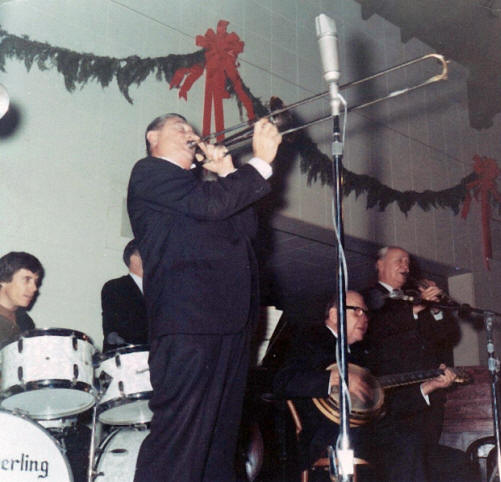
Well I had a ball listening to Clancy’s version! It’s a great torch/barroom song perfectly suited for Clancy’s singing, and he revises the lyrics to include himself in the story!! Each verse goes up a half-step so we start in F, and end up in Ab. It’s a real showcase for Clancy’s Hayes the entertainer and facile elocutionist of tongue-twister lyrics. It tells a good story as well!
The song “Don’t Forget 127th Street” came from the 1964 musical adaptation of Clifford Odet’s straight play from some years back, Golden Boy. It starred Sammy Davis, Jr. and got mixed reviews excepting high praise for the score, although composer Charles Strouse fairly filched the opening phrase of the tune being discussed from Harry Warren’s big hit, 1933’s “I Found a Million Dollar Baby.” The song and words are catchy, and Osie Johnson’s press roll/cowbell opening brings Clancy in fine style. After Yank again expertly backs Clancy’s first vocal, I too was taken with Pee Wee Russell’s clarinet contributions. I wonder if the inclusion of these two show tunes were at the behest of (or due to pressure from) ABC?
Anyhow, the wonderful “She’s Just Perfect For Me,” though penned by the versatile Bob Helm, is a tailor-made vehicle for Clancy! In fact, I think it’s just perfect for me as well and I’ll be learning it! Throughout the side, we are treated to the magnificent pianistics of a relatively young Dave McKenna! Simply grand!
Hal, although Mr. Hayes is not nearly as prolific during the final five years of his life, I know he made some great music between 1967-1969. Take us where you will!
HS: Clancy’s recordings through the rest of the 1960s were a mixed bag, but there are some terrific sideslike this live recording made at the forerunner of Jazz Bash By The Bay! “Rose Of Washington Square” was recorded at “Dixieland Monterey” in March, 1968. Based on the rambling introduction and the mumbled asides and responses to his own singing, Clancy seems to be feeling no pain on this performance. On this occasion, he was accompanied by the legendary New Orleans bassist Pops Foster. I was in the audience, hoping that the rain had stopped for the day!
JB: Delightful! It’s wonderful how Clancy assays a portion of the verse in waltz-time. And what a thrill went up my spine when I heard the applause for Pops Foster’s entrance.
HS: I believe this next track was recorded the same year, at the Manassas Jazz Festival in Manassas, Virginia. The band was co-led by cornetist Johnny Wiggs and clarinetist Raymond Burke and the sidemen were stellar: Paul Crawford, trombone; Don Ewell, piano; Van Perry, bass; Zutty Singleton, drums; and of course Clancy on vocals. The LP (Fat Cat Jazz 105) only includes a few numbers by the full band, but I think this one may be the best. And I love hearing the rarely-played verse!
JB: Hal, we’ve previously covered Johnny Wiggs and it’s a delight to hear him, his old friend Raymond Burke, and all those other New Orleans musicians including a hero of both of ours: Don Ewell!! His two solo choruses are masterful! That verse sends the horns into a vortex coming into the first chorus; nobody takes the melody until Burke finally takes it up in the ninth bar. That having been said, the groove, the rhythm, the feel, make me wish Clancy had done some more recording with musicians from the Big Easy. His vocal sounds much different than anything I’ve heard from him. The quality is still stellar, but it’s a much different approach. By the way, Haldid you love Zutty’s drum solo as much as I did?
HS: According to Chris Reid’s book, Clancy visited New Orleans in 1962. He was a guest artist at a concert of the New Orleans Jazz Club and made an overwhelmingly positive impression on everyone present.
Hearing that windup at the end of the first drum solo, I think Zutty expected the band to come back in. But when they didn’t, he sure did come up with another marvelous chorus!
The date is not confirmed on the next couple of tracks, but they were most likely recorded sometime between 1967 and 1969. Clancy was a featured at Blues Alley in Washington, D.C. with a small combo led by clarinetist Tommy Gwaltney. The LP they made is called Mr. Hayes Goes To Washington and the repertoire includes some numbers that we haven’t heard previously, such as “Poor Butterfly.”
JB: Such a relaxed and moving approach to this old ballad. This is the only time Clancy recorded the tune, and the group of hard swingers behind him lock right into his approach. I especially enjoyed the “modern” solos by vibist Gwaltney and the Shearing-like piano stylings of pianist John Philips. It would have been sweet if Clancy had had a chance to record more with ensembles sporting this loose feel.
HS: There is also a more familiar song, again with a verse that is not heard too often. Clancy really pulled out all the stops on this one: “Way Down Yonder In New Orleans.”
JB: YES! Clancy is in fine form here, and that smooth swing has been replaced with a real Dixie-sound supplied by the same players, Gwaltney now on clarinet. In Clancy’s bio, Chris Reid shares an observation by Steve Jordan, the guitarist on the session [who, as an aside, was the first guitarist to be offered Freddie Green’s spot in the Count Basie Band after Freddie died between sets in Las Vegas in 1987, albeit this being three year’s after Basie’s passing], that Clancy looked older than his fifty-nine years but that when he began to sing, the years sloughed off him tune by tune!
HS: At the end of the 1960s, Clancy was playing engagements with the “Ten Greats Of Jazz” just before it was renamed “World’s Greatest Jazz Band.” On a live recording by the band, we hear Clancy singing with an outstanding rhythm section: Ralph Sutton, Bob Haggart and Morey Feld. The song is Hoagy Carmichael’s “Washboard Blues” and this version is a real showstopper!
JB: I’ve always had a love-hate relationship with this song. I never enjoyed Hoagy’s version of it. It seems too episodic for me (although I’ve always treasured the epic version arranged by John Sheridan for the Jim Cullum Jazz Band). When I heard Max Morath’s version, it became a favorite, and I like Clancy’s even better! The setting and story come alive when Clancy warbles this one, and becomes even more beautiful when Bob Wilber starts backing him on the soprano sax. Wouldn’t it have been marvelous to hear this line-up live? Yowza!!
HS: There is one more track from this era that I want to share: “Wolverine Blues,” from a concert for the Blue Angel Jazz Club in Los Angeles. The BAJC was one of the earliest jazz parties and it is fortunate that they included Clancy in the roster. On this occasion he played and sang with an incredible band: Dick Cary, Bob Havens, Matty Matlock, Marvin Ash, Ray Leatherwood and Jack Sperling! Listen to how Clancy sings and scats the first part of the song and the turnaround into the final strain. This excellent band reminds me of the mid-1950s Scobey bands. It is some pretty listenable music, wouldn’t you say?
JB: It sure is! Clancy’s banjo intro and breaks on this last tune are wonderful as well. Everyone sounds in top form (Matlock’s and Haven’s solos are supreme, and Marvin Ash has always been one of my favorite pianists!). The appreciative audience seemed to know they were experiencing something very special. I have to say one final time, I’m amazed at how effortlessly it seems Clancy’s delivers tunes with so many words! He’s never flummoxed, he always makes the words clear and the rhythm swinging! Chris Reid chose wisely when he named his bio The Swinging Minstrel!
I’ve chosen one more track to say goodbye to Clancy that features him with the Scobey band, since that was the band with which he had such a longstanding relationship. It’s a great one called “Lovey Came Back.” Only ebullient entertainers like Mr. Hayes could put this one across. The tune itself is very nice, with a serviceable bridge and good blowing changes, but the set-up and punchline made this one a feast for Clancy fans. I won’t give it away, but the singer’s girl comes back with a bunch of experience (and other accoutrements) she didn’t have when she left!
Hal, I sure wish Clancy could come back. I don’t think I’ve ever smiled as much doing one of our columns as I have during our three on this revered entertainer, singer, and musician. Beloved by so many, his legacy lives on today in the work of people such as Bob Leary and Tom “Spats” Langham, to name just a couple. You suggested exploring the hot jazz music of composer Fred Rose (even his titles were hot: in addition to the well-known “’Deed I Do” and the multi-strain “Deep Henderson,” he wrote “Red Hot Mama” and “Flamin’ Mamie”!) I’m all for that! See you next month!
HS: It’s nice to hear “Lovey” with the Scobey band swinging away behind that enjoyable vocal! Exploring Clancy’s recordings has been a lot of fun and now I’m really looking forward to discussing some of the great hot music composed by Fred Rose.
JB: I’ll bring my extinguisher!!
Hal Smith is an Arkansas-based drummer and writer. He leads the Golden Snake Jasss Band and the El Dorado Jazz Band and works with a variety of jazz and swing bands. Visit him online at halsmithjazz.com.
Write Jeff Barnhart at mysticrag@aol.com and visit his website www.jeffbarnhart.com.
Jeff Barnhart is an internationally renowned pianist, vocalist, arranger, bandleader, recording artist, ASCAP composer, educator and entertainer. Visit him online atwww.jeffbarnhart.com. Email: Mysticrag@aol.com