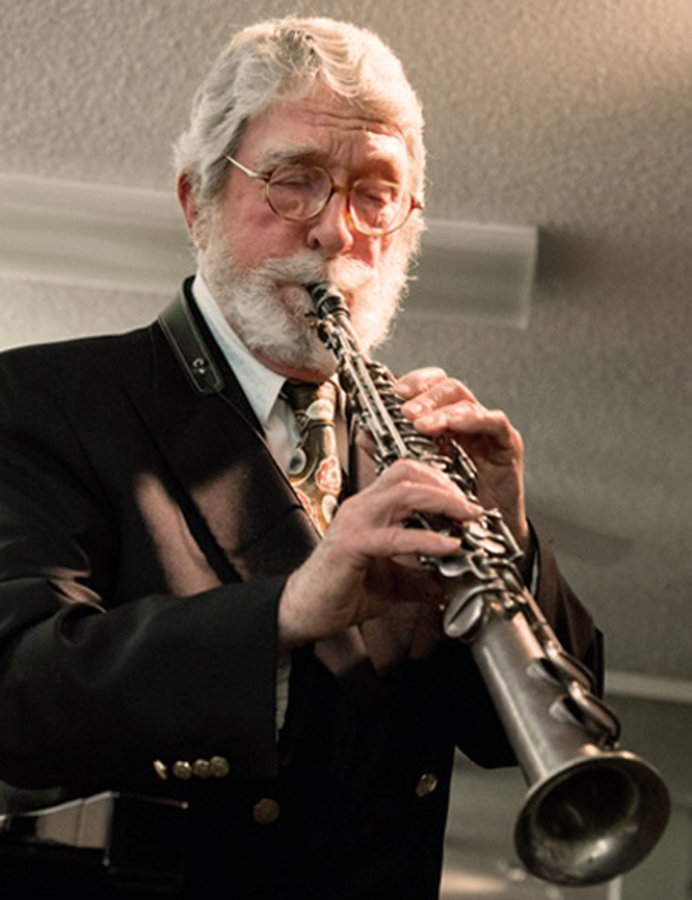
 Henry Blackburn was one of the most consequential behind-the-scenes figures in the traditional jazz revival, a gifted clarinetist and soprano saxophonist who, as a young medical student in New Orleans, fell under the spell of the music and spent the next eight decades carrying that flame northward to Minnesota and around the world.
Born in Miami, Florida, on March 22, 1925, Blackburn first came to music not in New Orleans parlors but in wartime service. He played clarinet and saxophones in US Navy swing bands during World War II. His real conversion came afterward, when he enrolled at Tulane University School of Medicine in New Orleans and encountered the nascent traditional jazz revival firsthand. He was “on the front line” of that revival, absorbing the sounds of post-war New Orleans and carrying them with him to Minnesota when he joined the University of Minnesota faculty in 1956.
What set Blackburn apart from other jazz-loving doctors was his organizational drive. In the summer of 1959, he was already hosting amateur jam sessions with the Amatooters and mentoring young musicians, it was there that a teenage Butch Thompson first met “Dr. Henry Blackburn, who played soprano saxophone and who would shortly play a key role in my early career,” Thompson later recalled. By the summer of 1961, Blackburn was leading a quartet at George Conroy’s, a St. Paul nightclub, with the young Thompson sitting in.
That same year, Blackburn was present at the very opening of Preservation Hall in 1961. Seized by the idea that Minneapolis needed this music, he founded Jass Sponsors, Inc., a consortium of Minnesota backers who guaranteed against losses and accepted no profits. The group pulled off something historic: the first tour ever by a Preservation Hall Band anywhere. They brought them to the Tyrone Guthrie Theater and the University of Minnesota in July 1963. The tour was so successful it was repeated in 1964, and from that second tour came an LP: New Orleans Sweet Emma Barrett and Her Preservation Hall Jazz Band, for which Blackburn wrote liner notes at the request of Allan Jaffe.
Though he played clarinet throughout his career, it was soprano saxophone, specifically, the influence of Sidney Bechet, that became Blackburn’s true voice. A University of Minnesota story captures the image, Blackburn “playing saxophone along with Sidney Bechet records on a boisterous Italian portable record player.” His colleague Russell Luepker never forgot the first time he witnessed Blackburn in action in 1972. Arriving at Preservation Hall, “Henry was greeted by the musicians, who invited him to sit in and play with them.”

Blackburn was foundational to what became a thriving traditional jazz community in Minnesota, so thriving that The Mississippi Rag, the once preeminent national trad jazz publication, being based there was “no coincidence” given Blackburn’s role. He was part of the community alongside the Hall Brothers New Orleans Jazz Band, Bill Evans, Bill Price, and others who not only showed Minnesotans what real New Orleans music sounded like, but brought many musicians from New Orleans to demonstrate it. The Hall Brothers eventually opened the Emporium of Jazz in Mendota, a traditional jazz Mecca for 25 years, partly supported by Blackburn and a circle of investors.
He led the Abbott Hospital Dixieland Jazz Band and performed in various configurations documented on recordings, and he was a regular at the legendary Dakota Jazz Club in Minneapolis, where the Preservation Hall Jazz Band recognized him warmly during a 2018 show.
Blackburn’s jazz life followed his epidemiological research around the globe. In 1968, on a trip to Japan for a medical study, he visited the New Orleans Rascals of Osaka and jammed with the band. It was the beginning of a multi-decade international friendship: “It would be the first of many meetings that continued in Japan, New Orleans, and Minnesota over many decades.” The sessions, spanning 1968 to 1993, were informally recorded to tape and released on Bandcamp as New Orleans Rascals of Osaka with Henry Blackburn, featuring Blackburn’s dominant soprano sax leading the band through warhorses like “China Boy,” “Yellow Dog Blues,” “Sweet Substitute,” and “Lady Be Good.” The Rascals in those years were, by any measure, one of the finest traditional jazz bands in the world.
He also recorded with the Creole Jazz Band, the Bechet Big Five, and various Blackburn-Balluff and Blackburn-Beach configurations, and participated in recordings from a 1962 night at a Minnesota jazz club, predating even the Emporium of Jazz, with Doc Evans, Jax Lucas, and others. As he approached his 100th birthday, Blackburn made a point of preserving and releasing over 20 of these recordings to Bandcamp for posterity. They span six decades, from early sets in Minnesota to his various groups in more recent decades.
Jazz88 (KBEM-FM), Minneapolis’s jazz radio station, announced his passing with a tribute shared by singer Patty Peterson: “Clarinetist and cardiologist, he is a MN Jazz Legend”. That epithet barely scratches the surface. Henry Blackburn’s role in planting the Preservation Hall sound in Minnesota, mentoring generations of musicians, forging jazz connections between Minneapolis, New Orleans, and Osaka, and preserving decades of informal recordings made him one of the great unsung champions of the traditional jazz revival. He was 101 years old.

Joe Bebco is the Associate Editor of The Syncopated Times and Webmaster of SyncopatedTimes.com