 It can’t have been easy for the kid who later became known as Little Jimmy Scott. Born in Cleveland in 1925, Scott’s mother died when he was 13 and his father deserted the 10 kids. He was born with Kallman Syndrome, which causes delayed or absent puberty. Four feet, 11 inches tall until the age of 37, when he grew by eight inches, he always had a voice that could easily be mistaken for that of a woman.
Scott left home early and started to work in a steel plant. He was a member of the Future Outlook League and participated in local civil rights actions. An aspiring singer, he loved Paul Robeson because “he wasn’t afraid to go wherever his artistic mind led.” In 1942 he started work as an usher at Cleveland’s Metropolitan Theater, which allowed him to soak up the music of major jazz acts of the era, including Ella Johnson, Cab Calloway, Duke Ellington, and Erskine Hawkins.
He had been offering extra dressing room prep services to artists and at age 18, he was asked by the vaudeville act Neal and Sims to travel with them as valet. At a gig in Meadville, Pennsylvania, Neal and Sims shared a weekend bill with a group that included Ben Webster and Lester Young. Scott got up the nerve to ask the musicians to let him sit in on a few pieces, which they did. Shortly after he began to sing, he recalled, the audience stopped dancing and gathered around the stage to listen.
Scott’s first recording was 1949’s “Everybody’s Somebody’s Fool” with Lionel Hampton, who dubbed him Little Jimmie Scott. Although other vocal tracks made by Hampton at that time did credit the vocalist(s) by name (Sonny Parker, Dinah Washington, Lionel Hampton) Scott is not credited on the label, which says “Vocal with Orchestra.”
Jimmy Scott’s voice might be called either a contralto (a low female vocalist range) or a high tenor. He used considerable vibrato. These are properties not associated with jazz and in fact, due to his early association with Lionel Hampton, he was first seen as an R&B singer. When he recorded “Everybody’s Somebody’s Fool” there was a lot of fluidity between R&B and jazz—Hampton being a prime mover in that—and that recording made it onto the R&B charts.

In 1950, Scott appeared in elite bop company, sitting in on “Embraceable You” with Charlie Parker and Fats Navarro on the album One Night in Birdland—a homemade recording. After Fats plays a chorus, he sounds like he expects to continue his solo, but Scott comes back in with confidence.
In the 1950s, Scott spent a lot of time time gigging in Harlem, his home town Cleveland and Newark. Toward the end of the decade, he toured with packages that included the likes of Big Maybelle, Little Willie, and Bill Haley and The Comets.
He recorded for Coral, Brunswick, Roost, and Savoy, based in Newark, for which he recorded 60 sides. We will see that his contract with Savoy and its “connected” proprietor Herman Lubinsky came back to bite him.
All the while he was doing day jobs-he worked in a factory making plastic molds and as a stock clerk in a plant store. His off-and-on companion Mary Ann Fisher, who’d been working with Ray Charles, got Scott to come out to Los Angeles in 1963 and he recorded Falling in Love is Wonderful for Ray Charles’ Tangerine Label. The record was released and got a strong response, but when Lubinsky heard about it, he said Scott was still under contract to him and threatened to sue Tangerine Records. Ray Charles withdrew the recording and replaced Scott’s voice with Wild Bill Davis playing organ.
Lubinsky also managed to keep Scott’s 1970 recording The Source from Atlantic Records from being released.

1973 to 1984 were years of almost no musical activity. He was living in Cleveland with family, caring for his aging father. He had taken a bad fall and was surviving on disability checks. He did one botched, ill-fated session for—of all record companies—Savoy. Lubinsky was near to death and knew nothing of the session.
Then, a few things happened that resurrected his career. In 1984, an old friend and future wife Earlene convinced Bob Porter, a record producer and DJ on Newark’s WBGO to interview him on air. The response was unexpectedly large. Then, in 1988, Jimmy McDonough published a piece about Scott in the Village Voice. This article reached a different, hip, urban audience. It coincided with a chance appearance at the Blue Note: Scott happened to be in the audience for the eighth anniversary celebration in honor of Cab Calloway and was asked to sing. Powerful people in the audience were impressed. In 1989, he received an award from the Rhythm and Blues Foundation which had also gotten Atlantic Records to release royalty checks owed to many artists, including Scott.
The biggest break came because Doc Pomus, who eventually wrote many rock and roll hits, was an important advocate. Pomus himself began as as an aspiring jazz and R&B singer and had been a friend of Scott since the 1940’s. Pomus said that more often than not, he was the only Caucasian in the nightclubs, but that as a Jew with polio, he felt a special underdog kinship with African Americans. Pomus championed Scott’s cause with an open letter to Billboard magazine in 1987 and tried for years to get record labels interested. When Pomus died in 1991, his wife asked Scott to sing at his funeral and it was there that it finally happened. Seymour Stein, a Warner Brothers executive, heard him perform “Someone to Watch Over Me” at the funeral and signed him to a contract. The LP that resulted, All the Way (1992), earned a Grammy nomination.

Hipsters of all stripes were drawn to him as an outsider. He was celebrated for the last years of his life and many people came forward to remark on his art and his influence. Madonna, Michael Stipe, Nick Cave, David Byrne, Bruce Springsteen were all fans. Frankie Valli and Joe Pesci (he was a singer before becoming an actor) said he personally mentored them and old Hampton band mate Quincy Jones said Scott “would tear my heart out every night.” He appeared on Lou Reed’s 1992 recording “Magic and Loss” and in an episode of David Lynch’s 1990s television series Twin Peaks. From that point on, it was award after award and a high public profile until his death in 2014.
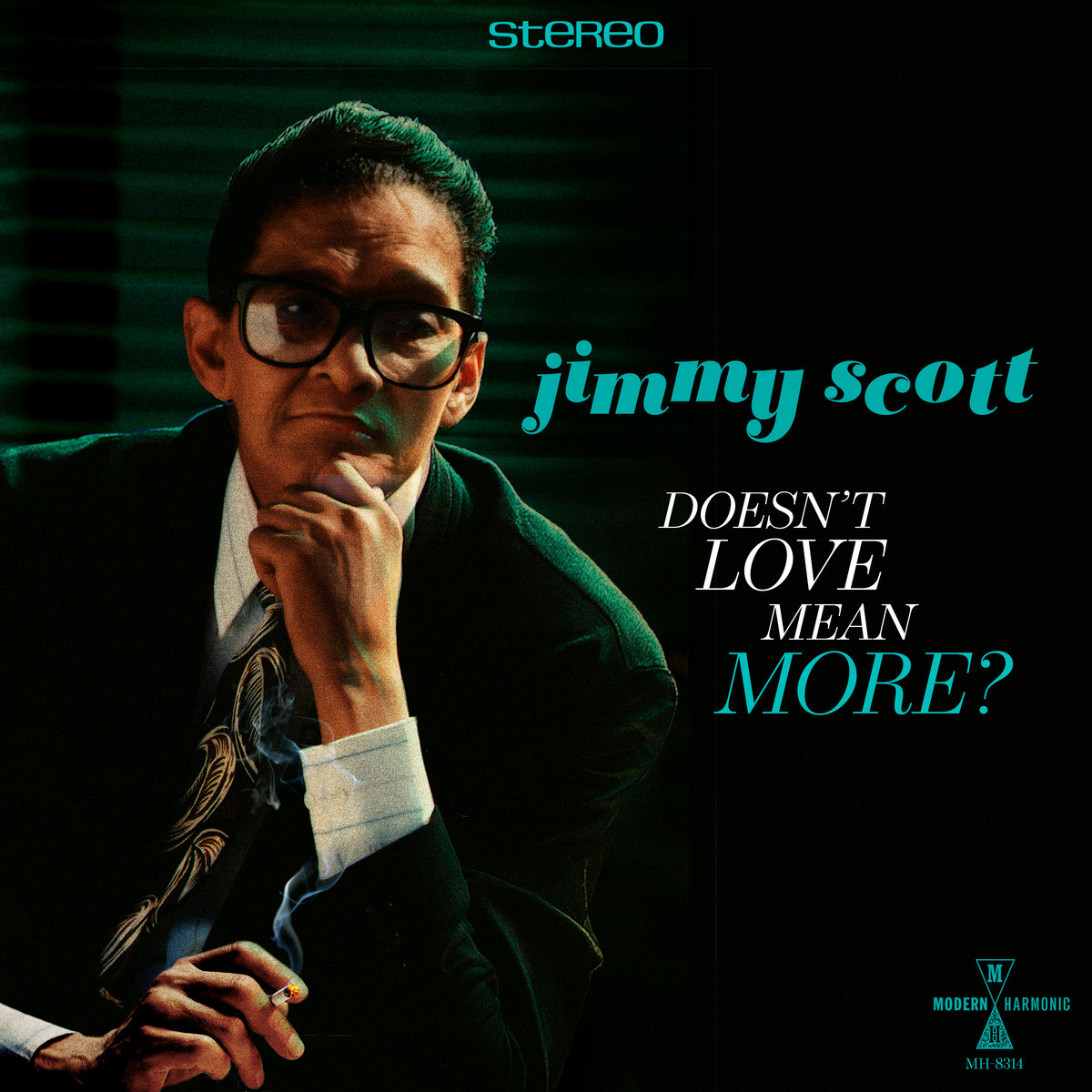
In this re-release of a 1990 set of tunes, Doesn’t Love Mean More, Scott works with a group he called The Jazz Expressions: Kenichi Shimazu, Piano; Hilliard Green, Acoustic Bass; Brian L. Kirk, Drums; and Alvin Flythe, Sax.
This set of nine tunes includes “Itchy” and “Blues for Little J” which have no vocals.“Portrait of a Family” has Scott briefly speaking his thanks to his faithful supporters. He sings on the rest of the tunes: “You Were Right Next Door,” “Doesn’t Love Mean More,” “I’ll Love You Just the Same,” “To Say I Love You,” all ballads. “How Can I Tell You? is a medium tempo jazz tune, “I’ve Loved You Always” is a mid-tempo, pretty straightforwardly R&B tune and “Another Side of Me” is a medium jazz tune which reminded me of some of Abbey Lincoln’s work.
Although there was an increasing huskiness and some wavering to his voice, there was a remarkable similarity between Scott’s very first and last recordings, 40 years later. Scott said his biggest influence was operatic baritone Paul Robeson, but if I was to liken him to other singers, his impassioned quality would be akin to that of Big Maybelle and Jackie Wilson and his penchant for slow ballads and playfulness with time I also find in Shirley Horn. Edith Piaf and Charles Aznavour, although French, I would consider his musical soulmates.
For someone who sounded and looked as unique as Scott, it took tremendous grit to forge a career in public performance in mid-century America. While he led a complex and chaotic personal life, had multiple marriages and wrestled with alcohol, he showed tremendous patience and restraint in the face of taunting and rejection. Clearly he internalized a lot of emotion, but he was able to channel that emotion when he sang and in so doing, Jimmy Scott brought a singular voice to jazz.
Love Doesn’t Mean More
Jimmy Scott
sundazedmusic.bandcamp.com
Steve Provizer is a brass player, arranger and writer. He has written about jazz for a number of print and online publications and has blogged for a number of years at: brilliantcornersabostonjazzblog.blogspot.com. He is also a proud member of the Screen Actors Guild.