Shrink the land mass of the continental United States to the size of California. Link every major city by high speed bullet train. Would you be able to assemble enough jug bands to pull off something like the Yokohama Jug Band Fest? Maybe not. Perhaps you’d need a magic ingredient, some kind of cosmic dust, maybe something from the moon.
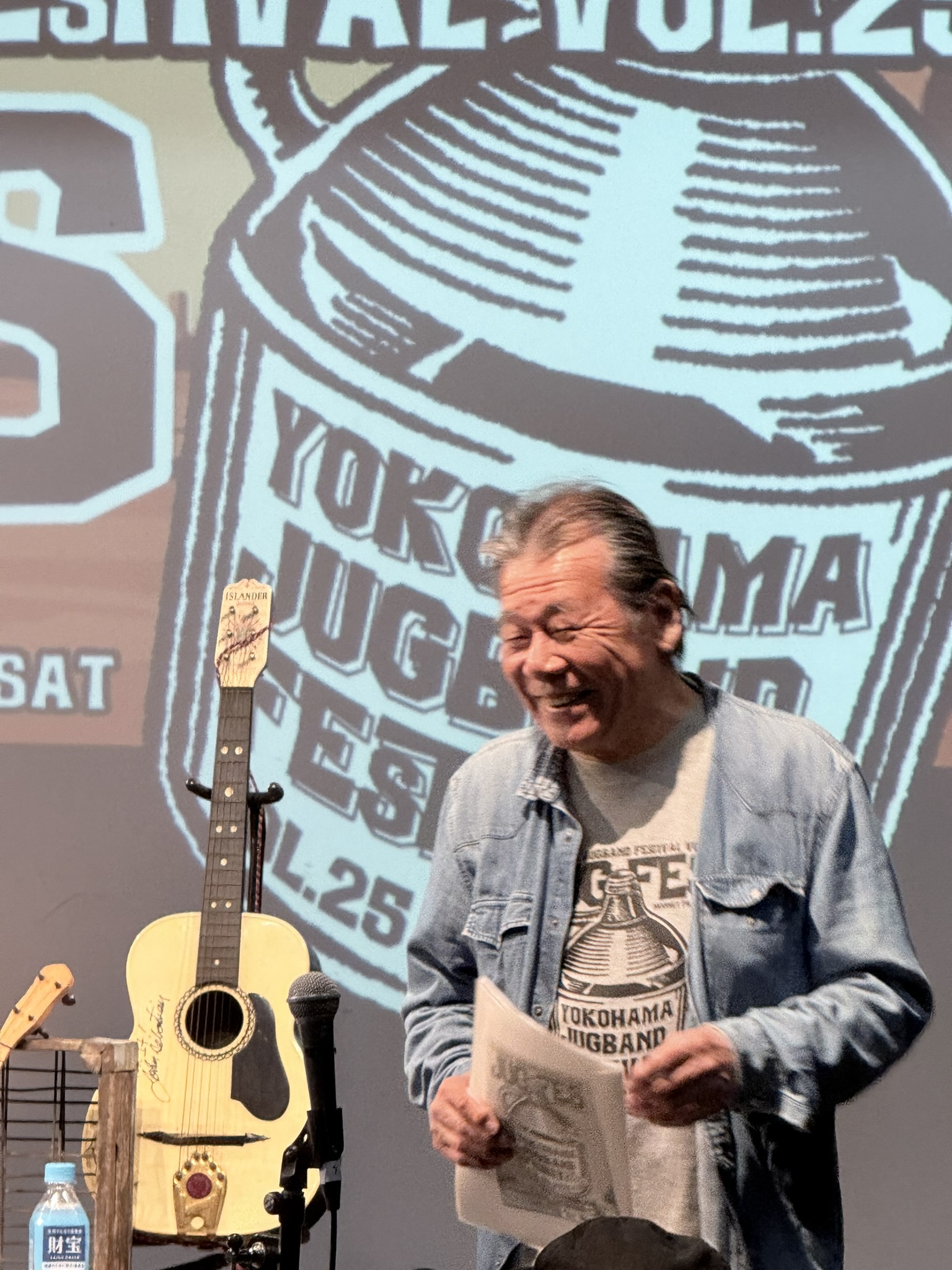
When I attended the twenty-fifth iteration of this annual Japanese jug band miracle this past April, I quickly found out where the magic came from: the festival’s founder, Yoshiaki Hashizume, aka “Mooney.” As I wandered between seven stages on the day of the festival, Mooney was everywhere: introducing bands, telling jokes, making sure the sound was right, playing his guitar and singing. And whenever I chatted with a performer about how jug band music became a “thing” in Japan, I heard about Mooney, a touring musician with a love for American roots music who inspired other musicians to start jug bands.
Let me put this phenomenon of a festival in perspective. I attended the National Jug Band Jubilee in Louisville Kentucky in 2019, where twelve bands participated. In Yokohama in 2026, sixty bands gathered from all over Japan to perform!
Jug band music is a small slice of Americana that straddles comfortably across the jazz, blues, string band, and popular music of the 1920s and ’30s. Born from Vaudeville and medicine shows, most featured some form of “hokum”: visual gags, entertaining banter, and lyrics that used double entendres to present the edgy topics of the day in song. A typical jug band included a mix of conventional string instruments, homemade contraptions, and sometimes horns or reeds. It was often performed on street corners and bars.
Jug bands in towns along the Mississippi and Ohio rivers, like the Louisville-based Dixieland Jug Blowers, played music with a New Orleans jazz tinge (especially with Johnny Dodds on clarinet), while others, like the Memphis Jug Band, were bluesier. While many early jug band musicians were never recorded and therefore lost to history, others were captured on 78s. At the height of jug band’s popularity, several well known musicians such as Louis Armstrong, Ma Rainey, and Jimmie Rodgers recorded with jug bands.

Like many forms of American roots music, jug band music was revived in the 1960s. Several folk and rock stars—Jerry Garcia, John Sebastian, Maria Muldaur, David Grisman, and Geoff Muldaur—played in jug bands in their early careers. Jim Kweskin and The Jug Band is the most well known and enduring revivalist jug band, and Kweskin can be credited for bringing many traditional jazz tunes and tin pan ally songs, such as “The Sheik of Araby” and “Somebody Stole My Gal,” into the jug band canon.
You may wonder: How did this distinctly American music become so popular in Japan?
Post World War, all sorts of elements of American culture cropped up in Japan, including music: jazz, blues, country, and folk. There also seems to be a cultural element at play, as many Japanese dive into their passions (manga, anime, etc.) with single-minded obsessiveness. Ride a train in Japan, and you’ll see this obsessiveness in the form of the daily “cosplay” that many Japanese engage in, dressing in ways that are inspired by manga characters or other cultural icons.
I had the good fortune to bump into Hiroshi Asada, a well known concert promoter in Japan whose Tom’s Cabin Production Company has brought musicians from Tom Waits to the Talking Heads to stages throughout Japan. When I asked him how jug band music became a phenomenon here, he humbly pointed to several tours by Jim Kweskin that he had arranged. The first was in 2006, when Geoff Muldaur, John Sebastian, and Kweskin performed at the Yokohama festival, no doubt providing fuel to the sparks of Japanese jug band fandom in the early years of the festival.
After that festival, the three performed in Tokyo with Japan’s Old Southern Jug Blowers and Mooney’s Mad Words in a tribute concert to Fritz Richmond, the Kweskin Band’s beloved and virtuosic jug blower and washtub thumper who had urged the band to connect with the nascent Japanese jug band scene before his untimely death in 2005. According to an article in Roll Magazine, the Japan connection started with Richmond, who had been sought out by Japanese jug bands for tips on jug blowing technique.
Repeated visits by Muldaur, Kweskin, and Sebastian over the years have no doubt augmented Mooney’s ubiquitous inspiration to create a Japanese jug band groundswell. Twenty years later, this jug-band-obsessed American reveled in surfing the Japanese jug band wave through the festival’s multiple stages.
I discovered the Yuglet Waterloo Jug Band warming up on a bridge over a canal near one of taverns that was hosting bands. The sounds they produced would not have been out of place on a New Orleans street corner. Fedora topped and clad in colorful vintage-style clothing, the band was visually striking. They featured an eclectic mix of instruments: banjo, washtub, accordion, mandolin, guitar, violin, washboard, kazoos, and clarinet. The band played rousing English versions of a couple of jug band standards, and then, quixotically, a Japanese version of “Santa Claus is Coming to Town.” I knew I was in for a day of surprises.
At the start of the festival, I thought I’d wander over to the main stage. I weaved through a crowd of Saturday shoppers headed in what I thought was the right direction, and luckily encountered Yuglet’s clarinetist, who was headed there also. She helped me to alter course, which I much appreciated, given that the extent of my Japanese vocabulary was limited to “hello,” “goodbye,” and “thank you.” Later in the day, I caught Yuglet’s first set. They brought an energy and charisma to such jug band standards as “The Sheik of Araby” and “Rag Mama.” I’d follow them anywhere!

The main stage was outdoors at an intersection of shopping malls and commercial buildings that created a natural amphitheater, and the unusually warm early April weather augmented the crowd. Passersby could listen from above the stage from the mall’s outdoor veranda, and dedicated festival-goers could dance on the plaza below. Simultaneous performances were scheduled on six other stages, mostly in a building about a block away that housed a cinema, several restaurants and bars, and a small theater.
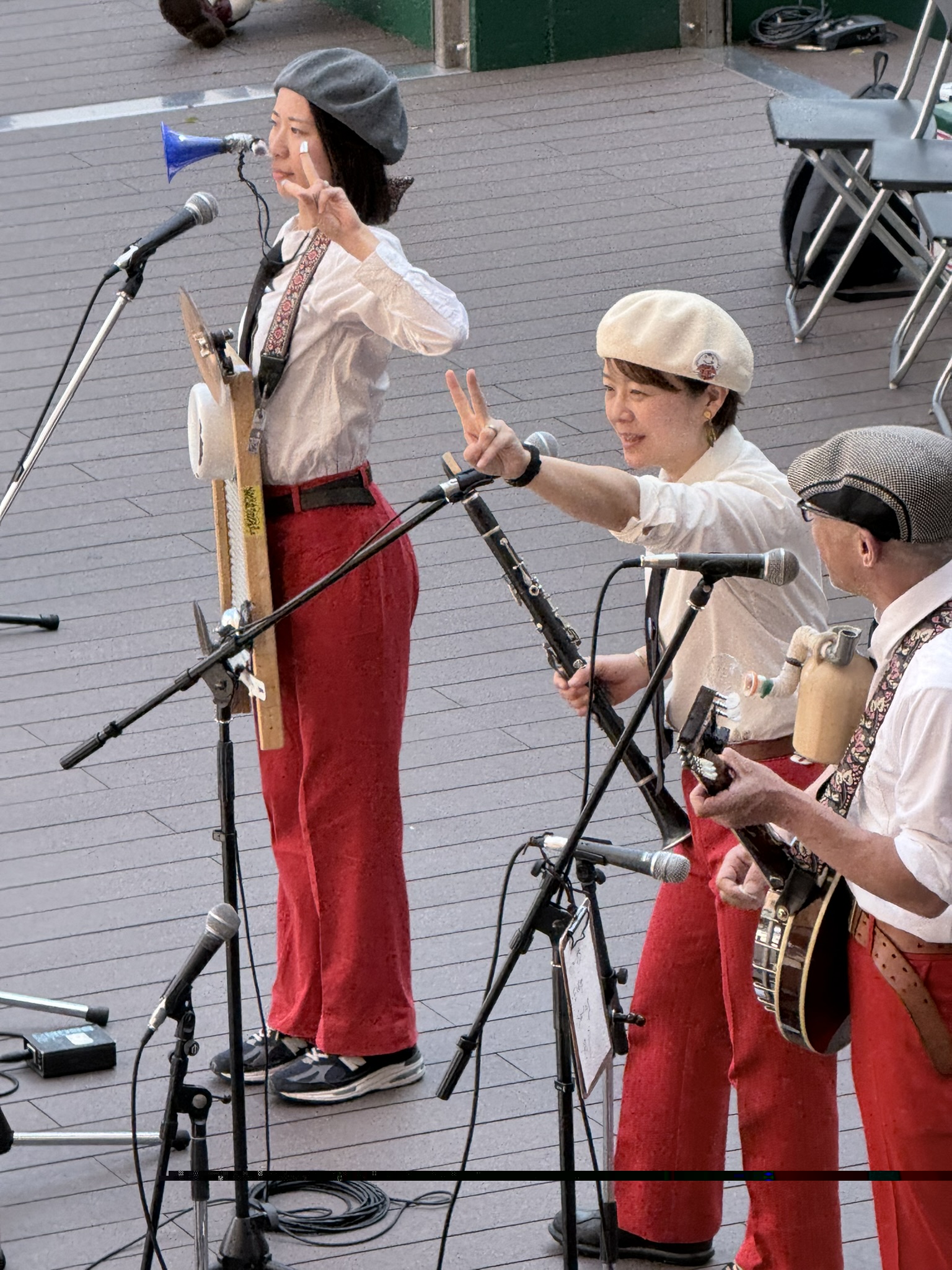
Many of the bands performed jug band or traditional jazz classics. sometimes in English but more often in Japanese. A band called Kechon Kechon had the crowd singing on the Louie Prima hit “I Ain’t Got Nobody,” tightly played on washtub, banjo, mandolin, and two washboards. The BiGOOD!, a trio decked out in red pants and white tops, projected a big sound with just washboard, clarinet, and banjo. The Liyama Gakideka Jug Stompers knocked out a terrific version of the Dixieland Jug Stomper’s classic “Banjoreno,” featuring multiple banjos and driven by a jug beat, mirroring the original.
The music I encountered was true to jug bands worldwide: eclectic and wide-ranging in genre and instrumentation. While versions of “Please Don’t Talk About Me When I’m Gone,” “Sunny Side of the Street,” “Down by the Riverside” or “My Blue Heaven” could be heard in Japanese or English, some bands strayed further. I heard Mungo Jerry’s 1971 hit “In the Summer Time,” played by the Rag Papas Jug Band, fueled by the mandolin playing of Shin Akimoto, aka “the Bill Monroe of Japan.” A band called Sababand played a version of Louisiana Fairy Tail that sounded distinctly Hawaiian, as the group centered around a slide guitar lead. The Taiwan-based Muddy Basin Ramblers (the only band not from Japan) mirrored the eccentric and eclectic nature of the festival, sounding like a traditional jazz band in their version of “Tiger Rag” one minute, and in the next, like a bluegrass band on an original number composed by their fiddler.

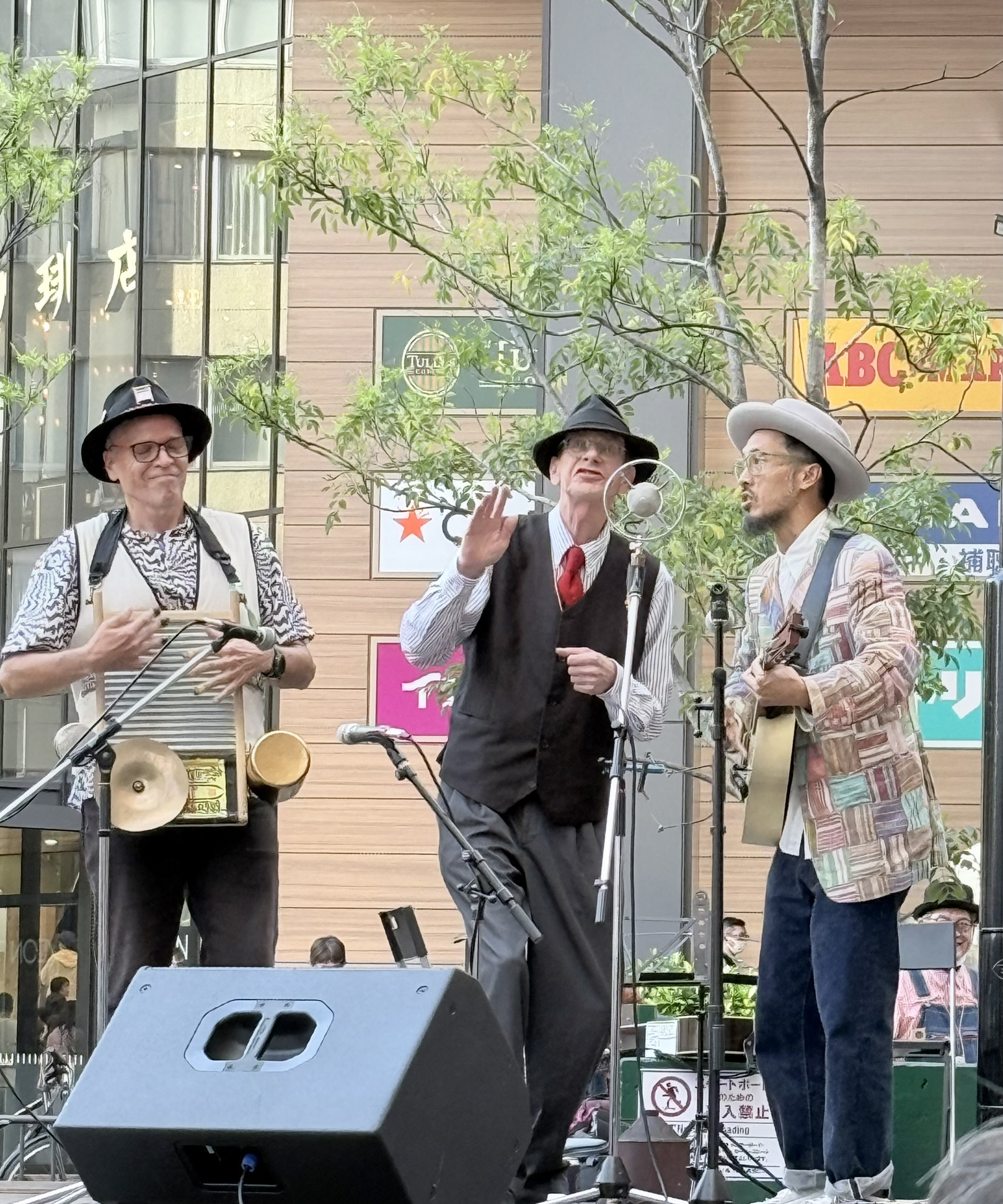
Keep a festival going for 25 years and you’ll see how it can become a family affair. I made friends with Hanawa Takahiro, the guitarist in a band called Free Swing. His “other band,” Spicy Coco Chan, also played at the festival. The band includes his twenty year old washboard-playing son Koyuki, who started fooling around on washboard when he first attended the festival at age three, and his daughter Misori on vocals and ukulele. They played a lively, swinging version of “Please Don’t Talk About me When I’m Gone” that’s still in my head. For the perennially returning bands, the festival serves as a reunion of old friends united by their love of this music. Tim Hogan, the washboard player from The Muddy Basin Ramblers, told me that many of the bands play at the festival for love not money, footing all of the expenses just to be a part of the festivities.
Jug band “hokum” was on display throughout the festival. Google Translate and I only understood about ten percent of the verbal jokes, but the visual gags were ever-present. In Mooney’s band, the harmonica player kept the melody going while seemingly brushing his teeth with his harp. At the end of the set, the band’s dressed-in-drag guitarist lifted his wig to reveal his shiny bald pate, to the roar of the crowd.
A high point of the festival for me was the “Summits”—gatherings of all of the harmonica players, washtub thumpers, and washboard scrubbers on stage in succession. First, fourteen harmonica players at the Harmonica Summit took turns at soloing over the Memphis Jug Band’s “Jug Band Waltz” with Mooney’s accompaniment. It seemed as though the stage could not be more crowded, but after they finished and left, the washtub players arrived, filling the stage to overflowing. Curiously, the washtubs played in Japan are more like oversized plastic flowerpots, the classic galvanized washtub found in American bands a rarity; however, the bass runs from these plastic creations were spot on and resonant in the hands of these masters. A band cobbled together from several of the festival’s jug bands played a call-and-response number that the audience all seemed to know, while each of the tub thumpers had a turn to solo at instrumental breaks.
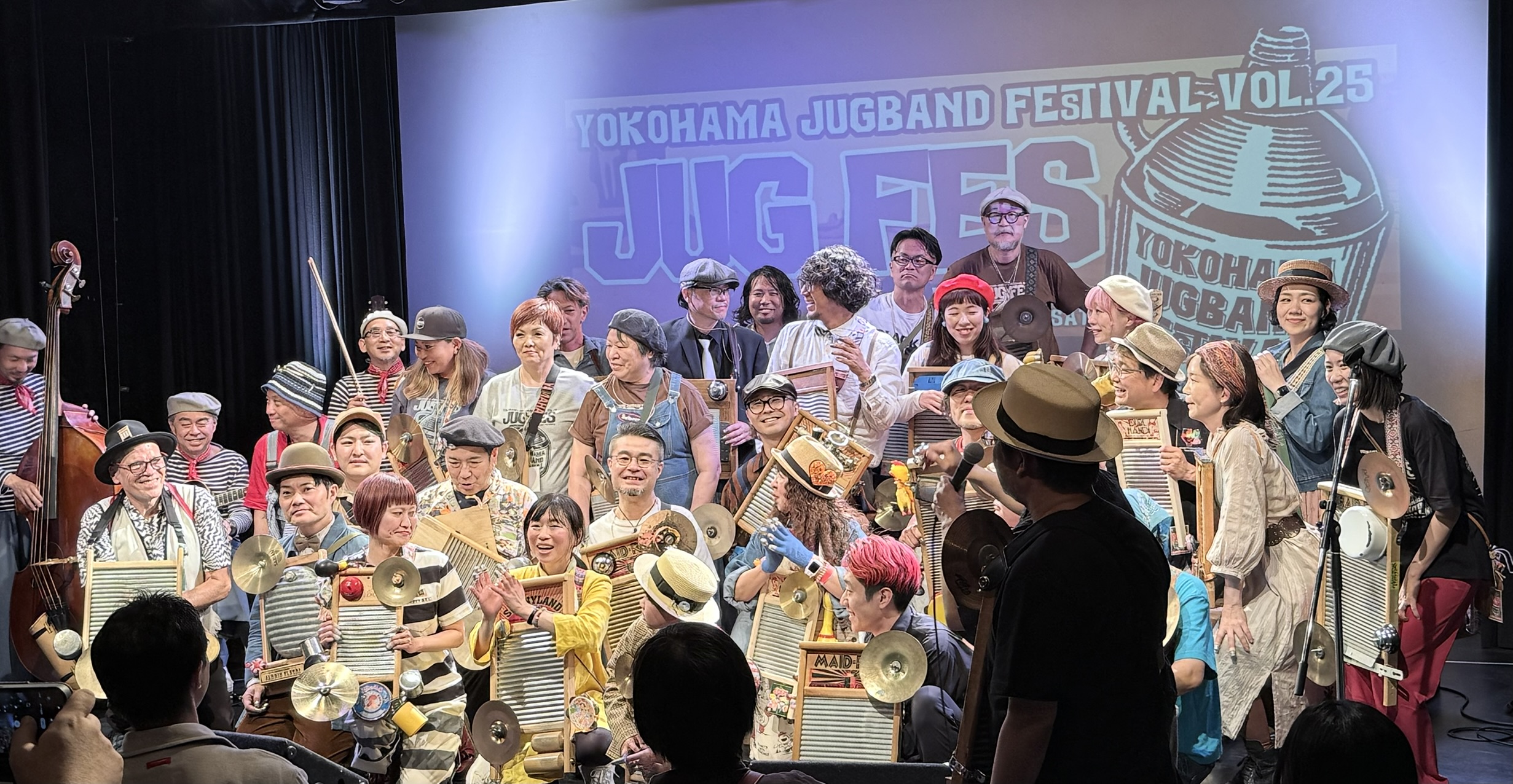
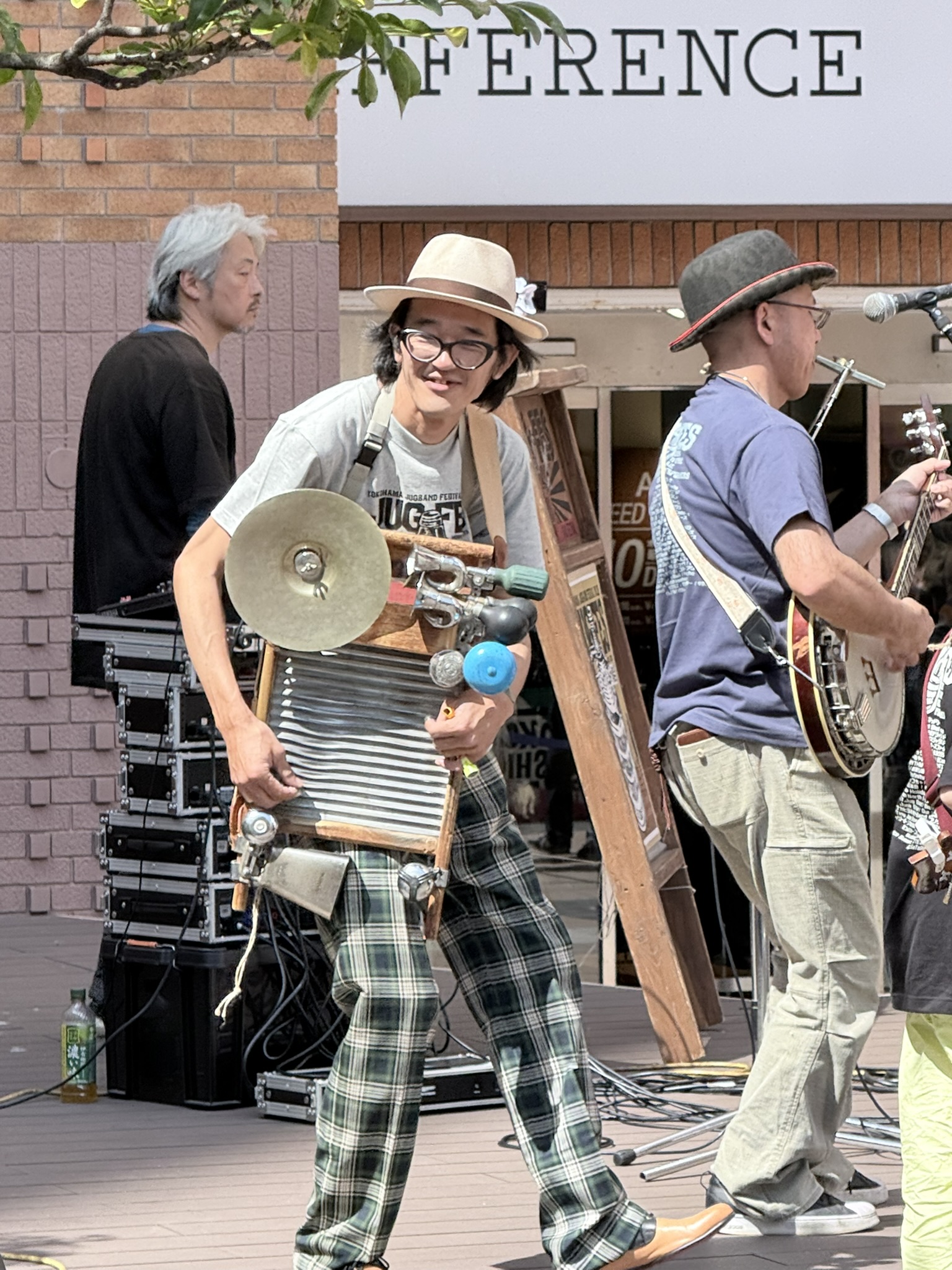
Then came the washboards. Not every band at the festival had a jug, but it seemed that each had a washboard. I tried to count them all on the summit stage but only got to twenty five as the layers of washboard scrubbers filed in in groups of three for their turns in the spotlight. What I love about washboards is that there is no one right way to outfit or play them—upside down or sideways, vertical or horizontal, with thimbles or brushes or spoons, tricked out with cymbals, tin cans, or bells and whistles—anything goes. And, indeed, anything went! The scrubbers ranged in ability from solid to virtuosic, some swaying hips in time to their syncopation while the back-up band played “I’ve Got That Old Fashioned Love in My Heart” in Japanese. At the end, the youngest of the group emerged, age nine or ten, and his playing brought down the house.
In Todd Kwait’s 2007 documentary film about jug band music Chasin’ Gus’ Ghost, John Sebastian recounts a conversation with Fritz Richmond, who said, “We might have to look to Japan for the future of jug band music.” The joy and enthusiasm of the Japanese jug band scene left me wanting more. Shrink the time it takes to fly between Boston and Japan by about half, put me on a high-speed bullet train, add a little magic Mooney dust, and I’ll be back every year.
Thanks to: Ernesto Gomez and Kiyoshi Imai for helping me connect to some of the Japanese organizers and players. “Arigato” to Shin Akimoto, Yoshiaki “Mooney” Hashizume, Hanawa Takahiro from Free Swing, and Tim Hogan from the Muddy Basin Ramblers for filling me in with background about the festival.
Visit author, artist, and musician Michael Buonaiuto online at thejugnut.com