The 52nd Scott Joplin Ragtime Festival, held May 27-30, had not even begun before I met two of the musicians getting off the same train I was on coming to Sedalia—Steve Hicks and Tadao Tomokiyo. Tadao, in fact, was sitting a few rows ahead of me in the same car, but I didn’t notice him.
This year’s festival presented an extensive and outstanding roster of musicians—21 pianists and 15 others by my count. A few were new to me, as well as to the festival: drummer Josh Duffee from Davenport, banjoist Gavin Rice from New York (whom I profiled in my January column), multi-instrumentalist Colin Hancock, also now of New York, banjoist Davey Jones from Michigan, bassist Tyler Thompson from New Orleans, and percussionist Nick White from Chicago. I apologize if I missed any. The festival theme was “Non pareil”—French for “without equal.”
There were a few events I missed, either by not arriving early enough or by choice: the trolley tour of the city, Dining with the Stars, the Ragtime Dance, and “An evening with David Thomas Roberts” (he was this year’s Outstanding Achievement winner).
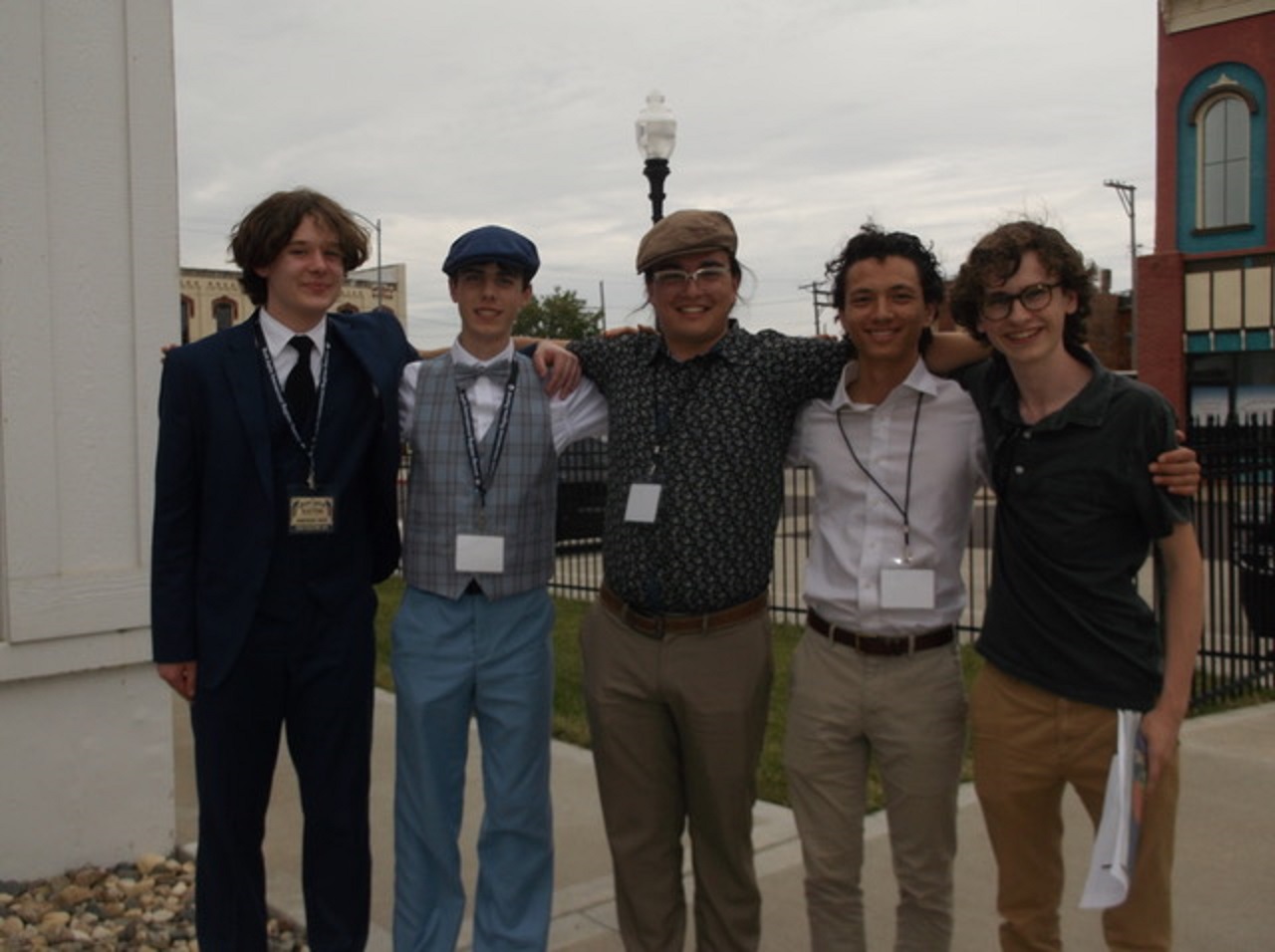
I should not fail to mention the Ragtime Kids program, begun in 2021 by Bill McNally. All but one of the “kids” were here (see nearby photo). Only Isiah Burton was absent, as he was getting married that weekend. The newest “kid,” Anderson Pries, age 16, is organizing a ragtime festival on August 22 and 23 at the Fox Valley Trolley Museum in South Elgin, IL, about 35 miles west of Chicago. I wish him well.
Weather-wise, we were spared Sedalia’s typical summer heat, but except for the first day, it was unsettled, with rain and thunderstorms making occasional appearances. These apparently had some effect on the outdoor music sets, but I was able to make adjustments to the performances I had planned to see. With three venues operating simultaneously, choices were necessary in any case. I believe that, between the individual sets and the scheduled concerts, I was able to see all performers at least once.

As usual, I signed up for all the symposia, which occurred on Friday and Saturday mornings. This caused me to miss some music, but I have found the symposia here, lasting one hour each, to be well worth the time and money. Those I enjoyed most were the second installment of the life of Trebor Tichenor through the eyes of his son Andy and daughter Virginia, covering their father’s life from about 1970 to his death in 2014; and Colin Hancock and Bryan Wright’s glimpse of the mechanics of early electric recording, begun in 1925. Both men have been deeply involved in creating and preserving early music—Bryan in his role as director of Rivermont Records and Colin through his research into early territory bands of the South and Southwest, mainly those of African-Americans.
Also of high quality were the afternoon and evening concerts. Each one had a theme and included nearly all the musicians. Here’s a thumbnail of them.
Thursday afternoon was “The United States at 250” and featured tunes, most of them quite obscure, with place names in their titles. Thursday evening’s theme was “The Roaring (and Silent) 20s”, with mini-sets in the first half by bands formed for the festival—the Midwest University Six and Miss Jubilee and the Blue Devils. Both bands included the following non-pianists (and others): Andy Schumm, alternating on clarinet and cornet, Colin Hancock on cornet and saxes, Josh Duffee and Hal Smith on drums, T.J. Müller on trombone, Matt Tolentino on bass sax (that once belonged to Adrian Rollini), and Tyler Thompson on bass. Again, both bands played obscure tunes, to my delight. Following intermission, a full-length Buster Keaton silent movie was shown, accompanied by Frederick Hodges. As good as Frederick is at this specialty, I would’ve preferred another hour of music, especially given the caliber of the performers on hand.
Friday afternoon’s “Roots of Ragtime” featured mostly individual performers playing one or two numbers. The last group to play was the Oliver-Smith Incomparables, and they lived up to their name magnificently. This band had Andrew Oliver, piano; Hal Smith, drums; T.J. Müller, trombone; Andy Schumm, clarinet; Colin Hancock, cornet; Gavin Rice, banjo; and Tyler Thompson, bass.
The Friday evening show’s theme was “Scott Joplin: Back to Back.” Here, each Joplin composition was first played as written by one (or two) pianist and then stylized by another pianist or band. The first set featured Joplin’s compositions written in Missouri, and the second was from his last years in New York City. A very enjoyable event.

On Saturday afternoon it was “Ragtime Old and New” with, you guessed it, old and (relatively) new rags, both played by the same individual(s). Several of the Ragtime Kids got the spotlight in this concert. The finale Saturday night was the “Ragtime Music Hall” which included a number of non-ragtime pieces. To wit: Jeff and Anne Barnhart played the ’60s hit “Cabaret,” Royce Martin played his ragtime/hip-hop composition “Higher,” and Carl Sonny Leyland played his adaptation of three tunes by Doug Suggs, an early obscure blues composer.
The festival music sets have traditionally wrapped up with an often hilarious exchange between Bryan Wright and Martin Spitznagel, and this year was no exception. It was a mock-up master class by Bryan, the teacher, and Martin, the student. Martin was “trying” to learn Joplin’s “Sugar Cane Rag.” When the skit ended, the two played it together.
Then there was the “guess the pianist” set, always an uproarious event. Three performers, blindfolded, had to guess the identity of the mystery pianist from one tune s/he played. The moderator was Dr. Dave Majchrzak (MAY-zack, if you’re not familiar with him); the panel was Frederick, Martin and Jeff Barnhart, any and all of whom are always good for a laugh. The panel guessed four of the eleven contestants correctly, their highest total in the three or so years this contest has been held.

Then the last Saturday set is usually held down by Jeff and Brian Holland, who on the last number, which is usually “Shake That Thing,” brings in any pianist still in the house (tent) and goes on for a good 15 minutes.
This festival marked the turnover of the Artistic Director role from Bryan Wright, who had held it for five years, to Ethan Leinwand, the noted barrelhouse pianist from St. Louis who has been a regular participant for many years. One significant change to be implemented next year, perhaps irrespective of the turnover of command, is a shift of the dates to one day later. Thus, the 2027 edition will begin on Thursday, June 3 and end on Sunday the 6th. I believe the reason for the change is to encourage more people from St. Louis, Kansas City and elsewhere to attend and make a full weekend of it. I have already begun making plans to attend, and I highly recommend that you do, too.
On my way home I stopped off in St. Louis for two more evenings of music that I’ll cover in an upcoming issue. On my outbound trip I was on my way to see the Chicago Cellar Boys’ regular Tuesday evening gig at the Green Mill, but a shutdown on the Red Line “L” literally stopped me in my tracks. But I’m planning another attempt in July enroute to the Evergreen and Bix festivals.
Though not related to this topic, elsewhere in this issue is my letter opposing the inclusion of political commentary in the paper. It is a credit to Andy’s personal integrity that he printed it (although I have not seen any reply he may have added, which is his prerogative). This is professional journalism at its finest.
Bill Hoffman is a travel writer, an avid jazz fan and a supporter of musicians keeping traditional jazz alive in performance. He is the concert booker for the Tri-State Jazz Society in greater Philadelphia. Bill lives in Lancaster, PA. He is the author of Going Dutch: A Visitors Guide to the Pennsylvania Dutch Country, Unique and Unusual Places in the Mid-Atlantic Region, and The New York Bicycle Touring Guide. Bill lives in Lancaster, PA.