Here a typical early coin phonograph scene is illustrated.
In the early 1890s people described the rise of coin phonographs as a disease, “popping up like mushrooms,” especially in New York. Before the beginning of the 20th century, most people listened to all recorded music through ear tubes, and often in phonograph arcades. Only after the phonograph became more affordable did the popularity of using the ear tubes fade away. People of all ages were spending their hard earned nickels and dimes in these places. Children especially loved these places. Many kids were working at the time, and would often spend their money at these places.

In this illustration, the two young boys listening to the arcade machine are Justin and Frank Ring. Justin Ring grew up on Avenue A on the lower east side, which is where a good amount of these arcades were popping up. Many of the more crass recordings that circulated at these places were also made on the lower east side. Recording star Russell Hunting was the most prominent maker of these, and recorded many hundreds in his apartment in that area. It was in this apartment where he was arrested for selling these in 1896. These records were particularly described as abhorrent to parents of young children. They were back then, and would be 130 years later. Very few of these records survive today.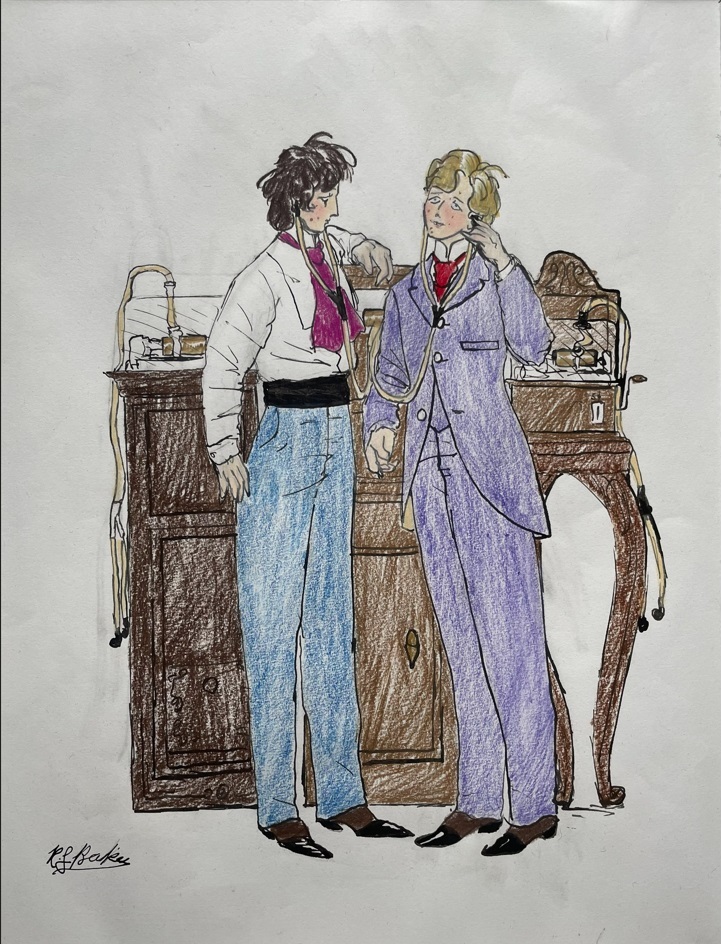
The Bowery was particularly famous for dozens of dive bars, and by the mid 1890s, many of these bars had a coin phonograph somewhere. Justin recalled as a child he and his siblings would often walk along the Third Avenue elevated train (the line along the Bowery) to get other places uptown. It is very likely that when he was a young man that Justin and his brother spent some time in these places, as their father also worked in German establishments as a musician. Many of these German restaurants and beer gardens included new novelties in entertainment, one of which was a 30-foot-tall orchestrion.
Justin as a teenager worked under his father for Carl Fischer, one of the biggest music publishers in New York at the time, which was also on the Bowery. Across the street his brother Frank was gifted enough to attend the prestigious Cooper Union College. The boys spent a lot of their formative years on the Bowery. Of course not many years after, Justin would start the career that would consume the rest of his life, playing music for the phonograph.

It wouldn’t be much of a stretch to imagine the boys in one of those sketchy Bowery bars with a new-fangled coin operated talking machine.
R. S. Baker has appeared at several Ragtime festivals as a pianist and lecturer. Her particular interest lies in the brown wax cylinder era of the recording industry, and in the study of the earliest studio pianists, such as Fred Hylands, Frank P. Banta, and Frederick W. Hager.