 Even the most committed “moldy figs” among us—devotees of traditional jazz, early swing, and ragtime—tend to gravitate toward the tried, true, and familiar. There’s comfort in a known melody, a lyric we can mouth along to, and everlasting awe in the iconic solos which have withstood the test of time (however freshly and frequently re-interpreted). It’s no surprise, then, that “vintage” recordings rarely venture very far from the established repertoire and are often based upon seminal arrangements, if not transcriptions of famous recordings.
To fill an entire album with songs that have never before been recorded takes a particular kind of courage, vision, and a genuine belief that the music justifies the risk.
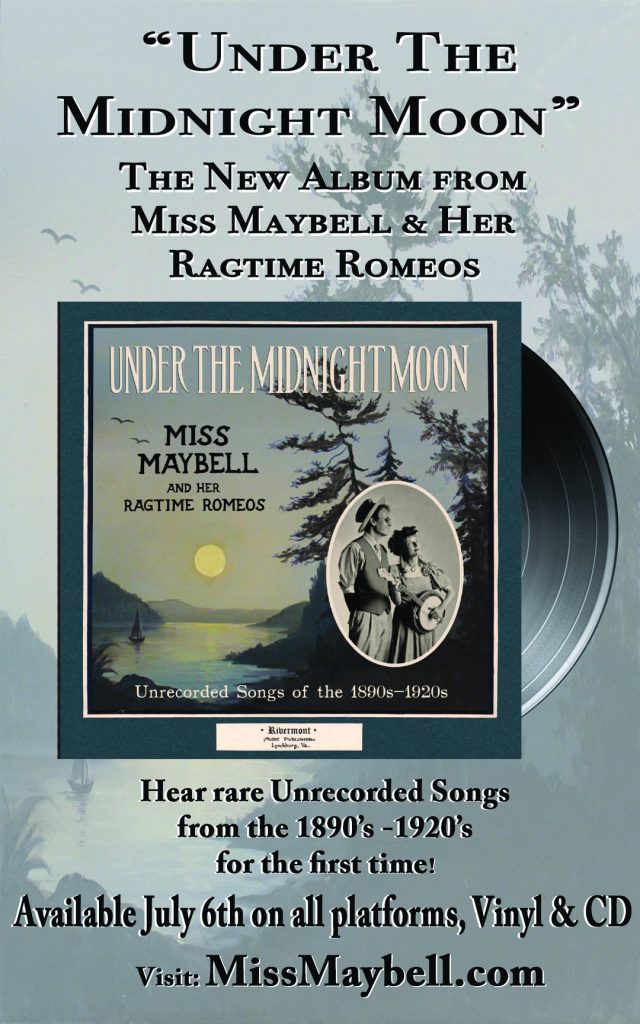
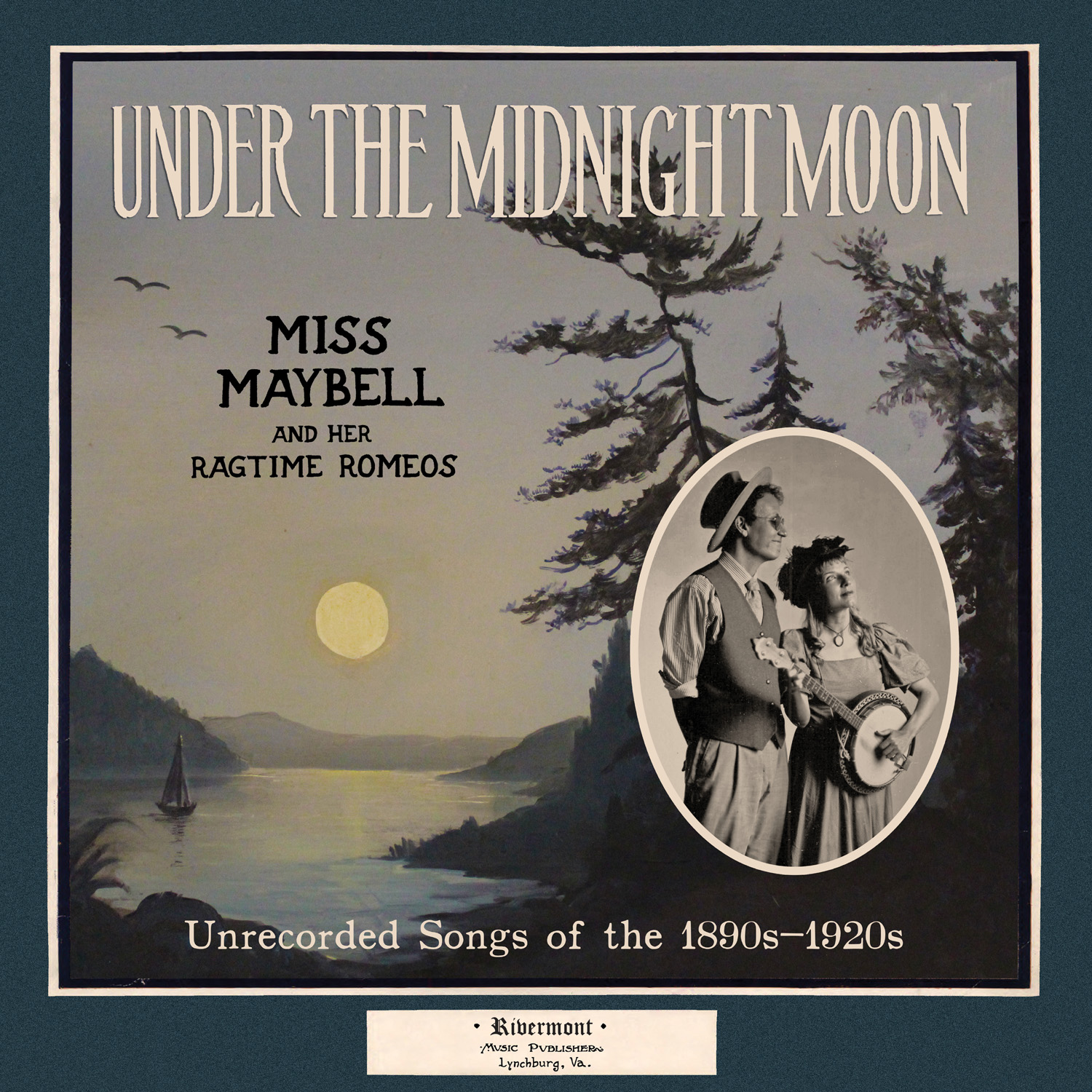
In their newest offering, Miss Maybell and Her Ragtime Romeos not only justify it; they make it feel inevitable.
Slated for July release, Under the Midnight Moon (Rivermont Records) is, in the most quietly radical sense, a groundbreaking record. Every one of its 15 tracks is drawn from songs written between 1899 and 1924 that have never previously been committed to tape, disc, cylinder, or any other medium. The musical archaeology behind this feat was carried out largely by the band’s two young co-founders, Lauren Sansaricq and Charlie Judkins, who combed library archives, roadside antique shops, and sheet music swap meets with what can only be described as missionary zeal. They were aided by a circle of veteran associates—musicians, historians, and musicologists alike, including David Sager at the Library of Congress among them.
The result is something genuinely rare: a work of preservation and performance that succeeds equally on both counts.

The Songs
Although these are songs unknown even to the savviest aficionados, a listener will appreciate that they feel immediately and warmly human. True to the Miss Maybell aesthetic, the songs paint vivid theatrical pictures: describing early dance crazes and dance marathons, ocean liner disasters, the disillusionment of leaving farm life for the teeming city, romances that bloomed outdoors under the midnight moon (long before cars or movie theaters provided new venues for courtship). Taken together, the selections form something like a subtle historical snapshot of the tensions between post-industrial agrarian life and the great northward migration to the city—a tension made particularly explicit, for example, in “Plain Country Rose” (1924).
The thematic range is considerable. “Bye Bye, Babykins, Bye Bye” (1899) is a cosmopolitan kiss-off with a knowing wink; “Do It the Right Way” (1910)—purportedly introduced by 18-year old Fanny Brice, in her Ziegfield Follies debut—mines cheerful comedy from the chaos of novice dancers on the dance floor; “Sadie, the Princess of Tenement Row” (1903) is an homage to an exemplary citizen of a humble ethnic ghetto; and “New York, I’m All for You” (1917) is frankly such a flag-waver, it ought to be New York City’s official anthem. Other songs tout regional pride and homesickness for New York, Tennessee, and—with somewhat more ambivalence—Cincinnati. One waltz, “Sun Ray” (1921), written well after WWI and before the start of the Depression, builds to a kind of transcendent, reverential hopefulness and optimism that recalls, in emotional register if not in style, the Beatles’ “Here Comes the Sun.”
The song’s temperaments span the full spectrum: vigorous ragtime two-steps, early blues, sweeping waltzes, country exuberance, coy suggestion, and storied comic relief. Remarkably, not one of these newly uncovered tunes feels derivative or cliché. Each of them has genuinely memorable melodies and lyrics—which raises the obvious question of how they ever went unrecorded in the first place?
Two tracks are purely instrumental, and they do double duty: They showcase the individual and collective abilities of the band members while demonstrating the arrangers’ command of period stylistic nuance. It’s worth noting that jazz solos, in this era, had not yet evolved into the extended featured “routines” we associate with later decades. Here, the emphasis is firmly on ensemble playing, with solos functioning more as ornaments or rhythmic propellants—passing flourishes that reiterate and elaborate, rather than depart. The arrangements deserve recognition as unsung heroes throughout, as they make full use of the Ragtime Romeos’ remarkable rhythm section, which operates without drums by deploying upright bass, banjo, rhythm guitar, washboard, and the powerfully syncopated left hand of the piano.
Two bonus “outro” tracks round out the collection: transfers processed to simulate the sound of early mechanical (pre-microphone) recording, giving listeners a sense of how these tunes would have registered on wax cylinders or 78 RPM shellac. It’s a thoughtful, character-driven touch.
The Band
More than nine musicians, in varying combinations, contribute across the album’s tracks, and the instrumentation alone tells you something about the seriousness of this enterprise. The players are: Lauren Sansaricq (vocals, guitar, banjolele, tenor banjo, washboard, kazoo); Charlie Judkins (piano, primary arranger); Brian Nalepka (bass, tuba); Dan Levinson (clarinet, C-melody and tenor saxophone); Andy Stein (violin); Gavin Rice (banjo, trumpet, accordion, bass); Colin Hancock (cornet); Jim Fryer (trombone); Mike Davis (cornet); backing vocals by Nalepka and Stein; and recording engineering by Slau Halatyn of BeSharp Studios—who, it should be noted, can also be heard contributing subtle harmony vocals in an instrumental passage on “Plain Country Rose.” It’s also noteworthy that bandmembers Stein, Levinson, and Rice consulted and collaborated closely with Judkins (as did ragtime authority Terry Waldo) on various arrangements.
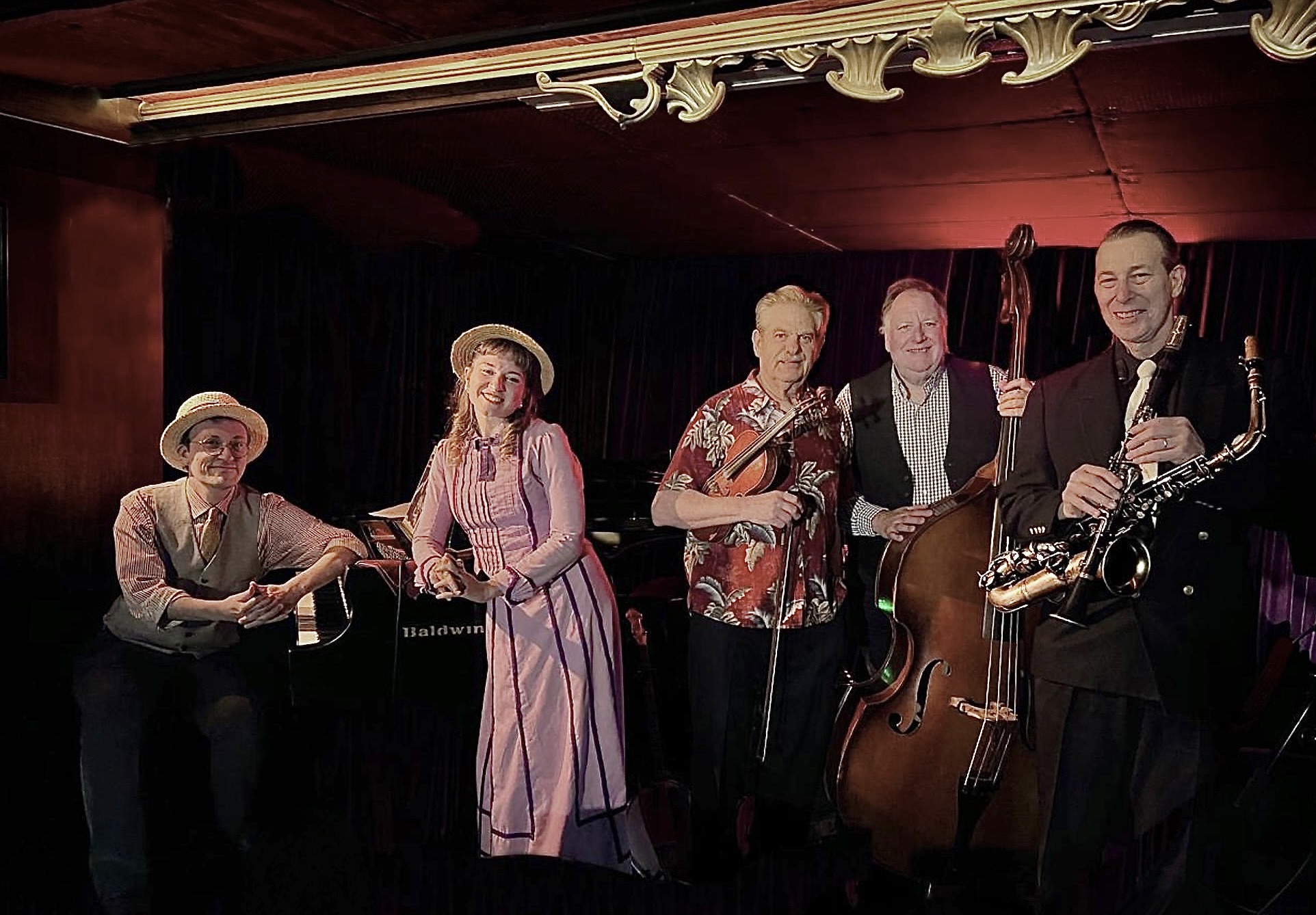
Several of these musicians have been featured independently in The Syncopated Times, and their individual contributions here are every bit as distinguished as their separate reputations suggest.
Sansaricq’s contralto is the band’s defining voice: full-ranged, clarion, warm, and consistently well-supported. She also, sparingly, employs absolutely seamless “vocal range flips” (vocal pivots or breaks: moving from contralto to mezzo-soprano, and sometimes even including yodels). Such additions of color and expression all combine to a most splendid effect. Her pitch is unfailing; her articulation of lyrics impeccable yet nuanced; and her natural, unaffected quality of expressiveness is the record’s emotional center. In the songs that call for the bright, corn-fed directness of a country girl, she is entirely convincing; in the few that don’t, she produces genuinely soulful growls with absolute blues authority. Sansariqc’s varying deliveries are highly informed by—but not imitative of—her influences, such as Sophie Tucker, Clarice Vance, Stella Mayhew, Maude Raymond, May Irwin, Fanny Brice, and Eva Tanguay. Her glass-cupped muted kazoo solo on “Non-Stop Lovin’ Man” (1923) is, improbably, one of the album’s most particularly charming moments. Somewhat uncharacteristically, she doesn’t do much (if any) washboard playing in this collection.

Judkins’s piano is meticulous and full of quiet surprises. His left hand drives the rhythm with an inescapable syncopated pulse. His right is colorful, imaginative, and tightly responsive both to the band and to the emotional content of the lyrics. In the opening verse of “If I Ever Get Back to Cincinnati” (1906), his accompaniment manages, without caricature, to suggest a silent-film villain’s theme—tongue-in-cheek and exactly right. His playing is most prominently featured on the two instrumentals, “Domino Rag” and “Saturday Night in New Orleans,” where his nimble, understated command of the idiom is given full room.
Nalepka’s bass and tuba playing is the album’s bedrock: big, bold, clearly articulated, and full-bodied. His contribution makes the rhythm section’s exceptional authority possible, and it has been so from the band’s inception, where he has served as both charter member and counselor.
Among the soloists, several moments stand out. Cornetist Hancock delivers a particularly fine turn on Clarence Williams’s “The Unknown Blues” (1923); Levinson’s reed work on “Sun Ray” (1921) is delicately beautiful; and Stein’s violin on “Georgia Lee” (1915) is, in this listener’s estimation, one of the album’s peaks. “Non-Stop Lovin’ Man” (1923) is something of an all-hands showcase, affording featured moments to Rice (accordion), Fryer (trombone), Levinson (clarinet), Stein (violin), and Judkins (piano) in quick, bright succession.

The Composers and Lyricists
Considering the total obscurity of these tunes, I was surprised to learn that several were composed and/or had lyrics written by formidable, well-known, prolific hit-makers and writing teams, and individuals such as Dubin and Burke; Ager and Yellen; Irving Kaufman, and Clarence Williams. Fascinatingly, others were “one-off” songwriters (like Richard Glade, with his “Domino Rag”), whose names were as obscure as their tunes. Some were department store song-pluggers, or bit-part vaudevillians, and some were only amateurs, peripheral to (or completely outside) of the music industry—including the rare female music composer Ruth Fernandez, whose “Georgia Lee” seems to have been the only song she ever wrote.
I’ve listened to this record repeatedly during the past several weeks, almost compulsively, and most of the tracks still move me to smile or to tears. More than half the cuts are candidates to be new favorites. That may not be everyone’s response to an album of pre-jazz, pre-Depression-era vernacular songs excavated from sheet music archives—but if you have any feeling for this music and what it represents, I very much suspect your response will be similar.
Under the Midnight Moon is an important record, a genuine act of preservation, and, by any musical standard, it’s a minor masterpiece.
Under the Midnight Moon
Miss Maybell and her Ragtime Romeos
Rivermont BSW-2275
rivermontrecords.com
Find Miss Maybell online at www.missmaybell.com and visit Rivermont’s website at www.rivermontrecords.com. Their live album release concert is scheduled for July 6 at Birdland NYC; tickets available at tinyurl.com/missmaybellbirdland20260706.
Neal Siegal is a Manhattan Bon Vivant and a Barber Shop Quartet Singer. He is grateful to Amy Winn for her assistance in editing and preparing this story.
Neal Siegal is a Manhattan Bon Vivant and a Barber Shop Quartet Singer.