I do not consider baked goods to be oracular. Nonetheless, there was a time when I looked forward to the end of a meal of Chinese take-out when the message inside the attendant fortune cookie would provide a moment’s amusement. The messages were frequently funny, sometimes cryptic, often written in slightly broken English, but always gave me a sense of a writer’s mind at work on the other end of the baking process.
What I feel now, after partaking of our “house special” fried rice, is a sense of impatience. The cookie is the same, but the slip inside imparts nothing but bland expedience. There is no longer a sense of someone communicating something. Our revealed destiny—our misfortune, if you will—is to be offered an inoffensive affirmation composed by machine. There is no wry humorist suggesting we should have ordered the shrimp. Instead (and I draw this slip at random), “An optimist is the human personification of spring.” In short, a pleonasm and a yawn. At least there is ice cream.
You’ve already read at least a dozen rants against Artificial Intelligence this year, but this is at least my rant written in my own words. I’ll try not to use the cliched terms like “slop” and “guardrails” but I have no idea where this topic will lead me. (“Life is like a mountain highway without guardrails” is a good start to a song lyric, though the scansion leaves something to be desired.)
Not just merely a dull thud at the end of a fine plate of Singapore Mei Fun, the productions of the rampant Gee Whiz machine that is AI are actively headache-making and depressing. Spotify is now promoting a premium service in which you may have Bing Crosby singing the back catalogue of Sid Vicious. (That alone should make Christmas extra merry this year.) Alternatively, YouTube offers endless streams of tuneless, indiscriminate “jazz” of almost any genre that may be unenjoyed in the background to fill the dystopian void of silence. The accompanying video of kittens playing saxophones is only slightly less nightmarish than the computer that created them.
I use the word “jazz” in quotes in the above paragraph because by definition machines cannot play jazz. Jazz requires craft and human intention. Even a player piano roll or a music box disc is more humanly musical, since a person had to punch the roll or the disc, determining which notes would play. Instead, the computer aggregates the jazz fed into it and produces an artificial jazz sausage, seasoned according to its algorithm. It’s no better than jazz-ish.

Those who have banked on the technology are strenuously at work to convince us it is something we cannot possibly live without. Billions of dollars are at stake, and if we refuse to embrace it we are just being old meanies.
I regret to say that Artificial Intelligence has crept even into corner of this hidebound publication and its associated online presence. Our website features certain illustrations, created out of necessity, that are generated by AI platforms. I was initially thrilled to discover that the illustration made to accompany a 42-year-old story of mine (“The Day of the Scumbags,” published in June 2026) vividly resembled something from an old Mad magazine. I then worried that it might be too close to something that actually had appeared in Mad. (The other thing that had me slightly piqued is that it visually gave away all the jokes in my text.)
What I ultimately decided was that I would hire real artists whenever possible and whenever I couldn’t create a competent illustration myself. Why should I deny brilliant human illustrators the pleasure of creating real works of art? We don’t all abandon our respective vocations to dig ditches just because machines have been taught to imitate us poorly. I appreciate the human eye and the human intellect, and the inspired spark that puts pen to paper.
Speaking for myself and presumably for others, I have already seen enough of the fake stuff. Two years ago everybody on my Facebook feed was playing with AI. It was a diverting novelty. Its productions were bizarre enough not to be confused with the real thing. Now it’s just an affront that consumes megawatts of electricity and oceans of water to spew slick mediocrity.
Real cartoons have a certain looseness of line and lettering that peg them as real. More than that, you sense the mind of the artist at work. The artificial productions lack any individuality. There is a particular AI “style” that is no style at all—unless that algorithm is copying someone else’s style.

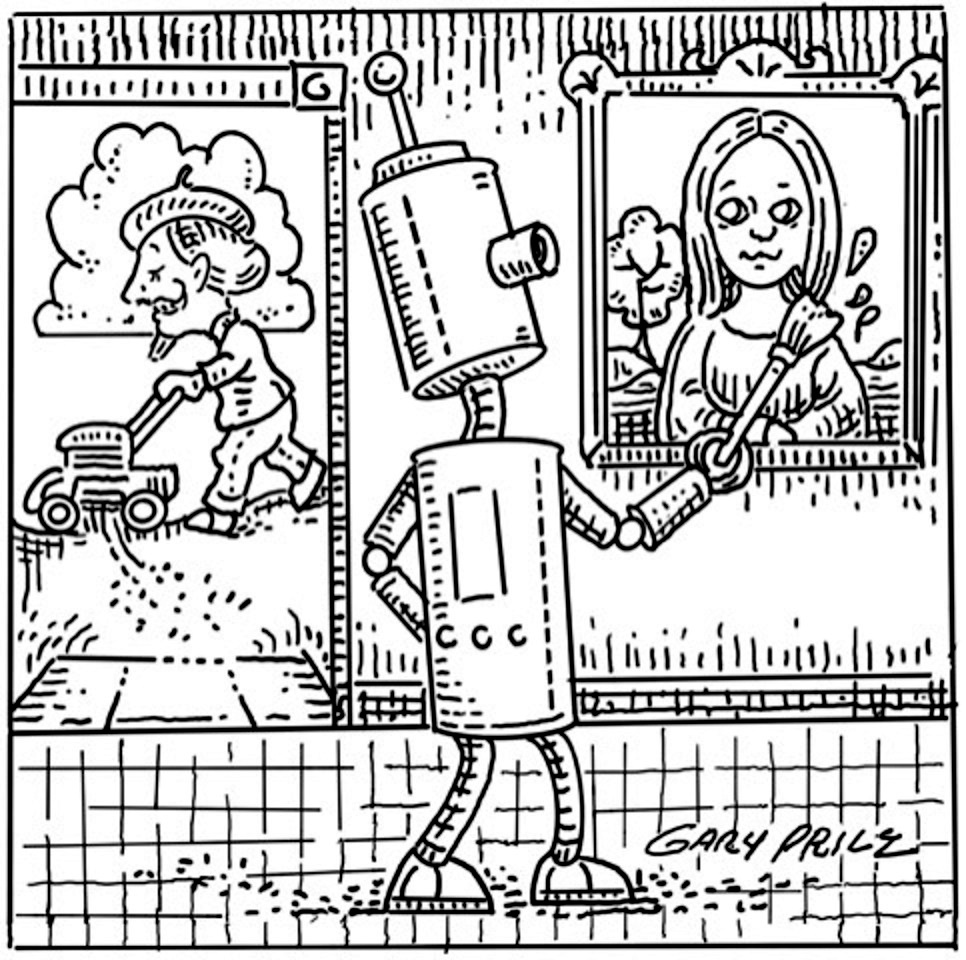
I read Mad magazine from the time I was in grade school. I was familiar with all the artists and could identify their works on sight. At that age, being able to draw was the greatest thing I could imagine. Gary Price, whose illustration you see accompanying this story, is my first cousin and I still remember him painting magnificent things when I was very young. Then, from February 2016 through May 2019, I was honored to have Gary contribute our “Jazz Birthday” tributes each month. I can recognize his style—and his creative spark—the minute I see it.
I would have attempted to be a cartoonist myself had the impulse to draw not been “inspired” out of me by art instructors in school. (My work was “too cartoony.”) Yet, through my own halting attempts at various creative pursuits, I find I admire musicians, artists, and writers far above the money-mad technocrats who ceaselessly contrive to put them out of work.
Happily for me, I have been privileged to know many of the first three. I know whose side I’m on.

Andy Senior is the Publisher of The Syncopated Times and on occasion he still gets out a Radiola! podcast for our listening pleasure.