 Some innovations were so inevitable that there’s an apparent simultaneity to their creations. Thus, the motion picture evolved contemporaneously in several countries with Edison attention-hogging his contribution, just as he did with his contribution to the creation of recorded sound.
Likewise, a monumental change visited the world of jazz during the 1920s. What was a fairly loose and small ensemble of instrumentalists weaving melodies and improvisations in a style that came to be called Dixieland grew into a larger group that was loud enough to be heard on a ballroom dance floor. Dancers drove the business, and there were plenty of dance halls offering plenty of work to the jazz bands. Instead of one player per part, there were three or four brass, three or more reeds. Thus was born the section-based chart and the need for arrangers who could provide that.

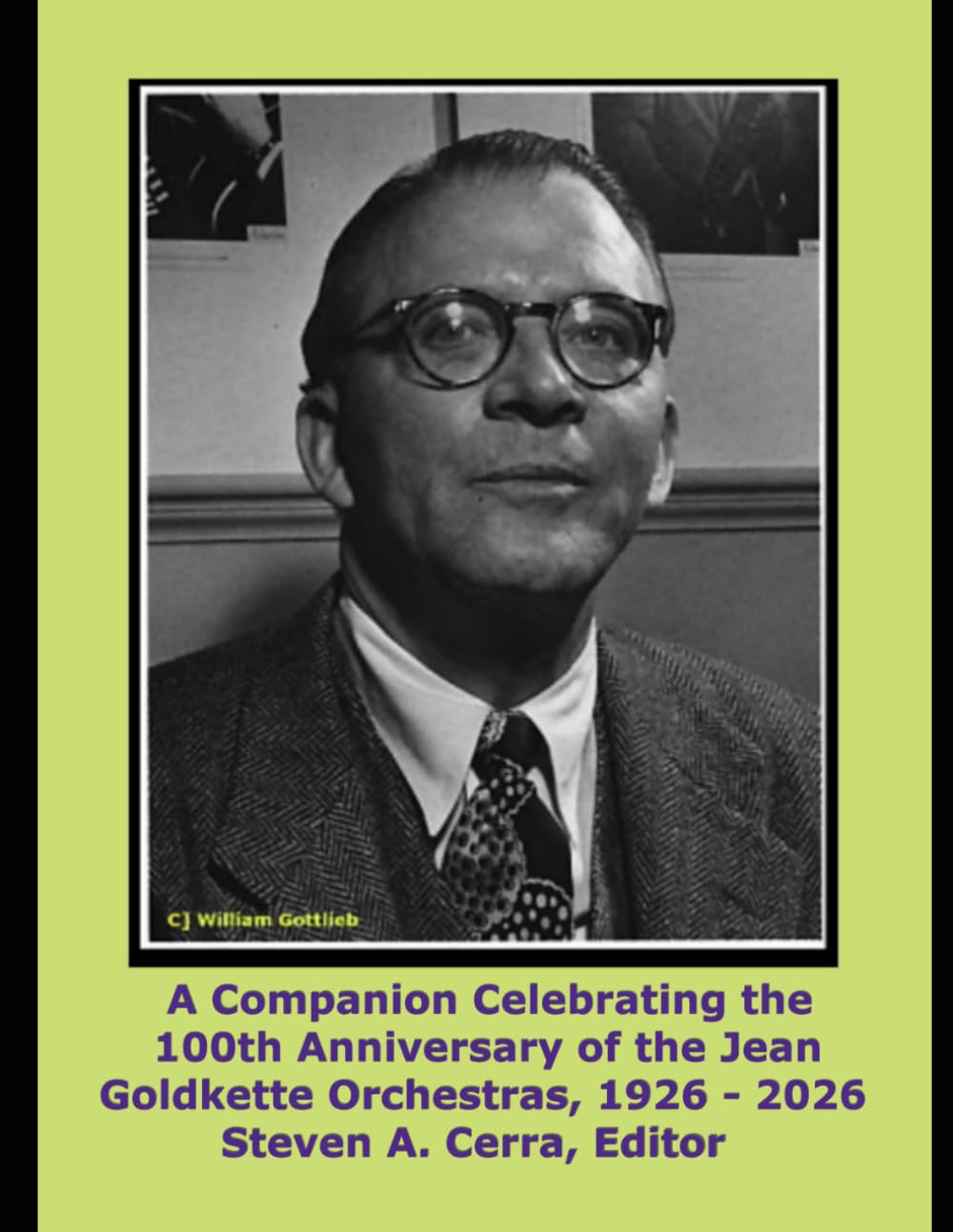
Don Redman was one of those innovators, and he’s one of the most-mentioned characters in Steven A. Cerra’s A Companion Celebrating the 100th Anniversary of the Jean Goldlkette Orchestras, 1926-2026. It’s a large-format 350-page compendium that gives us, in 38 chapters, a detailed examination of the music willed into being by a creative businessman who played classical piano.
Each of those chapters is drawn from existing writing, many of them from books familar to you and me, but revisiting those chapters in this context is a joy. And then there are visits to books more scarce alongside magazine articles and liner notes that span many decades. And, with Goldkette as the catalyst, they’re all centered on some of the most fascinating, influential, and enigmatic figures in jazz, working together in an era that saw the face of jazz change and mature thanks to their contributions.
Goldkette was born in France in 1899 or (more probably) in Greece in 1893 to a circus performer, a woman who may or may not have had an affair with a member of Greek royalty. Anthony Baldwin took a close look at Goldkette’s origins in an article for a 2005 issue of Vintage Jazz Mart, a British magazine, that isn’t reprinted in this book but is well worth online-seeking to understand the complicated background that led Goldkette to become a classical pianist and, eventually, a businessman with a flair for putting jazz bands together with extraordinary players.

He ran a popular ballroom, the Graystone, in Detroit, and made sure there were bands to accompany the nonstop dancing that 1920s patrons demanded. Most significant among those bands were McKinney’s Cotton Pickers, the Orange Blossoms, and the Victor Recording Band, the last-named so-named to trade on the popular platters it was cutting.
The cruel irony that defines this band is that it probably was the hottest jazz ensemble plying clubs and ballrooms during the mid-’20s, yet its recordings barely hint at the group’s talent. A recording executive at Victor named Eddie King, described as a “short, squat, unpleasant bulldog of a man,” had stubborn notions about what would sell. A Black band was allowed to record hot tunes, but Goldkette’s white players were forced to wax simpering dance numbers so as not to frighten off white buyers— who, after all, would be the ones with the deep pockets.
We have touches of the Goldkette band’s flavor flashing through the sides they did cut, especially in one of their final records, “Clementine.” But by the time of this (Eddie King-free) session, the group was in the throes of disbandment. And that’s the short version of what’s related in more than one of these essays.
Many of them center a narrative around a Roseland Ballroom meeting on October 6, 1926, between Goldkette’s Victor Recording Band and the Fletcher Henderson Orchestra, which already had been in residence at this location and was eager to take on these white-skinned newcomers in a much-anticipated “battle of the bands.”
Trumpeter Rex Stewart was in the Henderson band that night. He would go on to further fame as a member of Duke Ellington’s orchestra, and towards the end of his life, in the 1960s, he wrote a series of articles for DownBeat and other magazines that were collected into the book Jazz Masters of the ’30s, a vital, well-written history that opens with his Goldkette essay.
“Their arrangements were too imaginative and their rhythm too strong,” wrote Stewart, “what with Steve Brown slapping the hell out of that bass fiddle and Frankie Trumbauer’s inspiring leadership as he stood in front wailing on his C-melody saxophone.”
Stewart’s piece becomes Chapter Five in this Goldkette collection, an enthusiastic amplification of what we’ve already learned from the preceding essays, which are a lengthy piece by Russel B. Nye that examines the singular year of Goldkette’s Victor Band existence, with particular attention paid to the work of arranger Bill Challis; the first of eight chapters by Richard Sudhalter, this one from Lost Chords: White Musicians and Their Contributions to Jazz (1999); a short piece by noted discographer Brian Rust from his book The Dance Bands (1974); and a concise but thorough essay by British jazz writer Albert McCarthy.
That Roseland battle of the bands is examined in these pieces and throughout the rest of this book, giving the incident a Rashomon-like quality. It reminds me of a notorious baseball incident known, when it happened, as “Merkle’s boner,” during a decisive baseball game in 1908. Rookie player Fred Merkle failed to touch base and cost the Giants the game and probably the pennant. The incident was described by many of the players who witnessed it The Glory of Their Times, Lawrence Ritter’s 1966 collection of interviews. And to tie it back to music, Ritter was inspired to capture this history because he was a fan of the work of field recordists John and Alan Lomax.

Goldkette earned one of his places in history by populating his Victor Recording Band with, at various times, Bix Beiderbecke, Frank Trumbauer, Steve Brown, Hoagy Carmichael, Tommy and Jimmy Dorsey, Eddie Lang, Joe Venuti, and Pee Wee Russell. Prominent among his arrangers was Bill Challis, who often sought the players’ input, and wrote out what he’d heard them play. But the band was so expensive that Goldkette dissolved it after it had been existence for only a year. Many of its key players soon went to Paul Whiteman’s orchestra.
Several of them are profiled in this collection. Bill Challis is profiled by Gene Lees, in the context of a fascinating visit to the arranger’s home. Challis “was a man in whom modest self-effacement amounted almost to a serious defect of character,” writes Lees, but he offers a long, fascinating look at the man’s life, including the story of how he was able to transcribe the five Bix Beiderbecke compositions that included “In a Mist.”.
There’s a Steve Brown interview from a 1974 issue of The Mississippi Rag, and from the same magazine comes a portrait of saxophonist Doc Ryker; two pieces about trombonist Spiegle Willcox, who was the only original Victor Recording Band member to play on Vince Giordano’s Bill Challis’s The Goldkette Project, a 1986 recording that gives a good idea of the material the original orchestra wasn’t allowed to record. (And brother Evan Challis’s liner notes for that CD are included here.)

But it’s Bix who has prompted the most ink of any of those players, and he’s well represented, with six chapters covering his life and legend, including three from Bix: Man and Legend by Sudhalter and Philip R. Evans. It’s a fairly rare book, so good for you if you have a copy, but the chapters reprinted here take on a new life in the context of the other material.
Sudhalter also wrote the revelatory Lost Chords: White Musicians and Their Contributions to Jazz (1999), from which “Frank Trumbauer, the Divided Self” is drawn; a chapter titled “Bix and Tram in the Goldkette Orchestra,” comes from Tram: The Frank Trumbauer Story, a Bio-Discography by Philip R. Evans and Larry F. Kiner (1994).
Not surprisingly, McKinney’s Cotton Pickers merits a great deal of attention here. This is the band which flourished once Goldkette took it under his wing, and Redman’s arrangements, as noted above, helped perfect the art of the jazz ensemble.
Drummer Cuba Austin drove a rhythm section that drove the band, and he’s interviewed both in a 1942 DownBeat article and a fascinating 1951 interview from The Record Changer. The most comprehensive account of the band was written by John Chilton in 1978: McKinney’s Music: A Bio-Discography of McKinney’s Cotton Pickers. “I have gone through some expense to procure a copy,” writes Cerra, “but in the interest of sharing this comprehenasive study with you, in the immortal words, ‘It was worth every penny [dollar?].’” The four chapters reproduced here may well comprise the bulk of the prose in the 72-page book, following the ensemble from its beginnings as a trio in Ohio through its zenith in the late ’20s to its slow demise through the ’30s, as racism and the Depression took their toll. But, given the comparative lack of attention this band gets in other jazz histories, it’s a story that needs to be remembered.
The four chapters that close the book are devoted to the Casa Loma Orchestra. It was an outgrowth of a Goldkette ensemble, the Orange Blossoms. Following an engagement (that lasted eight months or never took place, according to who’s doing the telling) at Toronto’s Casa Loma luxury hotel in 1927, the band decided to break away from Goldkette and incorporate as a cooperative. Why they chose the name they settled on isn’t clear, but it seems like the kind of prankish thing a rambunctious bunch of 20-something musicians might come up with.
Writes Gunther Schuller (from The Swing Era: The Development of Jazz, 1930-1945), “The Casa Loma Orchestra represents in fact a complex, fascinating example of a musical paradox: an orchestra whose impact was at once enormous and yet negligible (or at least short-lived). Whose work was full of contradictions and enigmas, and whose musical origins have never been thoroughly examined.” In other words, the typical Schuller nose-in-the-air hyperbole. But it’s a valuable chapter nevertheless, providing technical insights into the band’s charts and performance style.
It was easy to characterize the band as too skillful, too perfect—the kind of critical brickbats thrown at Jascha Heifetz, but which didn’t at all hamper his career—even while acknowledging them as the true white-band precursor to 1935 and the Benny Goodman era. But Richard Sudhalter comes to the rescue. In another chapter drawn from Lost Chords, the Casa Loma phenomenon is examined with a more jazz-oriented eye, reinforced with insightful musical analyses.
The book’s chapters are presented in a logical sequence that covers each of the bands under consideration in turn, interspersed with chapters focusing on individual players—in the case of Bix, a bounty, but players like Joe Venuti and Eddie Lang get their due. And Cerra often provides not only a brief, context-setting introduction for each chapter, but he also usually precedes each with a pertinent quote from elsewhere—sometimes from another chapter in the book, sometimes unique.
We should feel very indebted to Steven Cerra for assembling this monster of important scholarship, because it not only gives significant early bands and players the attention they risk losing but continue to deserve, but also because Goldkette merits recognition as the organizing force behind the bands that are celebrated here.
A Companion Celebrating the 100th Anniversary
of the Jean Goldkette Orchestras, 1926-2026
Steven A. Cerra, Editor
Softcover, 353 pages, $24.62
ISBN: 9798187926862
B.A. Nilsson is a freelance writer and actor who lives in rural New York. His interest in vintage jazz long predates his marriage to a Paul Whiteman relative, and greatly helped in winning her affections.