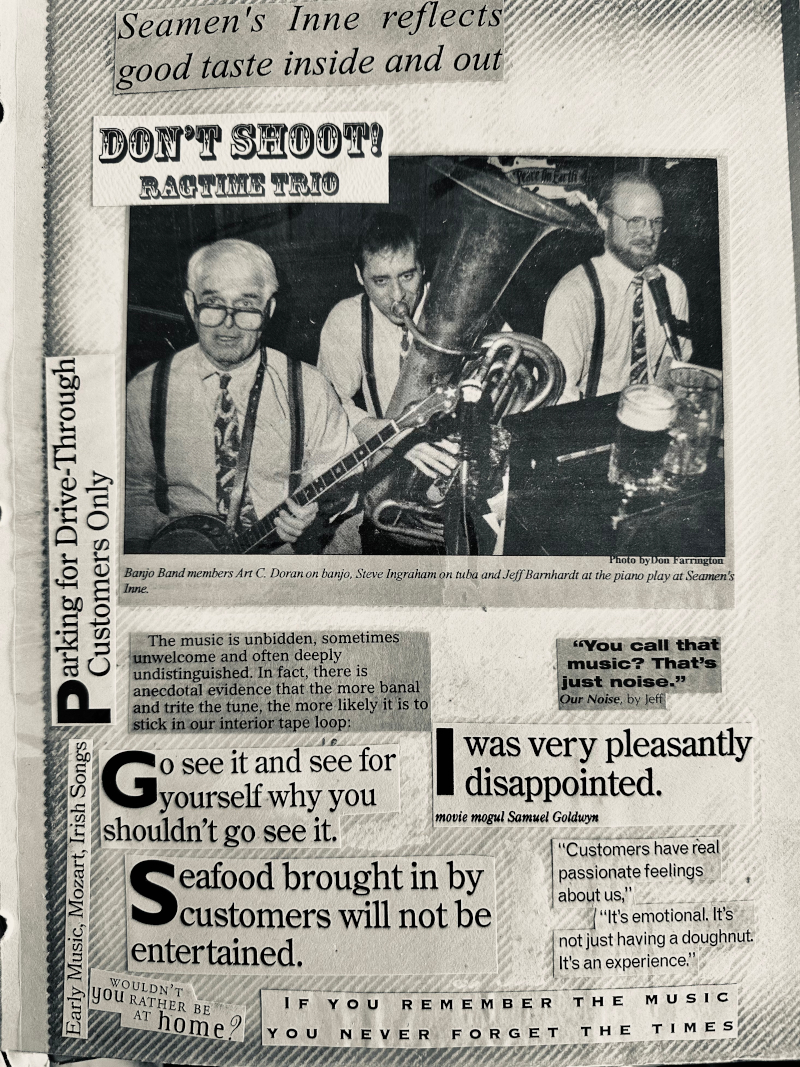
My column on the Samuel Adams Pub at the Seamen’s Inne at the Mystic Seaport in Mystic, Connecticut produced some great responses, but none as special as the phone call I received from Art Doran, the banjo player and leader of our “Don’t Shoot” trio. He’ll be 95 in October, and spent over 2 1/2 hours on the phone with me talking about all and sundry. He reminisced about the great times we shared along with tubist Steve Ingraham on our Friday and Saturday night gigs in the Pub and shook some old memories out of me.
Our residency at the Seamen’s Inne attracted repeat customers from locales both near and far. Some couples came every week including one from the other side of the state. The husband, a big bruiser of a man, always asked for Irving Berlin’s “When I Lost You” and his (much) younger wife would toddle up and throw some loot in our tip jar to seal the deal. Art would sing it sincerely if not beautifully and we’d wring every possible bit of pathos out of it that an out-of-tune piano, a banjo, and tuba could muster. The fellow would sit and listen and we’d often see his eyes tear up just a bit. We never asked, but we surmised Brenda was his second wife and was aware—and not threatened—by the sweet memories he had of his first.
Then there was Sonya. She’d bustle in with her husband in tow and virtually take over the place with her enthusiasm, loud voice, and energy. Seasonally when we cajoled the (mostly) willing audience to act out “The Twelve Days of Christmas,” she was our star “goose a-laying.” Her husband was much quieter and they’d often end up having an argument and huffing out before the night was through, but they’d be back the following week. One night, Art made a terrible goof. There was a table for two nestled in the picture window behind him and Steve, and Sonya and her husband were placed there for a bit of privacy away from the tumult to celebrate their 50th wedding anniversary. We played their favorite numbers, they danced a bit, and the wine flowed, and flowed, and flowed.
…and flowed.
After one particularly rousing rendition of [place your own tune title here], Art took the mic out of the stand, intoning, “We’re honored to have a lovely couple celebrating their Golden Anniversary! Let’s listen in on the two lovebirds.” Whereupon he thrust the mic behind him right up to Sonya’s face as she shouted, “I gonna divorce you, you ASSHOLE!” She was horrified, leapt to her feet, said some choice words to Art (and the rest of us) and toddled out, her anatomically-defined husband stumping after her.

And yes, they were back the next week.
We had two gents come in weekly for different reasons. Ted walked in wearing his leather cowboy hat and his floor length cowhide coat, played the spoons, and laughed like a braying donkey. His family didn’t understand him (wonder why) and he said he felt at home with us. Moreover, he was always well received as an accomplished spoonist! Michael was from Sweden, lived around the corner, and was in the US for business. He told me his time with us was the only thing saving him from a crushing sense of loneliness being so far away from his homeland and his people.
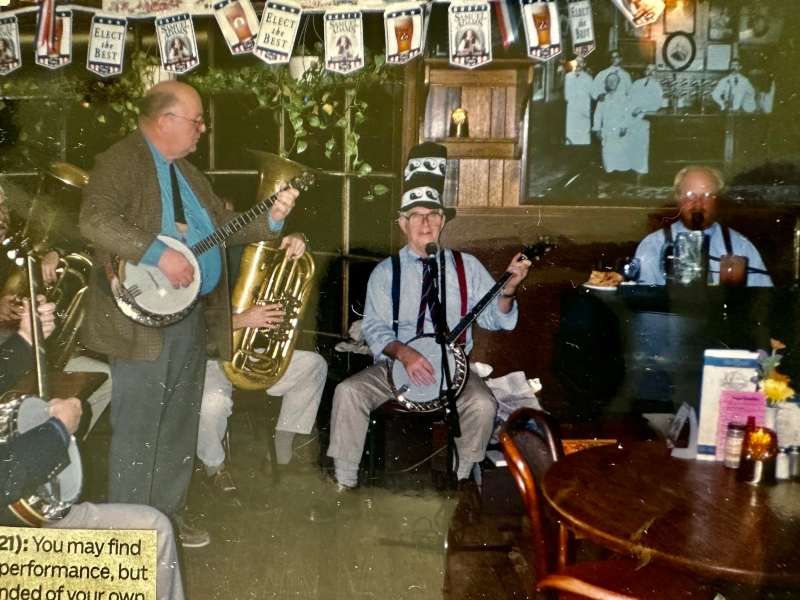
The group of patrons that came several times a month became a sort of family, temporarily insulated from the cruel world by the ambience, bar food, libations, and the vintage tunes and anarchic humor we offered. While when we put our minds to it we could play some serious music (rags, hot ’20s-’30s jazz tunes, Berlin, Kern, Porter: really whatever came to mind) people mostly came for our wacky outlook on life.
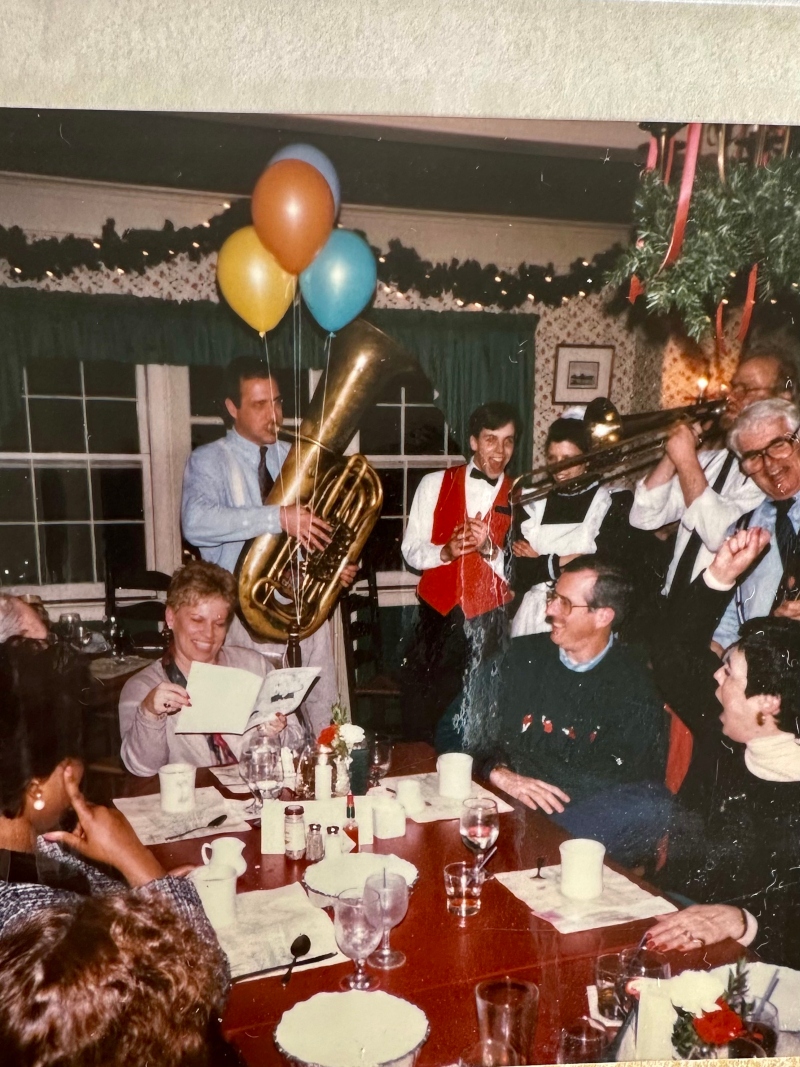
On that theme, Art, Steve, and I were always playing pranks on one another. Art and I would stick a wet towel in the bell of Steve’s tuba; or nuts; or bubbles; or a small woman: whatever we could find. Steve was constantly turning his horn to the left to blow an extra loud note directly at Art. They left me alone, as I was struggling with a Young Chang piano, a Korean PSO (piano-shaped-object) made of wood and strings obviously collected from the Dollar Store—OK, that is absurd, but the wood and strings from Korea were not acclimated to the New England climate so they might as well have come from one of those discount dungeons. Not a night would go by that I wasn’t breaking a bass string. Eventually Chuck Baxter, the owner, told me he’d have to let me go as repairing the poor beast was costing him more than I was. I suggested he let the piano go and get something that could stand up to my gentle, feathery touch. To his credit, he did. He provided me with an antique (ancient) baby grand piano on top of which legend had it Franz Liszt had been born and we were once again let loose to run amok.
I especially loved reaching to my right and detuning one of Art’s banjo strings as he was flailing into the final chorus of one of the Eddie Peabody warhorses. The whole thing would fall apart, the audience would go into hysterics and Art would (mock) fume. That is, until he’d had enough. During a break he very politely asked me not to mess with his banjo when he was playing it. I promised not to. Then I went to Steve and asked if he knew how to tune a banjo. He did!

“Art’s not playing it right now, is he? I queried.
“Sure doesn’t look like it to me.” Steve replied.
“Please tune each string up a half-step.” I requested.

Steve carefully did so (tuning up being a tad risky as a string might snap) and voilá, Art’s banjo was in perfect tune in a different key. Many of the audience members were watching our shenanigans and “tsk tsk-ing” us but they wanted to see where we were taking this so kept mum.
 Steve and I had decided that we would play the first tunes of the ensuing set a half-step up to match Art’s tuning. So if the song were called in C, Steve and I would play it in C# so we were in tune with Art’s re-tuned banjo. We started with “Bye Bye Blackbird.” Art thought he was playing it in the standard key of F, because Steve and I were playing along in F# with him. The next tune was “I Want A Girl,” usually played in Bb, but we were all playing in B. Then “It Had to Be You” (all of us playing in G#, while Art thought he was playing in G).
Throughout this farce, Art kept glaring at me; he knew something was wrong. He knew I’d been up to something but he also knew I hadn’t come even near his banjo since we’d started the set. Then he called “Margie.” THIS was our cue. The tune was in the key of F, so Steve and I played it in F: while Art was still playing a half-tone up in F#. The ensuing atonality could not have been improved by Charles Ives, Arnold Schoenberg, Ornette Coleman, or any combination of the three. From the first twang, Art knew we’d gotten him! He was very gracious, but never left his banjo out between sets again!

Were we making musical history? No.
Were we entertaining people in need of a laugh or in need of connection? No doubt.
I’ve space for two more brief, contrasting stories. Once a month, a couple would come in for the evening. He looked like a textbook accountant: large glasses; long nose; small eyes; unsmiling face; slightly jutting chin; tweed jacket. His wife was short, stout, wide-eyed, rather plain, and always wore a gown. They’d sit quietly at a table, not speaking, having their meal and one drink each. Then he’d screw up his courage and come up and put a dollar in our jar. That was Art’s cue to start playing and singing the beautiful waltz, “My Wonderful One.” The couple was transported as they danced to our rendition as if they were in the ballroom at the Biltmore. Gone for the duration of their dance were the regrets, the aging, the sorrow, the ordinariness of their day-to-day existences. They were radiant. The song would end, and they’d sit back at their table and sink back into their lives. But for that transformative moment, they were Fred and Ginger: And everyone knew it.
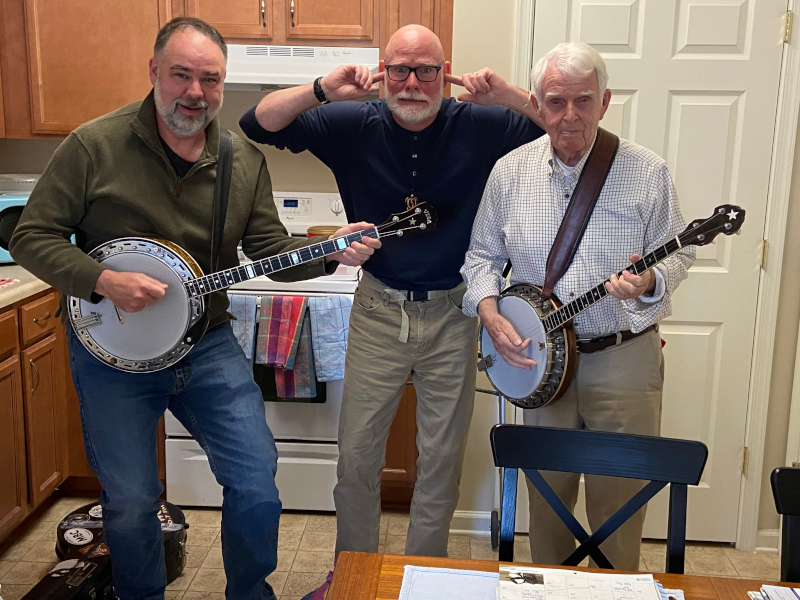
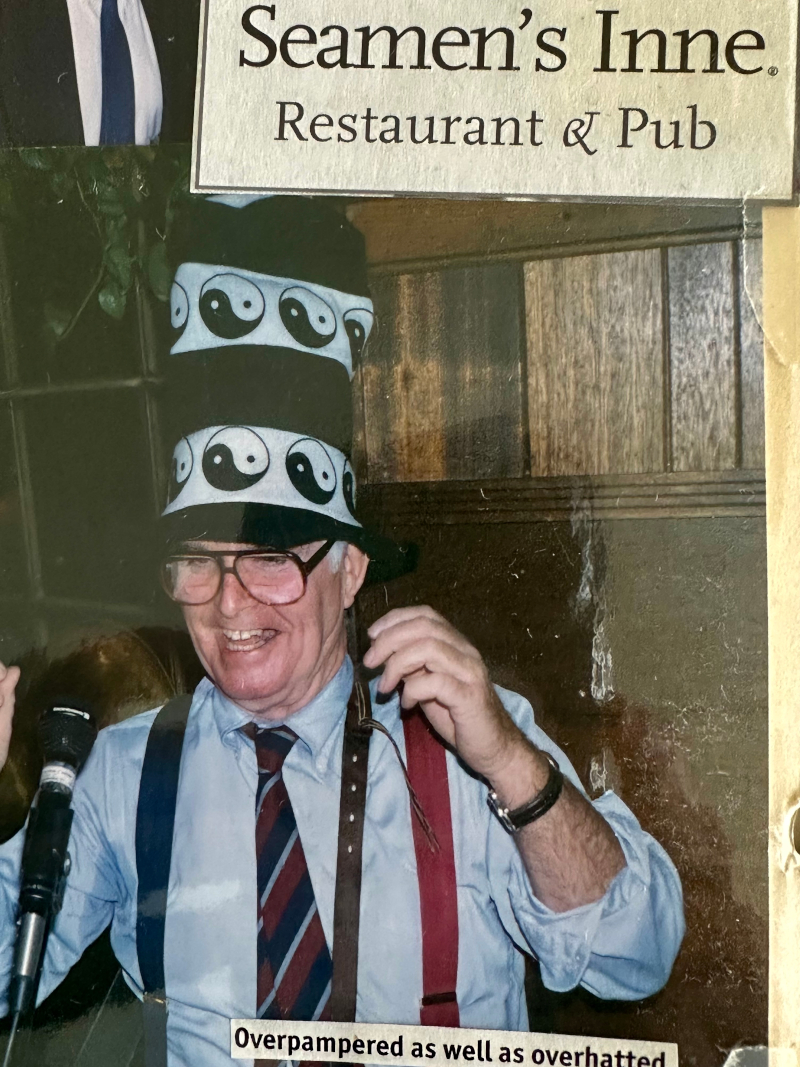 To illustrate the absurdity nightly awaiting an invitation to our party, one night a server told Art that Phil Donahue was dining in the other room. From the photos, you can see Art bore an uncanny resemblance to the talk-show host. Art even carried a photo of Phil in his banjo case. So when the server announced Mr. Donahue had stepped downstairs to use the facilities, Art called a break. He waited in the lobby for Phil to come upstairs, a crowd circling him.
As Phil came up to the landing and saw Art, he stopped short with a reaction reminiscent of the mirror scene in the Marx Brother’s classic film Duck Soup. Art waited several beats than realized someone had to say something, so he said the first thing that sprang to his lips:
“Excuse me, sir,” he began, “has anyone ever told you you look just like Arthur Doran?”
Pause.
Donahue reached out and grabbed Art by his braces, shaking him and growling “Look buddy, if you don’t mention this to anyone, neither will I!” He then thrust Art away and stormed off.
In my view, this was Phil Donahue’s one brief brush with greatness.

Jeff Barnhart is an internationally renowned pianist, vocalist, arranger, bandleader, recording artist, ASCAP composer, educator and entertainer. Visit him online atwww.jeffbarnhart.com. Email: Mysticrag@aol.com