Since I began performing Ragtime and Classic Jazz from the first three decades of the 20th century, I’ve inevitably been asked how I can keep so many tunes in my head (if you ask my wife Anne, that’s all I can keep in my head!). I usually tell them a story of being blessed with an ability to recall tunes I’ve heard 40 years ago or some such folderol. But a recent event has spurred me to reveal my secret. By sharing my secret, I’m confident that soon we’ll all be able to recall and play over 10,000 tunes, as I’ve claimed to be able to do (and haven’t yet taken the time to prove to myself that I don’t actually know that many ditties).
Briefly, and in layman’s terms, the harmonic vocabulary of the ragtime and early jazz eras was rather limited and repetitive. This is not to denigrate the marvelous music produced (or composers producing) during that time; as a case in point, one never finds any piece by Mozart to be substandard, yet he had an even more restrictive harmonic “bag of tricks” to work with than did the tunesmiths of Tin Pan Alley or the back alleys of St. Louis or Chicago. It’s only to suggest that such reiterative tendencies make learning vast numbers of these early tunes easier than, say, Rhapsody in Blue or any Chopin Nocturne or Mazurka. Once you learned the couple-dozen harmonic patterns that keep resurfacing from tune to tune, it comes down to whether the chord sequence is following a strict pattern or contains a “surprise” harmony or two. Once you know where those happen, voilà, a new tune is learned. [Lyrics are a different story, but there are a number of mnemonic devices to use when trying to remember them].
A glaring example is the harmonic structure of 1902’s “Bill Bailey, Won’t You Please Come Home.” The reason this tune was a mega-hit then, and is still played by pre-swing (and some more modern) jazz ensembles worldwide, is only partially due to the catchy melody. It’s also the inevitable satisfaction one experiences when hearing the distinctive chord progression that unfolds through each chorus to the tune. So perfect was this chord progression that, with no—or very minor— alterations, it became the basis for tunes such as “Bourbon Street Parade,” “Just Because,” the third theme for “Tiger Rag,” the third theme for “Beer Barrel Polka,” “While We Danced At the Mardi Gras,” the final section of “Milneberg Joys,” “Mexicali Rose,” “Over the Waves,” “Washington and Lee Swing”; I could go on but I need space to divulge why I’m writing all this in the first place.
In truth, the composer of “Bill Bailey,” Hugo Cannon, didn’t invent the chord progression. It appears earlier in 1893’s March “Under the Double Eagle” by Austrian Josef F. Wagner, but it’s the use of this sequence in Cannon’s song that caught on. Many times, if bandleader/cornetists call a rare tune that sends chills down the spines of the sidemen in their ad-hoc ensemble, they quell their bandmates’ nerves by assuring them, “It has the same chords as ‘Bill Bailey.’” Since the cornet/trumpet typically plays the melody, all will be fine.
So now you know why it’s possible (perhaps even probable) for practitioners of ragtime and early jazz tunes and songs to have a bigger repertoire than, by way of comparison, classical musicians specializing in the music of Béla Bartók or composers such as Schoenberg of the twelve-tone genre. It all comes down to knowing and following the chord patterns. Typically, a pop song from 1900-1935 or thereabouts will start with the I (one) chord. [I promise not to get too technical here, and that this will be brief: the I chord is the chord with the same name as the key you are playing in; so if you play “Bill Bailey” in the key of F, you’re starting on an F chord (the notes are F, A, C); the I chord is a place of resolution or rest. This is not always the case, but darn near to it. Regardless of what harmony the tune starts on, it will always end on the I chord—yes always…well, almost always…can’t think of one offhand that doesn’t.]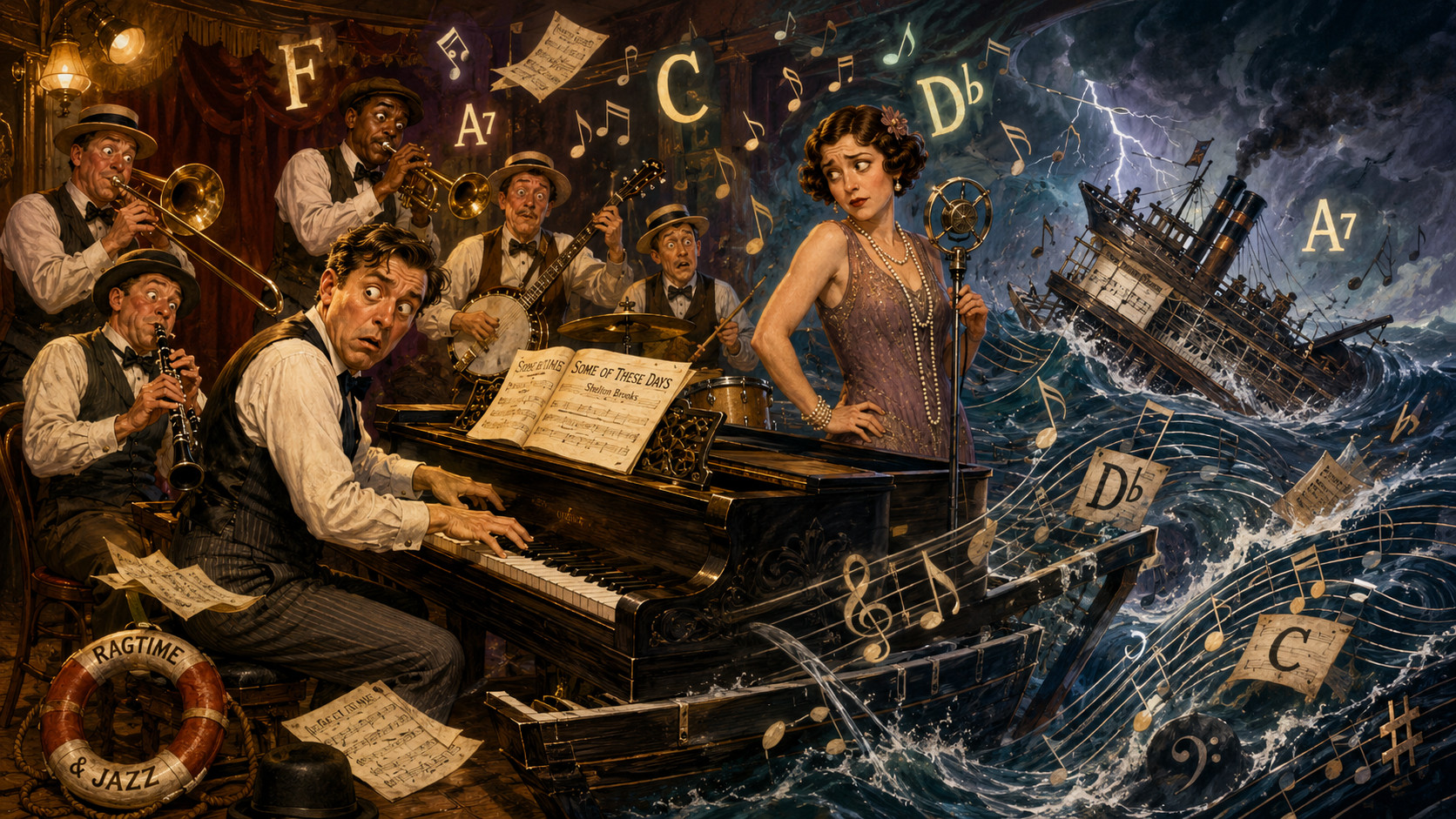

Just how important is the I chord? In its most basic form, the 12-bar blues uses that chord for 50% of the tune. Of course there are endless variations, but harmonically, a pure 12-bar blues starts on a (harmonic) home base and briefly deviates twice from it before finishing back where it started. The harmonic simplicity is as much a reason for the continued popularity of the blues as are the lyrics or performance styles.
To recap, all tunes of the Ragtime and Early Jazz eras either follow a well-known chord progression, or contain a surprise harmony or two to set themselves apart. Learn these chord progressions, keep track of any deviations thereof, and you are set.
…Except…
There will always be a handful of tunes that defy expectation, that have NO reason to work, but somehow do. One such song (that I couldn’t wrap my head around for the first six years I was playing professionally) was written in 1910 by Shelton Brooks. “Some Of These Days” is harmonically one of the weirdest tunes ever written! Please be patient, I’m going to get a bit more technical for a short period. The I chord, as a destination point, is only heard at the very end of the piece!! Thus, the only moment of “rest” in the entire 32-bar tune is in the final two bars. Unprecedented and never repeated. Brooks was a genius.
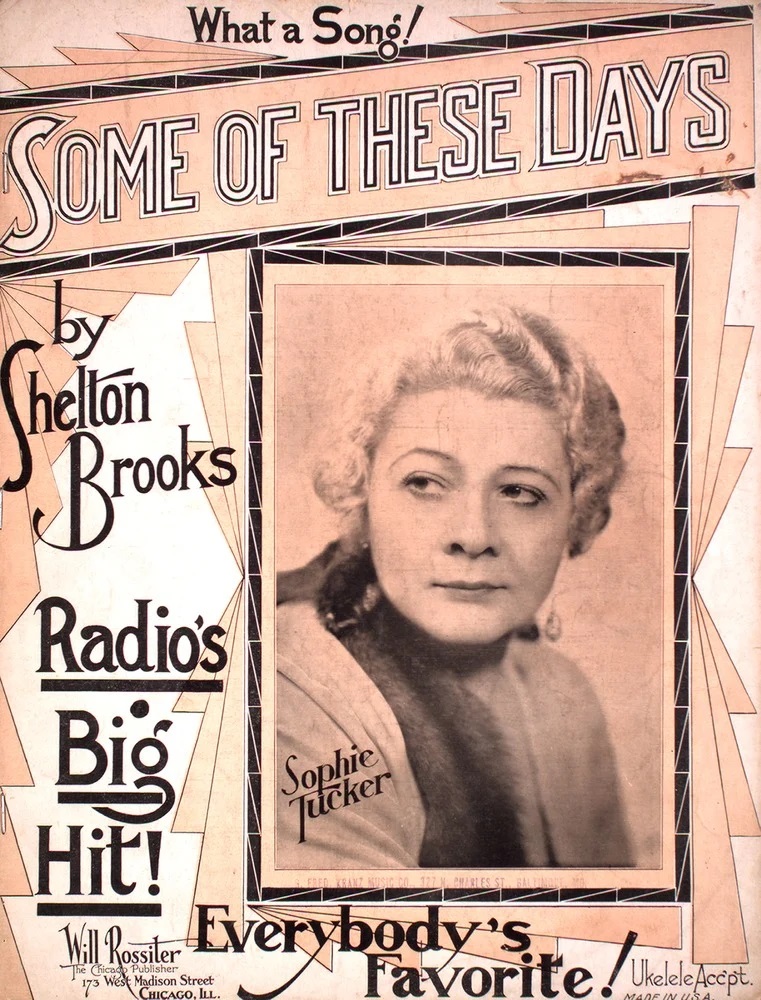 “Some Of These Days” is a dangerous tune to change keys in during the middle of a performance. For non-musicians, “changing keys” indicates going to a new “place of rest” with a new I chord. Bands love to change keys on the final out chorus of simple tunes (let’s use “Bill Bailey” yet again), typically moving upward. So a band might move from the keys of F to G or Ab on the final ensemble chorus. Some more adventurous bands even change keys from solo to solo. Tunes that start on the I chord are the safest on which to change keys (the musical term is “modulate”). Modulating during “Some of These Days” is foolhardy.
Yet, that’s just what I had to do a couple of months ago when my wife Anne came up to join the Galvanized Jazz Band (I was subbing for now regular member Charlie Freeman) and sing that very song. Why did I have to modulate? A brain-fart, perhaps. Or maybe it’s because I played it in the standard band key of F the week before at the Monterey Jazz Bash when presenting with the South Frisco Tribute Band. Or maybe I was still thinking about the wake I’d attended earlier that day for my friend, the leader of the GJB, cornetist Freddy Vigorito. At any rate, knowing full well Anne sings the tune in either C or Db (depending on the skill level of the accompanists, Db being much trickier to navigate), I called out the starting chord for the tune to be played in F (the first chord when you play it in F is A7). And the band happily launched into the number in the key of F.
Anne unhappily (but really remarkably well) sang the tune much higher than usual and turned around to glare at me during the trombone solo. I assured her I’d fix things. And boy, did I! I called the next solo for myself and indicated it would be an unaccompanied piano solo. “Great,” I thought. “I can get this thing turned around to her key.” By now I was so flustered I didn’t bother with a transition. I just slammed into the new key (Instant oatmeal? Instant modulation!!) so abruptly, the band literally jumped in the air. But now I knew we were safe, because I had wrenched us from the key of F to the key of C (should’ve have aimed for Db…you musicians know why).
Remember I said that the cushy, restful I chord never shows up until the very end of this tune? This fact felled the soloists following Anne’s vocal (each one of them an extremely accomplished and experienced musician). They floundered around trying to find a harmonic lifesaver to keep from drowning and they each ended their solos back in the key of F. One even turned to me in the middle of his solo and asked “Are we in C???” Another turned to Anne and said, “Oh, so that’s where you wanted it!”

Anne fearlessly returned to sing the final chorus and we did, by heaven, all crash firmly onto the shore of the final C chord we’d been steering toward since my brutish key change. It was the biggest musical shipwreck I’d been in in decades.
Everyone forgave me, and trombonist Jim Fryer had a good chuckle out in the parking lot at the end of the gig, extolling the virtues of bringing an element of Charles Ives to Traditional Jazz. I told him I’d planned it all along.
By some miraculous boon, my wife still loves me. She knows that all she needs to do to win an argument—of any sort—over the next several years, is say “Remember ‘Some Of These Days’?” And I’ll reply, “Every one of these days and for all the rest of them.”

Chord Progressions can kill you.

Jeff Barnhart is an internationally renowned pianist, vocalist, arranger, bandleader, recording artist, ASCAP composer, educator and entertainer. Visit him online atwww.jeffbarnhart.com. Email: Mysticrag@aol.com