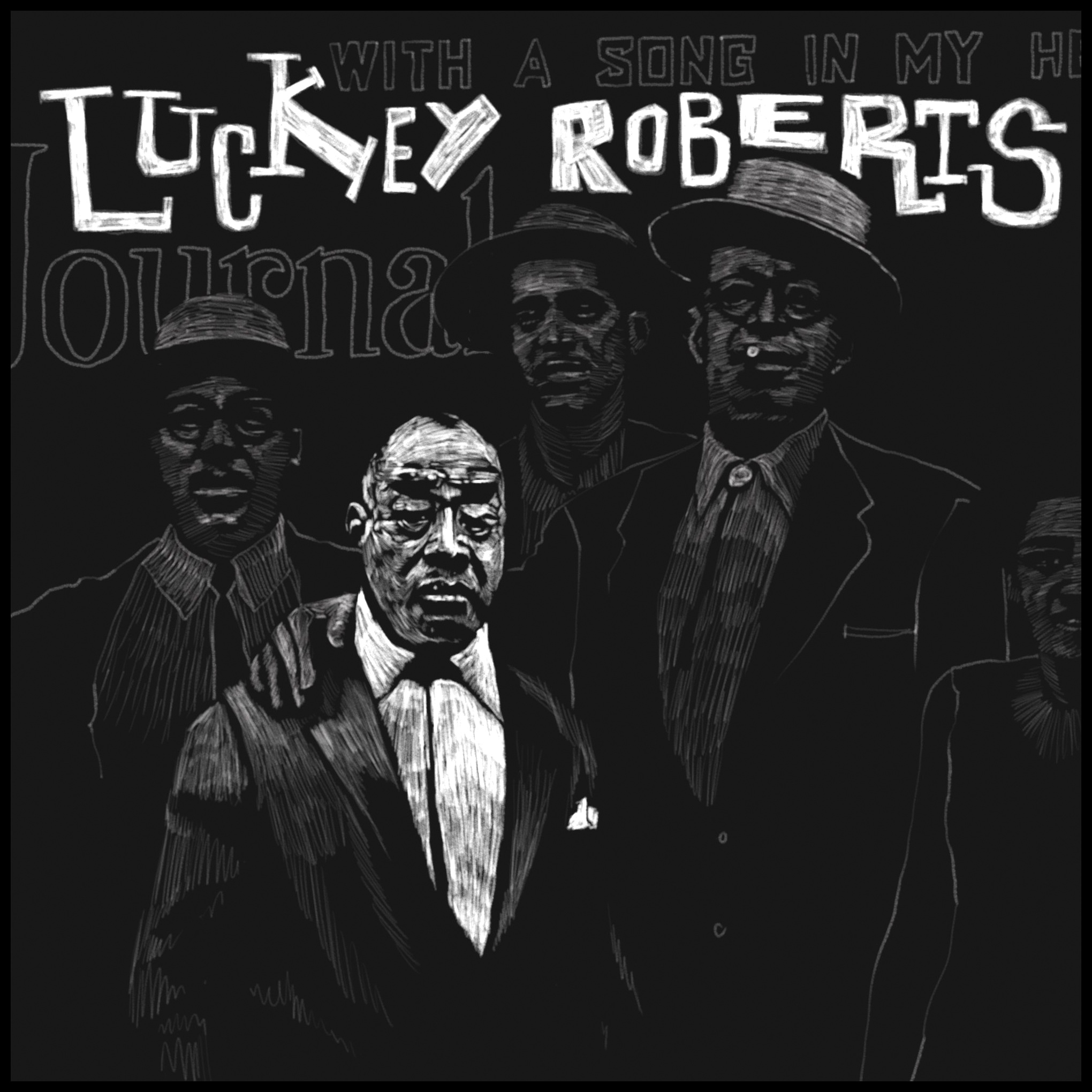
Charles Luckyth Roberts, better known as Luckey Roberts, was born in Philadelphia, Pennsylvania, on August 7, 1887, and was playing piano and acting professionally with traveling Vaudeville and Black minstrel shows in his childhood. His mother died shortly after his birth and his father engaged the Ringolds, a show-business family, to raise him. With the Ringolds influence, he became a lifelong Quaker, teetotaler, and abstainer from tobacco. His first stage performance was as a toddler with a troupe performing Uncle Tom’s Cabin. His vaudeville career began at age 5.
By the age of 7, he had taught himself to play piano, but only in the key of F-sharp, which is based on the black keys. Roberts performed at Billy Williams’ restaurant, in Baltimore, Maryland, in the summer of 1905. During this time he and pianist Eubie Blake, a lifelong friend, collaborated on ideas for piano composition.
Roberts settled in New York City about 1910. He became one of the leading pianists in Harlem and started publishing some of his original rags, including “Nothin’,” “Shoo Fly,” and “Ripples of the Nile.” In 1911, Roberts composed “The Junk Man Rag,” but since he could not yet notate music, he elicited ragtime pianist Artie Matthews’ help to create publishable sheet music.
Roberts next big hit was “Pork and Beans,” recognized as an early example of Stride. In 1913, through the encouragement of Lester Walton, Roberts teamed up with lyricist Alex Rogers to produce Broadway musicals, many of which resulted in subsequent publication of popular sheet music. Roberts successful partnership with Rogers lasted until 1930 when Rogers died.
In 1924, Luckey accepted an elite social-function gig at the Everglades Club in Palm Beach, a resort for New York society “snowbirds.” At the time, he charged about $1,700 for a single engagement, and his musicians were among the highest paid in the profession.

Thirty years after composing “Ripples of the Nile” (1912), Roberts drastically slowed the tempo around 1940 to teach it to a student. Realizing that it sounded good as a ballad, he collaborated with Kim Gannon to add lyrics and published it under a new title, “Moonlight Cocktail.”
Very late in life, Roberts wrote two more musicals: Emalina and Old Golden Brown. Luckey Roberts died in New York City on February 5, 1968. – via Wikipedia