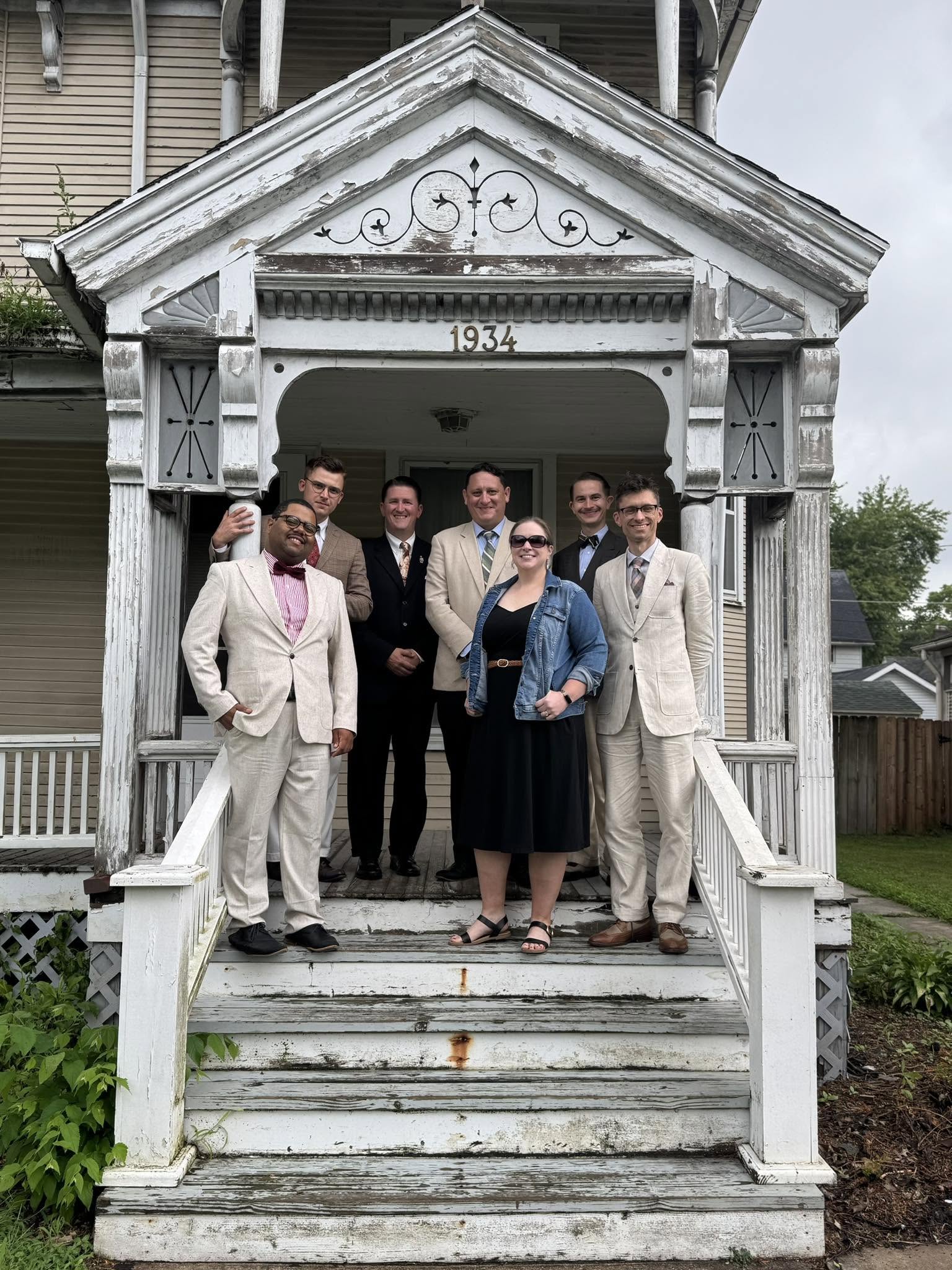
A group of relatively-young musicians who are devotees of the legendary Bix Beiderbecke and his music have banded together to form a legal entity (Bix House Band LLC) and have purchased the Beiderbecke family home at 1934 Grand Avenue in Davenport, Iowa. Plans are underway to make the necessary repairs to restore the house to its Late-Victorian-era condition and to maintain it as a historic base honoring the legacy of one of jazz’s great martyrs and legends.
The seven musicians initially got acquainted and discovered their common interest in Bix while performing at the Bix Festival in Davenport and the Whitley Bay Jazz Party in England. Now joining as owners of the Beiderbecke family home are Josh Duffee, Jenny and Andy Schumm, Colin Hancock, Mike Davis, TJ Muller and Andrew Oliver. (Four of the seven are professional cornet players.) The new owners were able to meet the selling price, so the property has no mortgage.

The nine-room house was built around 1890, and immediate plans call for critical repairs to the property. The roof leaks, the gutters need to be replaced, there has been serious water damage in the interior, the front porch is not safe, and the house has been without utilities for over a year. Raising funds to pay for these repairs is now a top priority.
Introducing the New Owners
There is a small cadre of Bixophiles throughout the world who are recognized as authorities on Beiderbecke and who share their research findings, opinions and questions through continuous postings on the Internet. One such individual is my late friend Rich Johnson, a native of the Quad Cities, whom retired college professor Albert Haim called “the world’s expert on anything and everything that pertains to Bix and his family and his life in Davenport.”

Rich took a young Josh Duffee under his wing and instilled in him great knowledge and love for Bix Beiderbecke. As a teenager, Josh toured the Beiderbecke home and met people like Les Swanson who was a childhood pal of Bix’s. For the past 25 years, Josh has called attention to the deteriorating condition of the house. During Covid, he did a live broadcast from the porch of the home, playing 78rpm records of Bix’s music. Over the years, he would regularly visit the gravesite in Oakdale Cemetery on the anniversaries of Bix’s birth and death. When the house finally went on the market in mid-2026, Josh along with Andy Schumm and Andrew Oliver issued a call to action to those interested in preserving Bix’s childhood home for future generations.
Andy Schumm found a true passion for jazz while studying at the University of Illinois. “My college experience was like living in the perfect world and learning so much about the music and just practicing,” he recalled. What sold him on 1920s jazz was hearing a Bix Beiderbecke recording: At the Jazz Band Ball played on an authentic Victor horn machine. Bix obviously has had a huge influence on Andy, who points out “Bix knew how to lead a band, how to lead with his horn, being able to tell the musicians what they should be doing, and where they should be going. His solos were incredible.” “Beiderbecke” is part of Andy’s email address.
During summer breaks, Andy started sitting in with Dixieland bands and soon discovered he could get more work as a 1920s musician than as a modern player. “When I first started, I was concerned that there might not always be work available playing what some people consider old-time jazz. I was assured that I could always get a $50 gig with a Dixieland band. So playing the older styles of music just sort of fell into my lap, and I’ve never looked back.” He now leads the Chicago Cellar Boys that can be heard every Tuesday at the Green Mill Cocktail Lounge in the Windy City.
Jenny Vidal Schumm is Andy’s wife, and her musical instrument is the oboe. Her role has been to handle much of the paperwork and legal matters during the sales transaction. Colin Hancock noted that Bix was the reason he got into music in the first place. Mike Davis has similarly commented: “Bix’s music has been my main artistic influence since I started studying and playing the music of the Jazz Age that means so much to so many people around the world.
Born in England, T.J. Muller first began performing early jazz styles with his family band. Moving to the United States in 2013 and now living in St. Louis, Missouri, T.J is known for his charismatic approach to early jazz, energetic performances and passion for sharing the stories and history behind the music. Andrew Oliver is a pianist, composer and occasional trumpeter from Portland Oregon. From 2002 to 2005, he lived in New Orleans and majored in jazz at Loyola University. A Morton specialist, he has recorded all of Jelly Roll’s known compositions on the YouTube channel.

Bix’s life story
Leon Bismark Beiderbecke, nicknamed Bix, was born in this house on March 10, 1903. His father, Bismark Herman Beiderbecke, was a son of German immigrants and was the owner of East Davenport Lumber and Coal Company. His mother, Agatha, was the daughter of a riverboat pilot and was the organist at First Presbyterian Church. Bix learned to play the piano by ear in the family home and possessed a brilliant musical memory. By the age of three he could play simple melodies. The Davenport Democrat published an article about his musical accomplishments when he was six years old
As he grew older, he would go down to the Mississippi River to listen to jazz being played on the riverboats. His older brother Charles brought home record albums when he returned from serving in World War I that featured the music of the Original Dixieland Jazz Band. Bix was drawn to the sound of the band’s trumpet player, Nick LaRocca. He bought a second-hand cornet when he was 15 and would slow down the turntable on his record player and learn the trumpet lines note-by-note. He never mastered fluent sight-reading, which sometimes created challenges fitting into strict big band arrangement setups that required reading complex written scores.

Except for a brief period in the early 1920s when he returned home to work for his father, Bix lived the rest of his life away from Davenport as a professional musician playing in jazz bands, most notably the Jean Goldkette and Paul Whiteman orchestras.
Bix had a severe, lifelong problem with alcoholism, especially the heavy consumption of bootleg liquor during Prohibition, which ruined his health. He began drinking heavily in his late teens, and it worsened due to the stress of constant touring with bands. His alcohol abuse led to physical exhaustion, a dramatic collapse on stage in 1928, and a complete nervous breakdown in 1929. Failed attempts at rehabilitation could not stop his physical decline, and he died in Queens, New York in 1931 at the age of 28 from the combined effects of alcoholism and lobar pneumonia.
Why the fascination with Bix?

Fellow TST writer Scott Yanow wrote a long article for this publication a little over a year ago covering Bix’s life in which he offered his thoughts on understanding the Beiderbecke mystique.
“A legend among many musicians and fans even during his relatively brief life, Bix Beiderbecke was jazz’s first cult figure. After his passing in 1931 at the age of 28, Beiderbecke’s fame grew steadily through the decades. Every known aspect of his life has been analyzed, and those “in the know” have savored every note that he recorded.
“During an era when many other trumpeters and cornetists either used staccato phrasing (which went out of vogue by 1925), tonal distortions, or thought that playing hot meant shooting out a lot of notes, Bix displayed a beautiful tone, relaxed phrasing and his own logic in creating his solos. Eddie Condon once described Bix’s sound as “like a girl saying yes.” No cornetist prior to the arrival of Bix on records in 1924 sounded like him. In addition, Beiderbecke’s ideas were often so advanced that they still sound fresh today, unlike the solos of many of his contemporaries. His four piano compositions, including In A Mist, are still considered a bit futuristic nearly a century later.
“Beiderbecke had a tragically brief life. It is easy to depict him as a true original who seemed to come out of nowhere, like a shooting star, burning out before he was truly appreciated. Another reason that Bix became a major cult figure is that he was the first white jazz player to be roundly-celebrated by African-American musicians, serving as proof that jazz has no racial restrictions when it comes to creativity.
“And beyond all of this, there is his unique name – Bix. It was a family name that his father, grandfather and older brother were also called, although it really stuck to the cornetist. But most of all, there was the romantic quality of his life and times, even if it was not quite as simple as the stereotype.
Record producer George Avakian had this to say: “Bix Beiderbecke was everything! There will never again be a jazz musician whose range encompassed both melodic improvisation of the most subline richness along with a fiery leadership of every ensemble in which he ever played.”
In the opinion of jazz impresario and Newport Jazz Festival founder George Wein: “Bix Beiderbecke was the stuff from which legends are born. He was the king of his genre of jazz who had a unique voice on the cornet and influenced everyone in his orbit. He was a master who died too young.”
Recognition and Honors
Bix Beiberbecke has been inducted into at least nine Halls of Fame that I could identify. His 1927 recordings of Singin’ the Blues and In a Mist are in the Grammy Hall of Fame as is his 1930 Georgia on My Mind recording with Hoagy Carmichael and his orchestra. The 1927 Singin’ the Blues recording with Frank Trumbauer and Eddie Lang was also placed on the U.S. Library of Congress National Recording Registry.
The Bix Beiderbecke Memorial Society was established in 1971, and the Bix Festival was launched a year later. A statute of Bix graces LeClaire Park on the banks of the Mississippi River at 400 West Beiderbecke Drive in downtown Davenport. Asteroid #23457 was named after Bix in 1989.
The Bix Beiderbecke Museum & Archives was opened in 2017 and is now located at 112 West 2nd Street, Davenport. It was established as a non-profit organization for the purpose of collecting, preserving and exhibiting material related to the life and career of the legendary cornetist who was a native of Davenport.
The cornerstone of the Museum is a collection of material from the Beiderbecke family obtained from Elizabeth Beiderbecke Hart and her brother Chris that include photos of Bix as a youth (some that had never been seen before), letters he wrote to his family, and documents pertaining to his early years in Davenport, supplemented by collections compiled by Philip R. Evans, co-author of Bix: Man & Legend, in conjunction with George Johnson, tenor saxophonist with The Original Wolverines.
Among the major exhibits on display at the Museum are Bix’s horn, the last piano he owned, a replica of the Hudson Lake Resort stage in New Castle, Indiana, where Bix played in the summer of 1926, and instruments owned by Frank Trumbauer, Bill Rank, Eddie Condon, Pee Wee Russell, Chauncey Morehouse, Red Nichols, Miff Mole and Spiegle Willcox, all of whom had some association with Bix.
And jazz fans around the world echo that familiar chant: BIX LIVES!
Lew Shaw started writing about music as the publicist for the famous Berkshire Music Barn in the 1960s. He joined the West Coast Rag in 1989 and has been a guiding light to this paper through the two name changes since then as we grew to become The Syncopated Times. 47 of his profiles of today's top musicians are collected in Jazz Beat: Notes on Classic Jazz.Volume two, Jazz Beat Encore: More Notes on Classic Jazz contains 43 more! Lew taps his extensive network of connections and friends throughout the traditional jazz world to bring us his Jazz Jottings column every month.