 In my review of Richard Ekins’ 2024 book The Genesis and Exodus of Preservation Hall: The Ken Grayson Mills Story (The Syncopated Times, Jan. 2025), I ended by saying,
In closing the final chapter of the book, Ekins alludes to “a forthcoming companion volume, The Birthing of Preservation Hall: the Barbara Glancey Reid Story.” Such a volume would be welcome: Reid’s role, fully limned, deserves an accurate telling to complete the entire story.
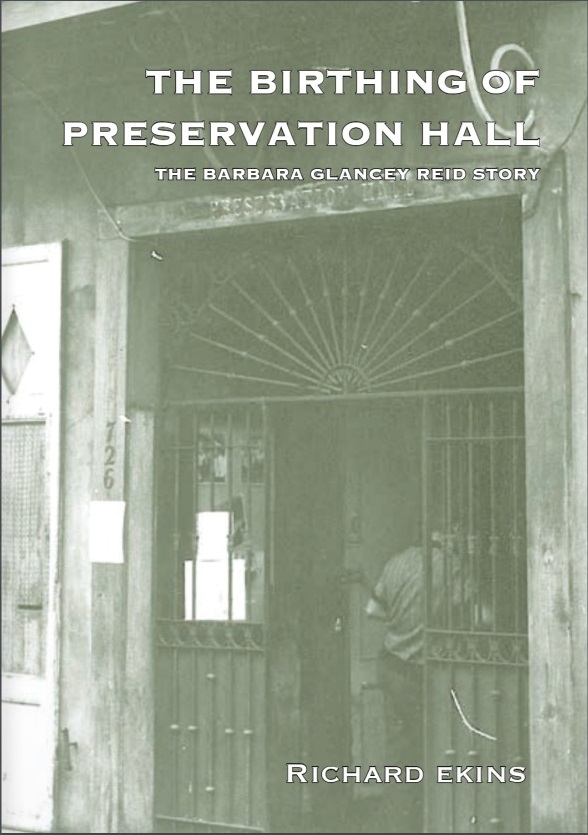
That companion book is now (2026) available. Like the previous Ekins volume, it appeared first as a series of twenty-one articles in the magazine Just Jazz (between July 2018 and May 2021), all of them gathered together now as a whole under the title given above.
Ken Mills and Barbara Reid co-founded Preservation Hall in 1961, but as Ekins avers, the initial idea was Reid’s. He concurs with Alden Ashforth when Ashforth says Reid “first conceived of the idea of what became Preservation Hall.” Mills was the one who brought the idea to fruition, but both he and Reid were joint architects.
While there is a dearth of biographical data on Reid, Ekins carefully researches what appears to be most of the existing material, and he further corresponds with and consults Reid’s second daughter, the late Kelley Edmiston, to fill whatever gaps she can. Ekins keeps his focus on Reid’s relationship to the music and the musicians, showing she was a devout fan of both the New Orleans revivalist musicians and the jazz they played.

Reid was something of a bohemian altogether, having left her first husband, Bill Reid, and their two children to go to New Orleans to follow her muse, although she admitted to some pangs of remorse initially, missing the children. Her second husband, Bill Edmiston—and second daughter with him—did not suffer any similar deserting, although neither of them seemed to share her musical passion—at least to the same degree.
Along the way Ekins limns Reid’s and Mills’ contributions, paying just a little more attention to that of Reid since the Mills had had his own apologia earlier. And throughout Ekins constantly deplores the “hijacking” of the Hall’s founding story by the Jaffes and others that simply erased Reid’s and Mills’ part, showing how unremitting the lie regarding the founding is.
Ekins covers Reid’s life and activities in Chicago prior to her going to New Orleans, aided by correspondence between Reid and Bill Russell in some approximately forty letters that he presents with occasional commentary on the content of some. In the early 1950s, Reid had been Russell’s assistant when both were in Chicago: she worked with Russell as he issued records on his American Music label.
Ekins also had access to Kelley Edmiston’s archive of materials on her mother, Reid, “the vast bulk of the material [being] relevant to Barbara’s time in New Orleans.” Edmiston’s archive also contained some excellent photographs from that period, most previously unpublished. So what we get is, in addition to information on Reid’s activities, a glimpse of the musical activities and musicians playing in New Orleans at the time. Ekins—and we—are indebted to Edmiston for much of what we know about Reid. It is fortunate for us that Ekins had been given access to Edmiston’s archive and had finished working with it before her sad death: “Kelley died in a tragic accident [having fallen down concrete stairs where she lived] just as we had completed our project in January 2021.”
There was a reconciliation of sorts in the mid 1960s with all parties involved in the creation of Preservation Hall as Reid, Borenstein, and the Jaffes went some way towards “burying the hatchet,” clearing the way for Preservation Hall’s ultimately being made available for a memorial for Reid on her death in 1983. Ekins opines plausibly as to what led up to this reconciliation, noting that with it,

Characteristically, [Reid] wanted to take her vision of Preservation Hall further and add to it food, drink, and dancing while emphasizing, as she always did, the family-friendly nature of her proposed enterprise.
During the period leading up to the rapprochement, Reid had been holding “jam sessions” at her home, featuring the New Orleans musicians and their music that she loved. All of this Ekins delivers, further delineating the bohemian character that he is convinced was Reid’s.
Reid’s involvement with Bill Russell and others such as Mahalia Jackson also provides a window into what Reid was like, and Ekins does not hesitate to take it up. Reid’s observations on such fabled venues as Luthjens, Mama Lou’s, and Happy Landing are both informative and very entertaining. Mention should also be made of the marvelous photographs by Lyle Bongé of the many revivalist musicians and other persons in Reid’s life, all of which were new to me.

As well as indentifying them, Ekins also supplies a brief biological statement on each. One of the book’s chapters is devoted to George Lewis, including many intimate photographs of Lewis and his family, all previously unpublished.
In several chapters Ekins documents the history of the process of the permitting and establishing legal recognition of Preservation Hall and Reid’s part in that. It was a process that was bedeviled with problems, many of which could have torpedoed the project as they were being resolved. Copies of several of these documents are reproduced. Ekins also takes up the subject of the first filming done at the Hall, under Reid and Mills’ aegis, making the case it was for television: “another ‘first’ for Preservation Hall; another ‘first’ for Ken Mills and Barbara Reid.”
Following Mills and Reid’s ouster from Preservation Hall, Reid became involved in other music projects, such as joining Mills again in the running of Icon (later Perseverance) Hall) when Mills returned to New Orleans to run his new ‘Kitty’ Hall between February and September 1962, and holding revivalist “jam sessions” for the musicians at her house. In true bohemian fashion, she also devoted much time and effort into studying and researching voodoo, visiting Marie Laveau’s tomb and making a “wish” there.
As part of his on-going research into Reid’s life, Ekins devotes a chapter to her involvement with the Bourbon House in New Orleans “[which] must have exceeded her every dream in terms of her identification with bohemian spaces and places.” It was frequented by such icons as playwright Tennessee Williams and detective fiction writer Erle Stanley Gardner, and a number of others, it seems, and many locals of a maverick bent. Among them were Larry Borenstein, Barbara Reid, and Dick Allen, and reputedly their conversations there had led to the concerts at Borenstein’s art gallery that, in turn, led to the establishment of Preservation Hall.
When the closure of the Bourbon House was announced, the regulars were devastated, including Barbara Reid, who was “beside herself with anger,” according to Ekins. It was only fitting, they decided, that there be a New Orleans Funeral for the establishment in which bohemian Reid played a prominent part. As artist Rolland Golden Golden informs us,
Barbara (the witch) Reid was the ‘corpse’ of the House, and properly so, I thought. Dressed in black, she lay in the open coffin, and crossed her chest. A traditional brass band [the Olympia Brass Band] was there and began playing the slow, soulful music of the dirge. With the open coffin being carried by ‘pallbearers,’ the band led the procession through the quarter, ending up in front of the St. Louis Cathedral. I don’t know how many followers there were, but the crowd, filling the street, was almost a block long . . . .
Included is a fine selection of photographs of the event taken by an unknown photographer, including a snapshot of Reid in the coffin, all from Kelley Edmiston’s collection,.
Part also of Reid’s life was an involvement in politics where, as stated above, she ran (unsuccessfully) for New Orleans City Council. She was also connected to the Jim Garrison Investigation of the Assassination of President Kennedy in 1963. And there were other cases where she was linked to the Hells’ Angels and to a drug bust. She also joined a counterculture religious cult called The Process Church of the Final Judgment, and she was one of the first members of the New Orleans branch of the Discordian Society, claiming to be the reincarnation of Eris, the Greek goddess of discord and strife. While Ekins does not go into most of these alternate activities as they have little bearing on her musical pursuits, they do serve to underscore what a fascinating, colorful (at least) character she was.
This study provides a convincing case for Barbara Reid’s being the initiator of the idea of Preservation Hall, well before the Hall’s actual creation; almost equally importantly, it argues for her role in sustaining revivalist New Orleans jazz almost to her demise in 1983. One would hope it will contribute to ending her being ignored in the founding of Preservation Hall and to promulgating her role in the survival of revivalist New Orleans jazz.
The book is not in the conventional book form, hardbound or paperback, but rather as a PDF file. It is downloadable at no cost at two locations. The first provides a “scrolling” experience at tinyurl.com/BarbaraGlanceyReid. The second, tinyurl.com/BarbaraGlanceyReidflip, is a “flipping” experience where one “turns” the pages by clicking on left and right arrows.
The Birthing of Preservation Hall:
The Barbara Glancey Reid Story
by Richard Ekins
London: La Croix Publications, 2026
(in association with Just Jazz Magazine, Ltd.)
www.lacroixrecords.com
Born in Dundee, Scotland, Bert Thompson came to the U.S. in 1956. After a two-year stint playing drums with the 101 st Airborne Division Band and making a number of parachute drops, he returned to civilian life in San Francisco, matriculating at San Francisco State University where he earned a B.A. and an M.A. He went on to matriculate at University of Oregon, where he earned a D.A. and a Ph.D., all of his degrees in English. Now retired, he is a professor emeritus of English at City College of San Francisco. He is also a retired traditional jazz drummer, having played with a number of San Francisco Bay Area bands, including And That’s Jazz, Professor Plum’s Jazz, the Jelly Roll Jazz Band, Mission Gold Jazz Band, and the Zenith New Orleans Parade band; he also played with some further afield, including Gremoli (Long Beach, CA) and the Phoenix Jazzers (Vancouver, B.C.) Today he reviews traditional jazz CDs and writes occasional articles for several publications.