What do you call three super-talented pianists and two grand pianos on the stage at a sold-out concert?
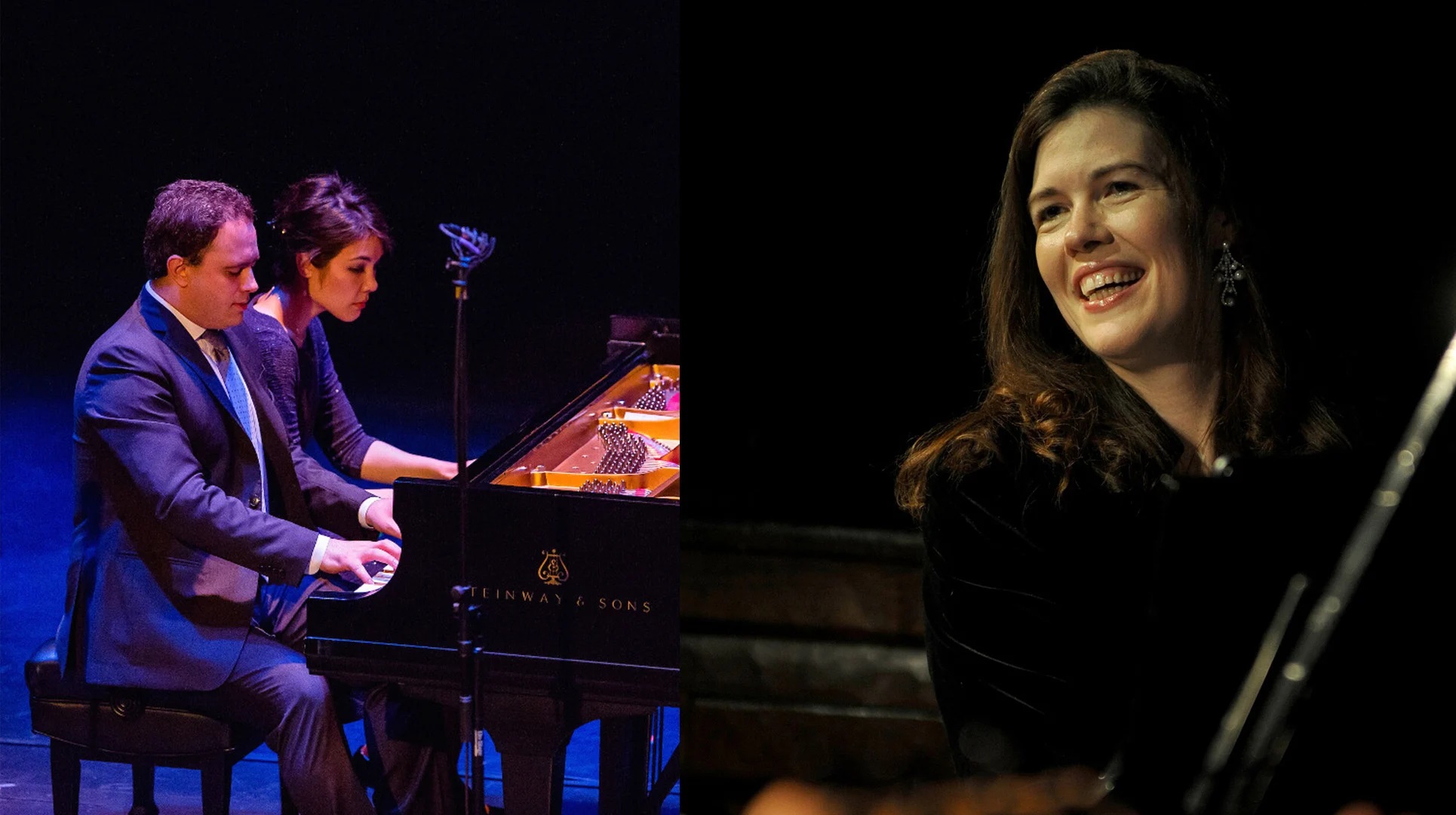
“SIX HANDS, TWO PIANOS featuring Stephanie Trick, Nicole Pesce, and Paolo Alderighi” – who delight in presenting high-energy arrangements of classic jazz, swing, ragtime, blues and the Great American Songbook tunes while demonstrating complex coordination across two grand pianos.”
Stephanie Trick is a leading stride piano virtuoso whose style is reminiscent of James P. Johnson and Fats Waller. Paolo Alderighi, one of Italy’s foremost jazz pianists, is more swing-oriented similar to Erroll Garner. They met at a jazz festival in Switzerland in 2008. Three years later as a married couple, they collaborated on a four-hands piano project dedicated to classic jazz popular in the years from 1910 to 1950.
Their dedication to jazz and the repertoire of early American popular music is accompanied in equal measure by a desire to share its rich history. Blending impeccable technique with mature musicality, this piano duo has performed across the United States, Asia and Australia, at some of the world’s top venues and festivals, winning the acclaim of critics and fans alike.
Keyboardist-composer-arranger Nicole Pesce entertains audiences with a unique blend of virtuosity, humor and pizzazz. For more than a decade, she was the headlining pianist at the Ritz Carlton Hotel in Phoenix, entertaining patrons with a repertoire that spanned from Bach to Lady Gaga.

The threesome began playing together in 2016 and have spent many hours rehearsing and integrating their respective styles. According to Paolo who does most of the arranging, “Nicole picks up things on the fly and adds a dimension to what we do. In simple terms, Stephanie plays the melody, I am the accompanist, and Nicole adds embellishment to our treatment whatever we are playing.”
Stephanie Trick
Stephanie Trick began the way most young music students do, learning the scales and simple classical pieces to become familiar with the piano. But she quickly separated herself from other students and challenged her teacher for more advanced exercises. At the age of 10, she was introduced to ragtime, and when she was in junior high school she took first place for three years in the St. Louis Friends of Scott Joplin competition. When she was given the sheet music for Carolina Shout, one of James P. Johnson’s signature pieces. she was immediately hooked and knew she wanted to play more of this music.
Phil Flanigan, who was the bass player in Stephanie’s trio at the 2012 Sacramento Music Festival, was quite expansive when asked his assessment of this talented young lady, saying “I don’t know how one acquires such things, but from the very first bars of hearing her play, you can tell this is one serious believer, a true and faithful Harlem stride pianist. Steph’s playing leaves you thinking you’re in a speakeasy on 138th Street.
“Yet you look and don’t see a grizzled old, cigar-chomping saloon dweller at the piano. You see Stephanie Trick, an unassuming young lady from St. Louis. What you hear is the authentic feel of the music which I attribute to her slavish devotion to playing the piano as well as the incredible daily discipline it takes to emulate the old Harlem stride pianists.”
Flanigan concluded, “Without question, Stephanie makes any listening experience way beyond just worthwhile. If I ran this country, I’d immediately assign her National Treasure status and promote her as an example of the best of American culture.”
Paolo Alderighi
When asked for his first impression on meeting Stephanie Trick in 2008 at a festival in Switzerland, Paolo Alderighi responded without hesitation, “I was totally blown away. Here was this attractive young girl who played stride piano and liked Fats Waller. What more could you want.”
Paolo’s father is an amateur jazz musician who still enjoys playing the double bass, banjo or harmonica, and Paolo has an older brother who plays the clarinet. So he grew up listening to a lot of classic jazz. At 16, he joined the Chicago-style Milano Jazz Gang. In 2000, he received his degree in music and piano from the G. Verdi Conservatory of Milan and then completed a five-year graduate program in economics for the arts, culture and media at Bocconi University, which is also located in his hometown of Milan, Italy.
In 2004, he won a prize as the best young musician at the Breda Festival in The Netherlands, which led to the first of five appearances at the Kobe Jazz Festival. It was at this point that it became obvious that Paolo’s future career would be as a professional jazz pianist
Stephanie and Paolo maintain an apartment in Milan, Italy and one in Stephanie’s hometown of St. Louis, where her mother still lives. They admit the travel is intense, spending half of their time in the United States, and half in Europe, a schedule that involves six or seven trans-Atlantic trips in the course of a year.

Eighty-five percent of their performances are currently joint appearances. “You get used to being constantly on the move,” Paolo acknowledges, “but the important thing is that Stephanie and I are together. We don’t have a particular routine, and every day is different. We practice as much as we can, and are always working on new arrangements. During the months of February and May, I teach a History of Music course at Bocconi University.”
Nicole Pesce
Beginning at the age of seven, Nicole was classically-trained by her late father who worked with artists such as Liberace and Lennie Tristano. It wasn’t long before she broadened her repertoire to include jazz, blues, country, Latin and Broadway show tunes while learning 100 songs. At 10, she had memorized 500 tunes and won the Discovery National Television Competition. Shortly after, she landed a steady gig at the prestigious Phoenician Resort in Phoenix, becoming the youngest pianist ever hired to play for “high tea.”
She began composing at age 11 and has since written 300 songs, including being commissioned to write the title track for a CD and documentary produced by the Susan Koman Breast Cancer Foundation. Her Symphony in D Major is a favorite, although Nicole is seldom completely satisfied with her work, calling it “in a perpetual state of evolution.”
Sixty million television viewers saw her on the Jerry Lewis MDA Telethon when she was 12, which led to an extensive tour of the United States with the legendary comedian and a 16-piece orchestra. At 13, she had a year-long residency in Las Vegas where she performed on stage with stars like Debbie Reynolds, Rich Little, Buddy Greco and Pat Boone. She has performed for two presidents of the United States as well as the Moscow Ballet. Her “Happy Birthday Variations” video has had nearly three million views on YouTube and over seven million “shares” on Facebook.
Returning to her home town of Phoenix, Arizona, she built up a cult-following for seven years at a local café and held forth for 15 years for afternoon tea at the Ritz Carlton Hotel. She will on occasion play three keyboards when performing: a Yamaha Disklavier with a small electric keyboard atop it, plus a full-size synthesizer behind her bench.
Oscar Peterson, Art Tatum and George Shearing are among her jazz role models, while she also gives kudos to contemporary classical masters like Olga Kern of Russia and Lang Lang of China. Always looking to improve, she has taken on-line courses on composing, arranging and theory from the Berklee College of Music, saying “a song has to have some kind of harmonic structure to work on the piano.” She briefly taught piano, keyboard organ and accordion, has degrees in computer science and information systems, and is certified as a web designer.
She will invite her audience to suggest tune titles and will then play a non-stop medley of seven or eight songs ranging from a Beatles favorite to a Rachmaninoff masterpiece to Rodgers & Hart. Drawing on the inventory of the 12,000 songs she has memorized, she bounces easily from jazz to pop to classical, be it Rimsky-Korsakov’s Flight of the Bumble Bee to Slim & Slam’s 1938 hit, Flat Foot Floogie, prompting one publication to refer to her as “the human iPod.”
Banjo Hall of Fame Inductees
Two familiar names—Howard Alden and Bill Dendle—are among the 2026 inductees into the American Banjo Museum Hall of Fame. These individuals will be officially received into the Hall of Fame during the Museum’s big Banjo Fest weekend, October 8-10 in Oklahoma City. Artists are chosen each year from six different categories to ensure that all areas of banjo music are represented, including the earliest days of recorded music in the United States.
Howard Alden was cited in the Five-String Performance category, and his citation reads as follows: “Although internationally recognized as a jazz guitar master, Howard Alden began his musical career in the 1960s playing the tenor banjo and has recently returned to his banjo roots. As a young banjoist with an innate musical curiosity and uncanny sense of swing, Alden was ultimately attracted to the broader musical range and jazz acceptability of the guitar, lending his immense talents to concerts, recordings and major Hollywood film soundtracks. However, recent years have seen him apply his decades of jazz study and musical maturity to the tenor banjo, elevating the instrument to new heights of acceptance in the jazz genre.”
Education and Innovation were the basis for Dendle’s selection. “In addition to being a masterful banjoist, musician and entertainer, Bill Dendle remains a tireless and world-renowned advocate of jazz education for young musicians. Subsequent to a performance career which saw him entertain at Mickey Finn’s in San Diego, Capone’s Warehouse in Monterey, California and The Empress Lillyat Walt Disney World in Florida, Dendle has taught thousands of aspiring jazz musicians at camps and festivals around the country in his role as a respected educator. Most notably, his leadership role of the Sacramento JazzCamp is credited with the city remaining a center for traditional jazz activity, as well as the banjo’s role in jazz being brought to the attention of mainstream jazz educators worldwide.
Banjomania, a unique performing group formed in 1984 that included HOF banjoists Doug Mattocks and Brad Roth, is another 2026 inductee.
In addition to housing the Hall of Fame, the American Banjo Museum features a wealth of exhibits, including more than 400 banjos of every sort, sheet music, and other collections of interest to banjo fans and players.
Lew Shaw started writing about music as the publicist for the famous Berkshire Music Barn in the 1960s. He joined the West Coast Rag in 1989 and has been a guiding light to this paper through the two name changes since then as we grew to become The Syncopated Times. 47 of his profiles of today's top musicians are collected in Jazz Beat: Notes on Classic Jazz.Volume two, Jazz Beat Encore: More Notes on Classic Jazz contains 43 more! Lew taps his extensive network of connections and friends throughout the traditional jazz world to bring us his Jazz Jottings column every month.