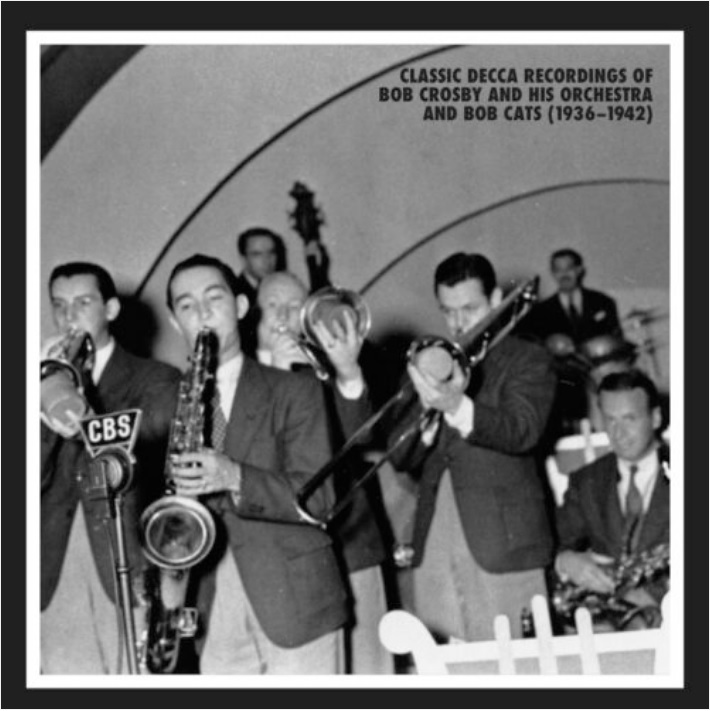
 A big clue to understanding this band lies in the fact that Bob Crosby isn’t on the box set’s cover. It’s the first artist-centered Mosaic set I’ve seen where the named talent isn’t pictured, and there’s an excellent reason. Bob Crosby was taken on only as the nominal leader of this group. He couldn’t read music, couldn’t wield a baton, and couldn’t sing as well as his brother Bing. But he was a radio performer with an easygoing stage presence, and the band members figured he wouldn’t get in their way. They were right. Incredibly, most remained happy with this arrangement.
The well-known backstory bears repeating due to its comic improbability. Ben Pollack led a hugely successful band through the 1920s, launching the careers of players like Benny Goodman and Glenn Miller. In the early 1930s, Pollack fell in love, and his inamorata was a second-string singer named Doris Robbins. He wanted her name to become famous. It did, but only in the context of this story.
His band members resented the attention he gave her and the awful performances she perpetrated, and late in 1934 they staged a mass walkout. They were dubbed “Pollack’s Orphans” in the music press. Many of them moved to Jackson Heights in Queens, to a building where they were able to commandeer the basement as a rehearsal space. They styled themselves as a coöperative and elected reedman Gil Rodin as their leader.
They recorded some undistinguished Brunswick sides in March 1935, calling themselves the Clark-Randall Orchestra. In keeping with the band’s lively sense of humor, there was absolutely no basis for that moniker.
They approached Cork O’Keefe, of the Rockwell-O’Keefe Agency, seeking representation. O’Keefe liked them but believed the band needed a name-known leader. Among his suggestions were the reliably annoying trumpeter Johnny “Scat” Davis, then working with Fred Waring, and 21-year-old Bob Crosby, Bing’s younger brother, who’d been making a name for himself (although always with a nod to his sib) on radio. “I’m the one without Hope,” Bob would later joke.
Bob Haggart, the band’s gifted bass player and composer-arranger, reminisced to early-jazz enthusiast Phil Schaap, “Bob was very congenial, and the guys all liked him right away. Our first night at Roseland, Crosby had never held a baton, didn’t know how to start. He said, ‘What’ll I do?’ ‘Well, you’ve got to beat it off.’ He couldn’t remember the tempos, so (drummer) Ray (Bauduc) said, ‘Don’t worry about it. You just beat it off your way, and we’ll take it away from you right away.’ He beat it off too slow, we’d go right away into the right tempo. Nobody knew the difference.”
That story is quoted in Michael Steinman’s superb liner notes included with the new Mosaic Records six-CD box set Classic Decca Recordings of Bob Crosby and His Orchestra and Bob Cats (1936-1942). And if ever there was a foundational set for your Swing Era collection, this is it. But don’t, if you can go back in time, tell Haggart that I termed it “swing.” He and the founding band members resisted that designation because they resisted the four-beats-to-a-bar rhythm of swing. They came with roots in a two-beats-to-a-bar Dixieland style. Even as Goodman’s sound swept the country in 1935, they doggedly stuck to their own identity. It wasn’t the mannered sound of what by then had become warmed-over Dixieland; it was the sound of early pioneers like Louis Armstrong and Jelly Roll Morton.
A number of the band’s core players, like Bauduc, saxophone wizard Eddie Miller, and guitarist Nappy Lamare, were born and raised in New Orleans and had enthusiastically absorbed the music they grew up amidst, which helped reinforce the band’s musical identity.
To modern ears, the distinction may seem slight, and even back then it was quite flexible. Add to that their record company’s pursuit of hit records—which, at the time, were swing-oriented—and you won’t be surprised to hear a great variety in this collection.
The ensemble signed with Decca (which was also Bing’s home) and made their first recordings there over several sessions in 1935. “The arrangements and performances on most of these early titles are unadventurous and tepid,” wrote John Chilton, a British trumpeter and writer in his definitive 1983 book Stomp Off, Let’s Go: The Story of Bob Crosby’s Bob Cats and Big Band. “(T)heir aim,” he noted, “was to transfer the excitement and flexibility of a small jazz group to a big band line-up,” adding, a few pages later. “The unwritten law of the band was that every arrangement had to swing, and this policy cut out the pretentious over-writing that made so many other bands sound stilted.”

I grew up treasuring a Decca two-LP set offering The Best of Bob Crosby, and all of those cuts are in this Mosaic box, in beautifully restored sound, nestled among many many more tracks I’m delighted to discover. I don’t dispute Steinman’s opinion of the opening number, “Christopher Columbus,” from a session recorded March 19, 1936: “(T)heir well-behaved performance, although perfectly accomplished, is like the BEFORE in a cosmetics advertisement: compare it to the June 12 ‘Pagan Love Song’ to hear why.” I compared it. I understand his point. But it’s still an exciting number thanks to some unexpected mid-chorus half-step-up modulations.
With 144 tracks spread over six CDs, there’s a lot of listening. Every track offers some measure of excitement. The selections come from the years 1936 to 1942 (at which point the band more or less disbanded) and are but a fraction of what the group actually recorded during this time. Decca put a lot of stock in sappy vocals, many featuring Bob’s serviceable but tremulous voice.
Mosaic’s Scott Wenzel explained that he and co-producer Patrick Goodhope “spent an afternoon going through what we thought should be on the set. All of the music is great but we had to draw the line somewhere. Just like our Benny Goodman Columbia and Artie Shaw sets we started with instrumentals and then picked out vocals that had outstanding solos.” He added, “I’m not a Bob Crosby vocal fan but you gotta love a guy who made sure his incredibly talented band got plenty of solo space.”
You’ll get a taste of a few less-sappy vocals in the set, including two by Connee Boswell: “I Met My Waterloo” and “You Can Call It Swing.” But check out “Come Back Sweet Papa” from the next session, still in 1936. It was arranged by Haggart after a 1926 Hot Five recording, and it sold a respectable-enough amount to encourage Decca to let the band indulge itself more often. Haggart loved those Hot Five performances, which also inspired his arrangements of “Savoy Blues” and “Sugar Foot Strut.” And while we’re considering inspirations, check out Dean Kincaide’s Bix-tribute “Royal Garden Blues.”
Ultimately, the band had over forty hits, with three number-ones. And if you’re curious, they’re “In a Little Gypsy Tea Room,” “Whispers in the Dark,” and “Day in Day Out,” the last with a vocal by Helen Ward, but you’ll find none of them here. I’ll mention a few more of those non-inclusions along the way to show that the band made some interesting repertory side-trips.
Pianist Joe Sullivan joined the band in August 1936; shortly afterward, he was diagnosed with tuberculosis and decamped to a California sanitarium for treatment. The band then picked up Bob Zurke from Detroit—“a full-blown eccentric,” writes Chilton, who arrived in a tattered tuxedo, carrying 87 cents, and with no other luggage. “A man whose first thoughts rested on playing the piano and drinking hard liquor, whose next pleasure came from having female company and doing a little pool hustling.” But listen to Zurke on “Gin Mill Blues” and you’ll understand why they put up with him.
As we move into 1937, we get “The Old Spinning Wheel” (a Haggart arrangement), which Steinman calls “the first Crosby masterpiece on record.” It shows the band at its effortless best. Steinman reminds us that it was first recorded by Al Bowlly with the Ray Noble orchestra, but I want to add that it’s also featured in Laurel and Hardy’s 1934 short “Them Thar Hills,” wordlessly sung as the boys naively drink whisky-laced water alongside an equally inebriated Mae Busch.
The Bob Cats, Crosby’s band-within-the-band, were first heard during an April 1937 NBC broadcast. They entered the recording studio that November, laying down six terrific tracks that are included here, as well as some Connee Boswell vocals that aren’t. Eight of the 13 Crosby-band musicians comprised the Bob Cats; on this date, the lineup was trumpeter Yank Lawson, Warren Smith on trombone, Matty Matlock on clarinet (and arranger), tenor sax man Miller also doubling on clarinet, and the rhythm section of Zurke, Lamare, Haggart and Bauduc.
There will be a pride of Bob Cats recordings to follow, but these six are the harbinger, encapsulating all that was innovative and exciting about this more intimate ensemble. They knew their precedents: “Fidgety Feet” pays tribute to the Original Dixieland Jazz Band but with no trace of antiquity, while Zez Confrey’s 1922 novelty “Stumbling” gets new life. And this date gives you more time with the soloists than most of the full-band recordings offer: “Who’s Sorry Now” showcases Zurke’s piano, while “Can’t We Be Friends?” gives us a taste of Miller’s Hawkins-esque ballad work. Writes Steinman, “Would that every band playing ‘traditional jazz’ in this century studied these sides very closely.”
One of the band’s signature numbers, “South Rampart Street Parade,” was written by Bauduc and Haggart on a tablecloth they then had to make off with. It’s an exciting flag-waver, and its three-and-a-half minute length required a 12-inch 78 (backed by the equally compelling Haggart original “Dogtown Blues.” It was popular enough that Decca requested a version that could fit a 10-inch disc, and that one is in this set as well. (You can see a brief version of it performed in a 1938 Vitaphone short that’s on YouTube: tinyurl.com/BobCrosby1938)
The completist in me enjoys Mosaic’s “Complete (Whatever Definition) Sessions of (Name the Artist),” but the “Classic” (meaning “cherry-picked”) sobriquet has brought us collections that otherwise would have been bogged down in dross. This Bob Crosby collection is one of the best. Listen to what roars on by!
There’s Kincaide’s mesmerizing arrangement of Meade Lux Lewis’s “Yancey Special,” itself a tribute to pianist Jimmy Yancey; Haggart’s “Milk Cow Blues,” offering a solo spot to clarinetist Irving Fazola, a new arrival who would make an indelible mark on the band; and Zurke’s snappy “Tea for Two,” not surprisingly giving himself some airtime before Miller eases in. And those are all from one March 1938 session.
One of the band’s most famous numbers is a two-performer novelty, conceived as a time-killer right before a broadcast. The story behind “Big Noise from Winnetka” is detailed in Steinman’s notes and you probably know it already, but the number itself never loses its charm. (Look for a Soundie on YouTube to see how it was done: tinyurl.com/BigNoiseSoundie)
That “Big Noise” recording session, October 14, 1938, also saw Bing stroll into the studio to record a trio of songs with his brother’s band, the first of a few such sessions featuring the siblings. You won’t find them here, but they’re easy enough to hunt down online.
More highlights from this collection include Haggart’s reworking of a hymn from an old Mitchell’s Christian Singers recording. “I’m Prayin’ Humble” was recorded October 19, 1938, during the date that also gave us the two-part flag-waver “Diga Diga Do” and a Haggart original, “I’m Free,” written for the newly arrived young trumpeter Billy Butterfield and later given the lyrics that turned it into “What’s New.” And the next day’s session produced the wistful Fazola feature “My Inspiration.”
Another interesting side-trip: From April 20, 1939, came a quartet of, believe it or not, Shakespeare settings, featuring vocalist Marion Mann doing an admirable job with jazzy versions of “It Was a Lover and His Lass” and “O Mistress Mine,” among others. They’re also not in the set, and probably didn’t deserve to be, but what other band was imaginative enough to try such a thing?
Steinman takes us through the included sessions session by session in his liner notes, unafraid to offer his considered opinions. He can’t hear me arguing against some of those opinions, of course, but at least I get the last word.
By 1940, the band was reaching a peak in popularity, still a cooperative venture, still a comparatively happy bunch. Wartime spelled the end. The final recordings were made in 1942, with a January 27 session that was kind of a “best-of” of the band’s past and present. “Sugar Foot Stomp” salutes Fletcher Henderson; Jelly Roll Morton gets the nod with “King Porter Stomp” and “Milenberg Joys, and the Original Dixieland Jazz Band, the progenitor of so much of the Crosby band’s sound, is honored with “Eccentric” and “Original Dixieland One-Step.”
The final sessions occurred in July 1942, with a series of patriotic numbers saluting branches of the armed services. The following October, wartime restrictions on passenger-train travel spelled the end of touring. Glenn Miller disbanded his group. Rodin and Bauduc enlisted. Eddie Miller took over leading those who were left, while Crosby, finding himself with time on his hands before his stint in the Marines was to start, put together a pick-up group. Both bands (often confusingly) toured through 1943.
Haggart turned down offers to join Tommy Dorsey and Benny Goodman, and went into a new Bob Crosby-led outfit after the war. There was no shortage of post-war freelance work for the others, which included many reunions. Lawson and Haggart had a last hurrah with the World’s Greatest Jazz Band (a name they hated) in the 1970s, whose recordings are in need of a comprehensive reissue.
Would you like another glimpse of Bob Crosby? He was the mystery guest on “What’s My Line” on June 15, 1958. It’s here: tinyurl.com/BobCrosbyWhatsMyLine.
Steinman poses this question: “(I)f you were to ask current enthusiasts to list the memorable American swing bands between 1936 and 1942, the Crosby organizations would be far down the list that began with Miller, Goodman, Dorsey, Basie, Ellington, Lunceford … Why this amnesia?”
But let’s give Chilton the last word: “Arranger Paul Weston commenting on the merits of the group said, ‘The Crosby band was unique in that it was a real family—the men who made up the nucleus were remarkable people as well as musicians.’”
Classic Decca Recordings of
Bob Crosby and His Orchestra
and Bob Cats 1936-42
Mosaic Records #283 (6 CDs)
www.mosaicrecords.com
B.A. Nilsson is a freelance writer and actor who lives in rural New York. His interest in vintage jazz long predates his marriage to a Paul Whiteman relative, and greatly helped in winning her affections.